
Ending a tenancy in Wales looks nothing like it did a few years ago. Since the Renting Homes (Wales) Act 2016 came into force on 1 December 2022, tenants have become contract holders, tenancies have become occupation contracts, and the familiar section 21 route has gone.
The stakes are real. Rent Smart Wales listed 100,422 registered landlords and 213,463 registered properties in May 2026, and every one of those landlords now works under a stricter notice regime.
One missed step can void a notice and restart a six month clock. This guide sets out each notice period, the correct prescribed form and a realistic timeline, so you can plan with confidence.
Key Takeaways
- A no fault section 173 notice needs at least six months’ notice on form RHW16.
- You cannot serve that notice until the contract holder has lived there for six months.
- An unprotected deposit, a missing safety certificate or a late written statement can invalidate a notice.
- Serious rent arrears allow a 14 day notice, while most other breaches need one month.
- From the occupation date, a no fault route usually takes well over a year to complete.
What Changed Under the New Welsh Renting Rules?
The 2016 Act swapped assured shorthold tenancies for standard occupation contracts. Landlords now end most private lets through section 173, giving at least six months, instead of the two months a section 21 notice once required.
Because the vocabulary and the timings differ so sharply from England, start with a plain English explainer on landlord notice to end tenancy Wales rules, then compare it against your own contract and paperwork.
| Before December 2022 | Since December 2022 |
|---|---|
| Tenant | Contract holder |
| Tenancy agreement | Occupation contract with a written statement |
| Assured shorthold tenancy | Standard occupation contract |
| Section 21 notice (two months) | Section 173 notice (six months) |
| Section 8 fault grounds | Breach and rent arrears grounds (sections 157 and 181) |
With the new language settled, the obvious next question is how long each route takes.
Notice Periods Landlords Must Give in Wales
Notice periods in Wales depend entirely on the possession ground you rely on. The gap between the quickest and slowest routes is enormous, so choose the ground before you pick up a form.
| Possession ground | Section | Minimum notice | Form |
|---|---|---|---|
| Landlord’s notice, periodic contract (no fault) | 173 | Six months | RHW16 |
| Landlord’s break clause (long fixed terms) | 194 | Six months | RHW24 |
| Breach of contract | 157 | One month | RHW23 |
| Breach involving antisocial behaviour | 157 | None, claim can follow at once | RHW23 |
| Estate management grounds | 160 | One month | RHW23 |
| Serious rent arrears | 181 and 187 | 14 days | RHW20 |
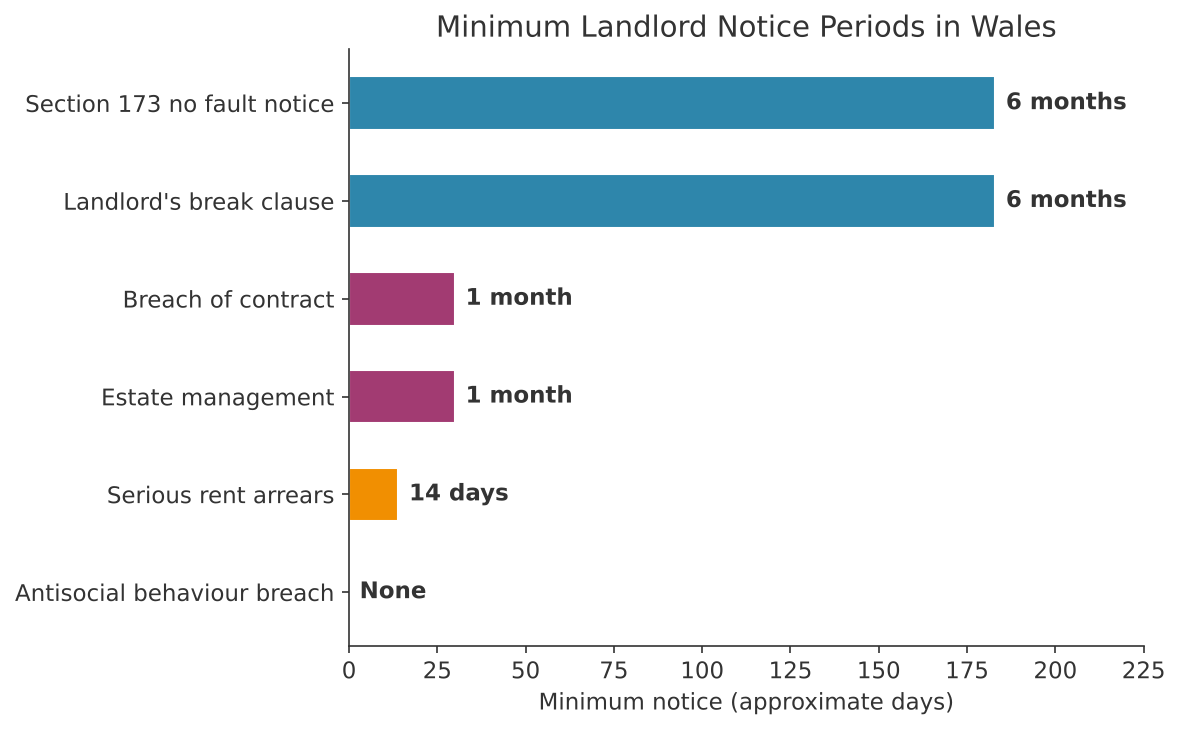
Breach grounds are discretionary, so a judge decides whether possession is reasonable. Section 173 and the serious arrears ground are mandatory once proved, although a retaliatory section 173 claim can still fail.
How Serious Rent Arrears Are Measured
Section 181 sets fixed thresholds, and the contract holder must be behind by at least:
- Eight weeks’ rent for weekly, fortnightly or four weekly payments
- Two months’ rent for monthly payments
- One quarter’s rent, overdue by over three months, for quarterly lets
- 25% of the annual rent, unpaid for longer than three months, for yearly lets
When Can You Serve a Section 173 Notice?
Section 173 is the Welsh no fault possession notice that ends a periodic standard occupation contract without the landlord needing to prove any breach. Strict timing rules govern every stage of it.
- Wait until six months have passed since the contract holder moved in (section 175).
- Set a possession date no sooner than six months after you give notice (section 174).
- Use prescribed form RHW16 for a standard periodic contract.
- Start your possession claim within two months of the possession date in the notice (section 179).
- If you withdraw a notice, you generally cannot serve another for six months (section 177).
| Pro Tip: Fix reported disrepair before serving notice. A court can refuse possession where a claim looks like retaliation for a repair request, and you then face a further six month bar on serving a fresh no fault notice. |
What About Fixed Term Contracts?
Fixed term contracts in Wales rarely end on their own. Should the contract holder stay once the term expires, the law treats both parties as having made a new periodic standard contract, and you then rely on section 173.
A landlord’s break clause offers an earlier exit, but only in a fixed term of two years or more. It is unavailable before month 18 of the occupation, and its notice must still last six months, served on form RHW24.
Compliance Checks That Can Invalidate Your Notice
Welsh possession notices only work when your paperwork is already in order. Before serving a section 173, section 186 or break clause notice, confirm you have:
- Issued the written statement of the contract within 14 days of the occupation date
- Protected the deposit in an approved scheme and served the prescribed information
- Provided a current gas safety record, where the property has gas appliances
- Given the contract holder a valid Electrical Installation Condition Report
- Fitted mains wired smoke alarms on every storey, plus carbon monoxide alarms where required
- Supplied a valid Energy Performance Certificate
- Registered with Rent Smart Wales, with any required licence in place
- Repaid or credited any prohibited payment taken under the Renting Homes (Fees etc.) (Wales) Act 2019
| ⚠ Warning: A written statement issued late creates its own delay. No fault notice can follow for half a year after you finally provide it. |
These duties become routine once diarised. A steady upkeep plan, like the one in this landlord’s guide to property maintenance in the UK, keeps certificates current before you need them.
A Realistic Timeline From Occupation to Possession
Possession timelines in Wales stretch further than many investors expect. Stack the six month restriction, the six month notice period and court time together, and the no fault route passes the 18 month mark.
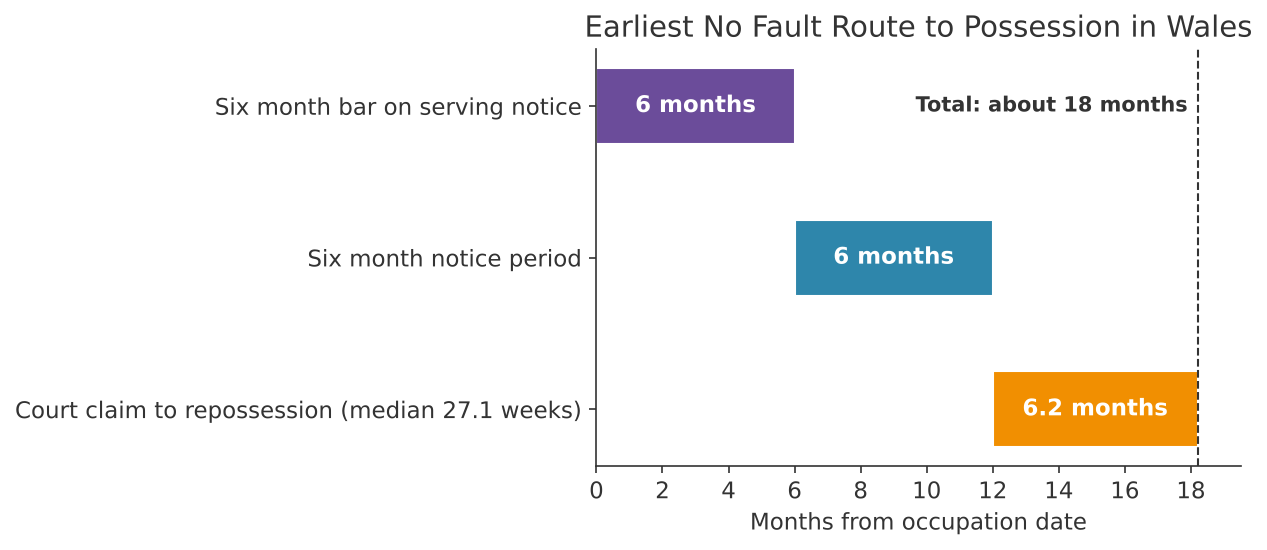
Court time adds the final stretch. According to the latest Ministry of Justice possession statistics, landlord claims across England and Wales took a median of 27.1 weeks from claim to repossession between April and June 2026.
“Median time from landlord claim to repossession in England and Wales: 27.1 weeks (April to June 2026).”
The accelerated possession procedure can shorten section 173 claims, though it is unavailable where you also claim rent arrears. If you plan to sell, build these months into your exit strategy and avoid the biggest mistakes landlords make when selling a tenanted property.
Step by Step: Serving a Valid Landlord’s Notice
Serving notice correctly matters as much as the timing. Work through these steps in order:
- Confirm the contract type, the occupation date and whether any fixed term is still running.
- Audit every compliance item above and keep copies of each certificate.
- Complete the correct RHW form, checking the possession date against the minimum notice.
- Serve it by hand or post, or by email if the occupant has agreed to that, and keep proof of service.
- Diarise both the possession date and the two month window for issuing your claim.
- Ask the county court for a possession order should the occupant stay beyond that date.
| Key Point: The Welsh Government’s guidance on the possession process for private landlords lists every ground, notice period and form in a single annex, which makes it a useful final check. |
Keeping the Relationship Workable During the Notice Period
Six months is a long time to share an uneasy relationship with a contract holder. Clear updates, prompt repairs and respect for their privacy keep viewings smooth and reduce the risk of a defended claim.
Contract holders can leave sooner by giving at least four weeks’ notice on a periodic contract, so an honest conversation often ends things earlier than the statute requires. These ideas on how landlords build trust with tenants translate well to Welsh lettings.
Frequently Asked Questions
How much notice does a landlord have to give in Wales?
Landlords in Wales must allow a minimum of six months under section 173 to end a periodic standard contract without fault. A serious arrears claim needs 14 days, and most breach grounds need one month, using the matching prescribed RHW form each time.
Does section 21 still apply in Wales?
No. Section 21 stopped applying to Welsh private lets in December 2022, when the new occupation contract regime began. Its closest replacement is the section 173 landlord’s notice, which requires six months rather than two.
Can a landlord give notice in the first six months of a contract in Wales?
Section 173 notices are barred until the occupant has completed six months in the home. Fault based notices for breach or heavy arrears work differently, and you can serve those once the relevant ground arises.
What happens if the contract holder does not leave after the notice expires?
You must apply to the county court, normally no later than two months after the date in your notice. Only court bailiffs or enforcement officers can then carry out an eviction, and changing the locks yourself risks an unlawful eviction claim.
Can a landlord end a fixed term contract early in Wales?
Only if the contract includes a break clause for the landlord and runs for at least two years. You cannot trigger that clause within the first 18 months, and the notice must run for six months or longer.
Planning Your Exit With Confidence
Welsh landlords now work to longer clocks and stricter paperwork than their English counterparts. Six months of occupation, six months of notice and several months of court time can add up to a year and a half, and a single compliance gap can send you back to the start.
Get the certificates, deposit and written statement right first, choose the correct ground and form, and keep talking to your contract holder throughout. That combination gives you the best chance of a clean, lawful handover.
References
- Welsh Government, Understanding the possession process: guidance for private landlords, 2025: https://www.gov.wales/sites/default/files/publications/2025-04/understanding-possession-process-guidance-private-landlords.pdf
- Renting Homes (Wales) Act 2016, legislation.gov.uk: https://www.legislation.gov.uk/anaw/2016/1
- Ministry of Justice, Mortgage and landlord possession statistics: April to June 2026, 2026: https://www.gov.uk/government/statistics/mortgage-and-landlord-possession-statistics-april-to-june-2026/mortgage-and-landlord-possession-statistics-april-to-june-2026
- Propertymark, Welsh rental market shrinks as ownership becomes more concentrated, 2026: https://www.propertymark.co.uk/resource/welsh-rental-market-shrinks-as-ownership-becomes-more-concentrated.html
- Welsh Government, Form RHW16: Landlord’s notice of termination, 2022: https://gov.wales/sites/default/files/publications/2022-09/form-RHW16.pdf
Fact Check: All statistics and data points in this article were verified against original sources as of 9 October 2026. Sources are listed in the References section.
