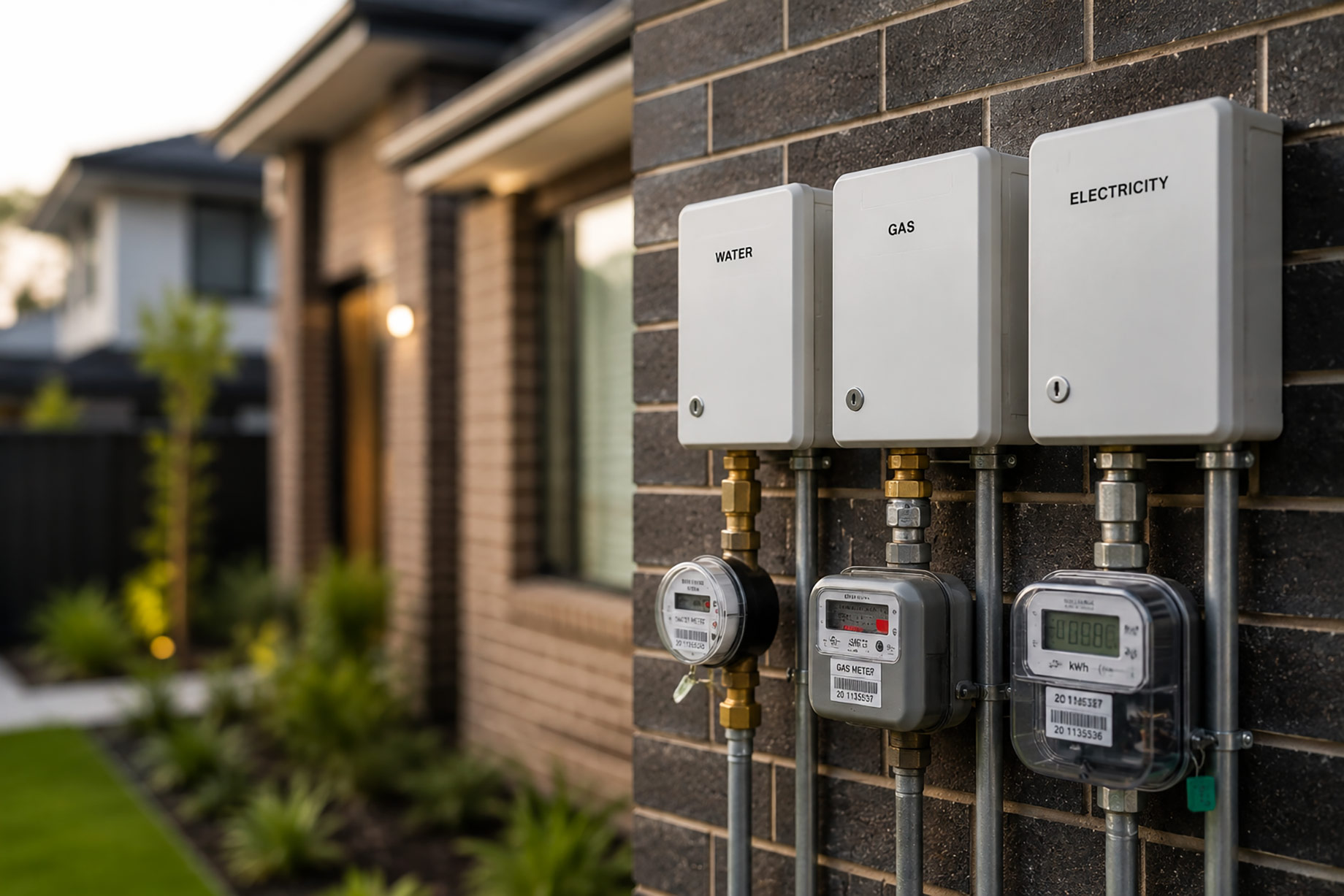
A second dwelling on a suburban block is usually discussed in terms of floor area. How many bedrooms, how many square metres, how close to the boundary.
Those are the wrong questions for anyone assessing the investment case. The variable that determines whether a second dwelling behaves like an income-producing asset or merely like additional living space is far less visible than floor plan.
It is the meter.
Two Dwellings, One Set of Bills
A second dwelling without independent utility connections is, from a landlord’s perspective, an awkward proposition.
The reason is statutory rather than commercial. Under New South Wales tenancy law, a landlord’s ability to recover utility costs from a tenant depends directly on how the property is metered.
State tenancy rules set out that a landlord may only ask a tenant to pay water usage charges where the property is separately metered, where prescribed water efficiency measures are met, where the charges do not exceed what the supplier billed, and where the tenant has been given a copy of the relevant part of that bill.
Fail any one of those conditions and the cost stays with the owner. The landlord also remains responsible for water and sewerage service charges regardless.
For a shared-meter arrangement, the practical consequence is that utilities must be absorbed into the rent as an estimate. Estimates are conservative by nature, and a conservative estimate on a rising utility bill is a slow erosion of yield.
The planning framework shapes what is possible before any of this becomes relevant. Planning portal guidance confirms that a secondary dwelling is a self-contained dwelling within, attached to, or separate from another dwelling on the same site, that it is permitted across residential zones R1 through R5, and that the lot cannot subsequently be subdivided.
That last provision is the one investors most often misread. The second dwelling generates income; it does not generate a second title.
What Dual Occupancy Design Determines Before Construction
Because metering cannot be meaningfully retrofitted without significant cost, the decision belongs at the design stage rather than the leasing stage.
This is where builders specializing in the format differentiate themselves. Everyday Homes, which designs dual occupancy homes Sydney owners build across the south-western growth corridor, specifies granny flat configurations that arrive with their own water meter, gas meter and electricity meter, along with NBN provision for separate billing and a distinct street number.
Each of those elements does specific work.
- Independent water metering satisfies the statutory precondition for recovering usage charges.
- Separate electricity and gas allow the tenant to hold accounts in their own name rather than reimbursing an estimate.
- NBN provision removes the shared-connection arrangements that generate disputes between unrelated occupants.
- A distinct street number matters more than it appears, because it establishes the dwelling as a discrete address for mail, deliveries, emergency services and account registration.
The same builder markets a co-living format as an alternative — independent living areas within the principal dwelling rather than a separate secondary dwelling — which it describes as not requiring the approvals a granny flat does, and as viable on lots under 450 square metres.
Anyone evaluating that pathway should confirm the classification with their own certifier, since secondary dwellings and dual occupancies sit on different approval tracks with different consequences for what can be rented and to whom.
The Threshold That Governs Everything
The eligibility criteria are unusually specific, and they explain why so much Sydney product clusters around identical dimensions.
Council guidance summarizes the standard position: a secondary dwelling must be self-contained with a habitable room, kitchen area, bathroom and laundry facilities, sit on a property of at least 450 square metres with a single existing home, and occupy no more than 60 square metres of floor area. Only one is permitted per property, and it cannot be subdivided and sold separately.
Sixty square metres is the number that shapes the market. It accommodates a comfortable one-bedroom or a compact two-bedroom layout, which is why builders standardize around it.
Four hundred and fifty square metres is the number that determines the approval pathway. Below it, the fast complying-development route generally closes and a full development application becomes necessary — adding months and cost without guaranteeing consent.
Electricity and gas follow the same logic as water. The Energy Ombudsman in New South Wales states plainly that a tenant can only be charged for electricity or gas where the rented premises are separately metered.
Three utilities, one consistent principle: separate metering is the condition precedent for cost recovery.
Where the Return Actually Comes From
The yield case for a second dwelling is frequently presented as rental income alone, which understates it in one direction and overstates it in another.
It understates it because independent metering does more than shift bills. It converts a room into a tenancy — a discrete lettable premises with its own address, its own accounts and its own utility responsibility. That distinction affects tenant quality, lease terms and the willingness of unrelated parties to occupy the space at all.
It overstates it because the costs are real. Site preparation, separate service connections, council contributions and the ongoing landlord obligations for service charges all sit against the income.
There is also a taxation dimension that deserves professional advice rather than assumption. Renting part of a principal residence can affect the main residence exemption on eventual sale, and the calculation depends on floor area, duration and use.
The Question Worth Asking First
For buyers assessing a property already carrying a second dwelling, the useful due diligence question is not how large it is.
It is whether the meters are separate, whether the address is registered independently, and whether the water efficiency measures required for cost recovery are actually in place.
Two otherwise identical properties can carry materially different returns on that basis alone. One produces a genuine second tenancy. The other produces a spare room with a kitchen in it, and an owner quietly absorbing someone else’s utility bills for the length of the lease.
