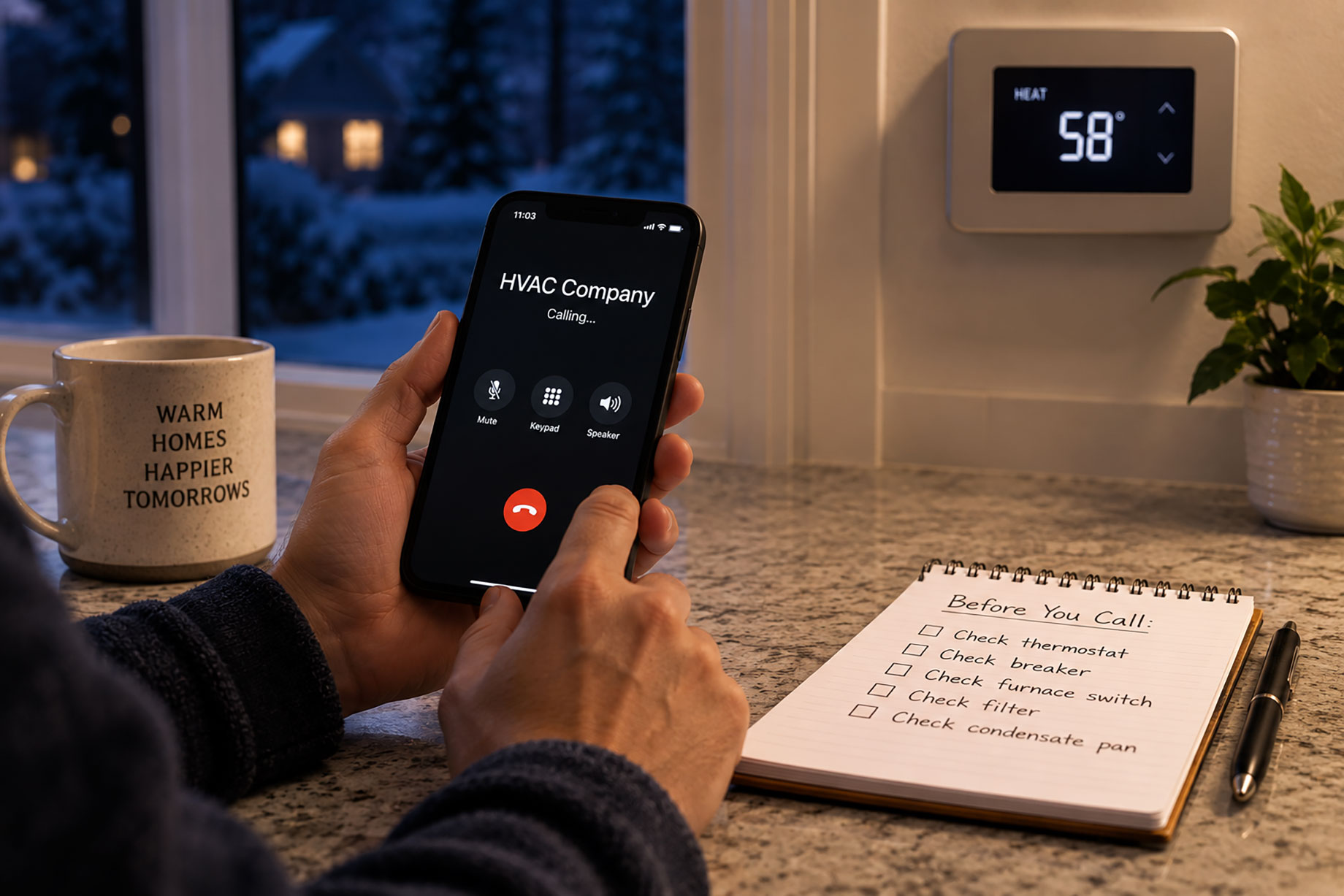
It is 11 p.m., the house is 58 degrees and still dropping, and you are standing in the kitchen with your phone in your hand trying to decide whether this is a tonight problem or a tomorrow problem. This is a walk through what happens after you press call: who picks up at that hour, what the night rate is actually made of, and the handful of situations where the right move is to put the phone down and go to bed.
Here is the part that surprises most people. When you dial an HVAC company after closing, you are probably not calling the company. The line gets forwarded, and it usually lands in one of four places: an on-call technician’s own mobile, a live answering service staffed somewhere two time zones away, an automated HVAC after hours answering service, or plain voicemail. Which one you get decides your night. You can normally tell which it is inside about ten seconds.
Who is actually on the other end
| Who answers | How you can tell | What they can do | What they cannot do |
|---|---|---|---|
| On-call technician | Picks up fast, sounds like they were asleep, knows the company’s own systems | Decide to come out, quote the fee, sometimes talk you through a reset over the phone | Much else. They may be two hours into another call and nowhere near you |
| Live answering service | Polite, clearly reading a script, takes your details and says someone will call back | Take an accurate message and page the on-call tech | See a schedule, quote a price, or commit to an arrival time |
| Automated answering system | Answers instantly, asks structured questions, can offer you an actual slot | Capture the job properly, book a time, push a real emergency through to a human | Diagnose anything, or exercise judgement on a situation nobody scripted for |
| Voicemail | You know | Nothing until morning | Anything |
If you have reached a live answering service or voicemail, what you have is a message sitting in a queue. That is not a dispatch, and it is the moment to start calling the next company on your list rather than sitting there watching the phone. Two companies working on your problem at midnight costs you nothing; you can always call one of them off.
Which brings up the other version of this, the one where nobody answers anywhere. The instinct is to keep redialling the first company and leave increasingly tense voicemails. Resist it. Work down a list of three instead, and before you agree to pay anyone out of pocket, spend two minutes on your warranties — a system still under manufacturer warranty, a home warranty policy, or a builder’s warranty on a newer house often has its own 24-hour line, and calling an unauthorised contractor can void the coverage you are already paying for. People discover this the morning after, which is the worst possible time.
Two minutes before you dial
A fair number of 11 p.m. calls end with a technician collecting a night fee for something you could have done yourself in slippers. Five checks, roughly in order of how often they turn out to be the answer:
- The thermostat. Dead batteries cause more “the system just stopped” calls than any actual fault. Check the display is lit, that it is set to Heat or Cool rather than Auto or Off, and that the setpoint is genuinely above or below the room temperature. It sounds too obvious to mention. It is also correct maybe a quarter of the time.
- The breaker. Find the breaker for the furnace or air handler, and the one for the outdoor unit. A tripped breaker has to be pushed all the way off before it will go back on. If it trips again immediately, stop there — that is a real fault, and a real call.
- The furnace switch. Most furnaces have a switch beside or on the unit that looks exactly like a light switch, because it is one. Anybody can catch it with a laundry basket on the way past.
- The filter. A filter nobody has changed since spring can freeze an evaporator coil in July or choke airflow in January. If it comes out grey and matted, you may have just found your whole problem.
- The condensate pan. Plenty of air conditioners have a float switch that shuts everything down when the drain backs up. Standing water in the pan is a strong hint, and a wet vacuum will sometimes buy you the night.
If one of those was it, you have saved a night fee. If none of them was, you now have something specific to say on the phone, and that changes the call more than you would expect.
Call now, wait until morning, or call someone else entirely
Not every after-hours HVAC problem is an HVAC call. This is the part contractors have no particular reason to publish, since most of it ends with you not calling them.
| What is happening | What to do |
|---|---|
| You smell gas | Leave the house. Do not touch switches, and do not use your phone indoors. From outside, call 911 or your gas utility’s emergency line. Not the HVAC company |
| A carbon monoxide alarm is going off | Everyone outside, then call 911. Do not go back in to investigate |
| Burning plastic or hot electrical smell | Kill the system at the breaker, then call. This one is genuinely urgent |
| Water coming through the ceiling under the air handler | Shut it off, contain what you can, then call. Water damage compounds by the hour |
| No heat, below freezing outside | Call now. Frozen pipes turn a repair bill into a restoration project |
| No heat or no cooling in extreme weather, with an infant, an elderly person, or someone medically vulnerable in the house | Call now, and say so on the phone. It changes your place in the queue |
| No heat, mild outside, house holding above 60 | Morning. Tonight you would pay a premium for the identical repair |
| No cooling, mild evening, windows and fans are an option | Morning |
| Running, but making a new noise | Morning — unless it is grinding or metallic, in which case shut it off and call |
| Short-cycling, or not holding temperature | Morning. Irritating, not urgent |
The honest version: the cases that earn a night call are safety, water, freezing, and vulnerable occupants. Discomfort on its own, however miserable, generally is not one of them, and it is worth knowing that before somebody quotes you a fee.
What “after hours” means, and what it costs
There is no industry definition of after hours. Each company sets its own, which is why two firms on the same street can quote you completely different things for a call at the same time on the same night. In practice it tends to start when the last scheduled appointment of the day ends — often somewhere around 4 or 5 p.m. rather than at a tidy 6 — and runs until the dispatcher is back in the morning. Weekends usually count in full. Holidays almost always carry their own rate, and a few companies run a third, higher band for the small hours. None of this is posted anywhere. You have to ask.
Rates themselves vary enormously by region, season and company, so treat any specific figure you find online as decoration. The structure is what matters, and the structure barely varies. Three things sit on a night invoice, priced separately:
- The trip or diagnostic fee — what you pay for somebody to turn up and work out what is wrong. After hours this carries a premium over the daytime rate, and nights, weekends and holidays may each step it up again.
- Labour, normally at an overtime rate, and quite often with a minimum number of hours attached whether the job takes that long or not.
- Parts, the same price they would be at noon, with one catch. Supply houses are shut at midnight. A part that is not already on the truck means a temporary fix tonight and a second visit tomorrow, and that second visit is another trip charge unless you agree otherwise before anyone leaves.
Three questions pin the whole thing down, and all three belong at the start of the call rather than at the end of the invoice:
- What is the after-hours diagnostic fee, and does it come off the repair if I go ahead?
- Is labour at an overtime rate, and is there a minimum?
- If the part is not on the truck tonight, is the return visit billed as a second call?
A company that cannot answer the first one on the phone is a company whose phone is being answered by somebody with no access to pricing. Which, as it happens, tells you quite a lot about how the rest of the night is likely to go.
What to say so you get a technician instead of a callback
Whoever picks up is deciding where you sit in a queue, usually within the first twenty seconds. Give them the things that decide it, all at once:
- Your address, and whether the place is easy to find in the dark
- What the thermostat reads, and what it is set to
- The system type, and roughly how old it is
- What you already checked — breaker, filter, switch, thermostat
- Whether anyone in the house is medically vulnerable, elderly, an infant, or whether pets are at risk
- Whether you are on a maintenance or service agreement with them, which nearly always moves you up
- That you want the fee confirmed before anybody is dispatched
“My furnace is out, it is 54 inside, breaker is fine, filter is new, we have a six-month-old in the house, and I need to know the call-out fee” gets a different answer than “my heat isn’t working.” Nobody is playing favourites. The first one is dispatchable and the second one is not.
When “wait until morning” is the wrong advice
The triage table above quietly assumes a healthy adult household in a house that holds its temperature. Change either assumption and the answer moves.
- Infants, adults over about 65, and anyone with a heart or respiratory condition lose the ability to regulate their own temperature far faster than a healthy adult does. In a heat event this stops being a comfort question fairly quickly.
- Below-freezing weather turns a no-heat night into a pipe risk, and one burst pipe costs more than every after-hours fee you will ever pay.
- An older or poorly insulated house can shed ten or fifteen degrees overnight where a newer one loses three. If you have already watched the thermostat drop five degrees in an hour, do the arithmetic before you decide to sleep on it.
- Anyone dependent on powered medical equipment, in a house where the HVAC failure looks like part of a wider electrical problem, is not having a repair problem. That is an emergency.
Whichever of these applies, say it out loud on the phone. Of everything in this article, it is the single sentence most likely to change the answer you get.
Meanwhile, while you are waiting: in freezing weather, open the cabinet doors under sinks on exterior walls, let the taps drip, and shut the doors on rooms you are not using. In heat, close the blinds on the sunny side, move downstairs, and run fans. Space heaters go well clear of anything soft, and never on an extension cord. And find your water shutoff now, while the lights are on — nobody has ever enjoyed looking for it at 2 a.m. with a phone torch.
