
Internet speed in Valley swings from block to block. AT&T touts a 5-gig fiber tier, yet only about 1.6 percent of homes can order it. WOW!’s 1.2-gig cable covers far more addresses, Spectrum’s 1-gig plan blankets nearly the whole city, and 5G steps in where wires stop. In this guide, we rank those four options by real-world speed, coverage, and two-year cost so you can choose the fastest plan your exact address can actually get.
Quick verdict: Valley’s fastest options at a glance
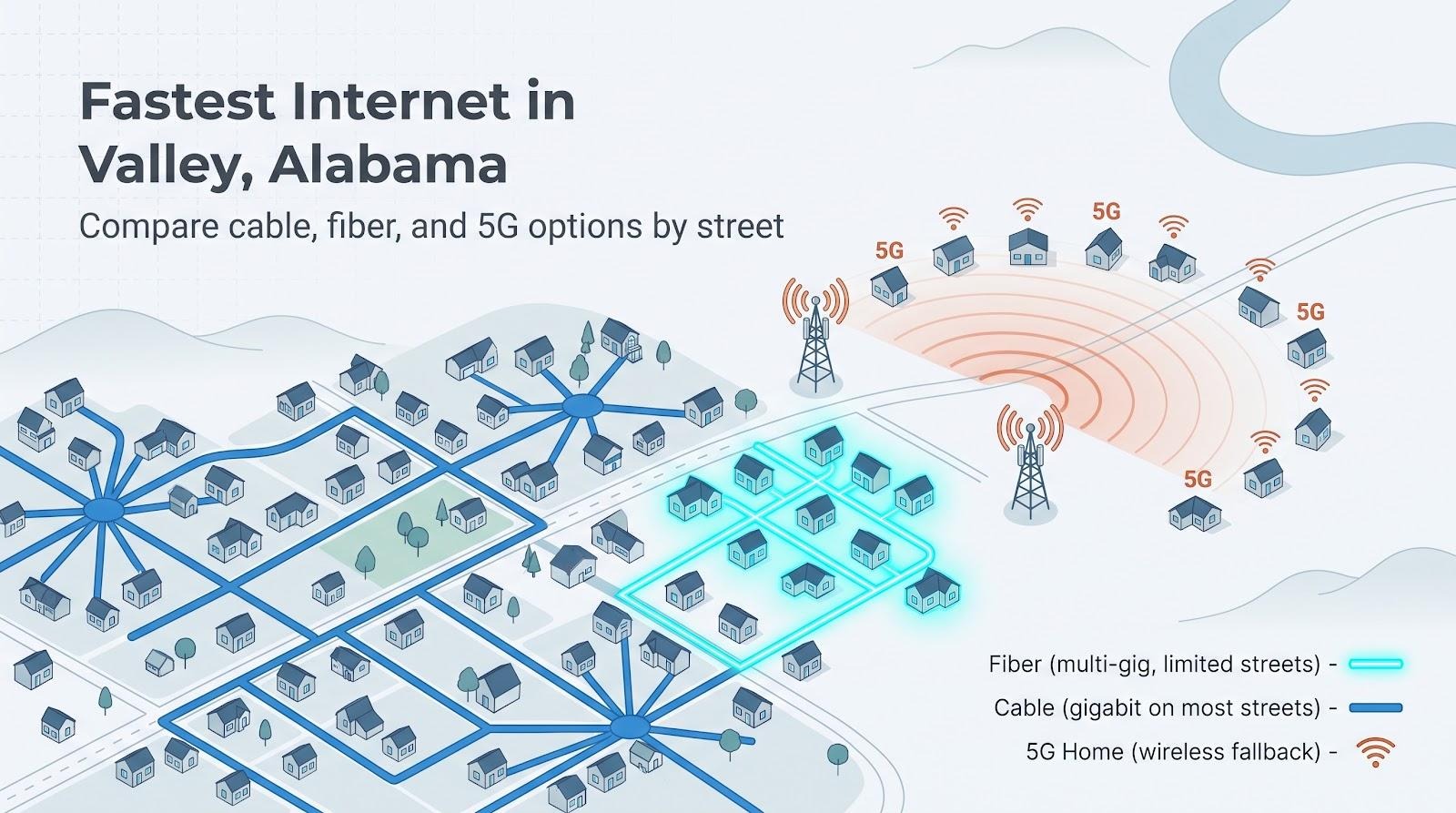
Need the short answer? The table below shows which provider is fastest for most addresses, and why.
| Provider | Why it Wins | Highest Widely Offered Plan* | Best For |
|---|---|---|---|
| WOW! | Broadest high-speed cable footprint | Up to 1.2 Gbps download on upgraded DOCSIS | Larger households that want gigabit-plus speed without fiber |
| AT&T Fiber | Absolute top speed where lines exist | Symmetrical 5 Gbps | Content creators and power users at a qualifying address |
| Spectrum | Widest wired reach | Up to 1 Gbps on Valley’s order page (2 Gbps only in select metros) | Renters who value easy setup and nearly city-wide availability |
| T-Mobile 5G Home | Best no-cable fallback | Typical 170-354 Mbps download on the Rely plan (up to 498 Mbps on pricier plans), 12-55 Mbps upload | Homes outside cable zones or needing quick-install backup |
How we evaluated Valley internet providers
Our scorecard starts at the curb, not the ZIP code.
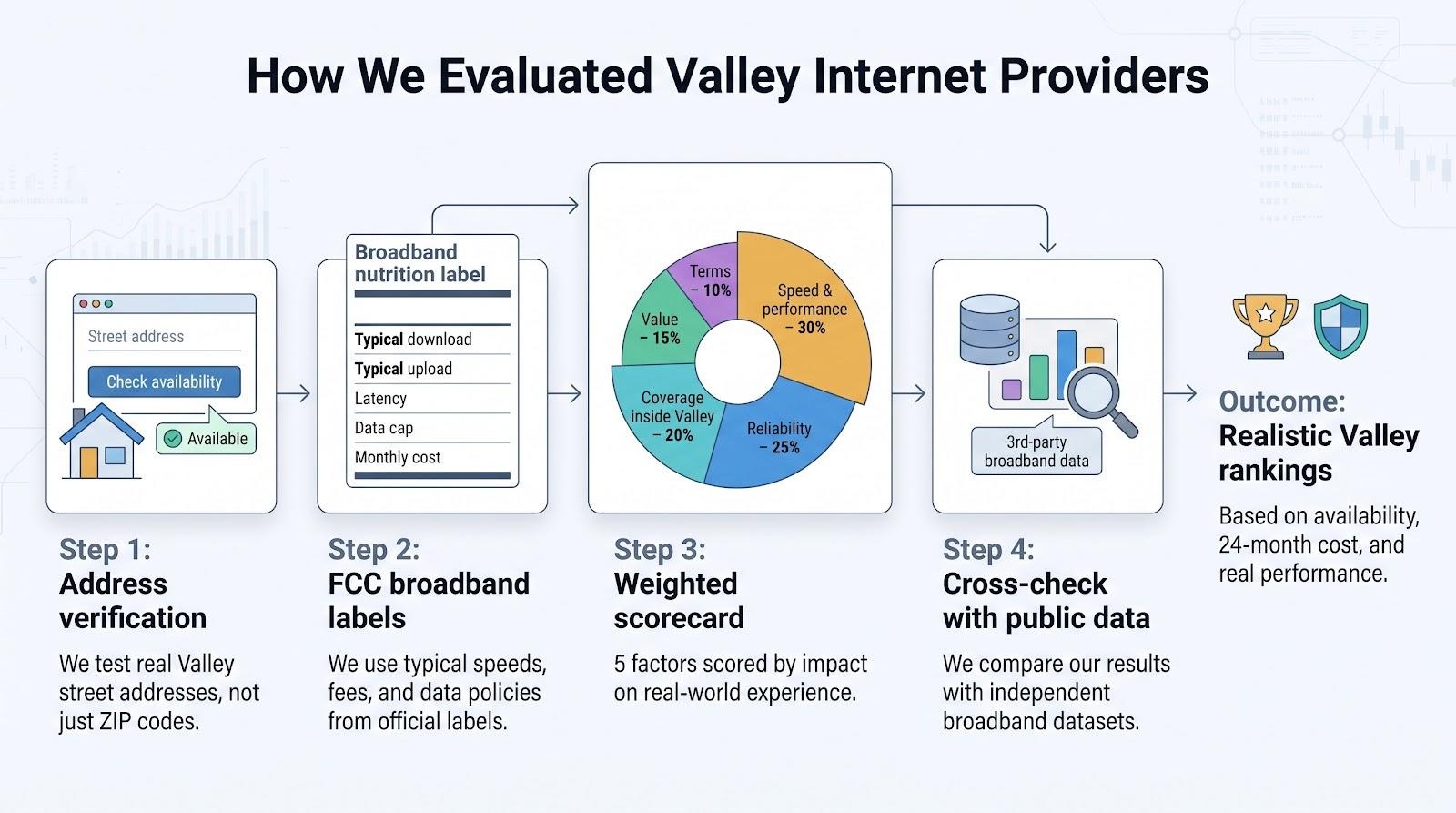
- Address verification. Each contender had to accept a Valley street address in its online checkout. If the form stopped at “not yet available,” the provider dropped into an “alternatives” table.
- Broadband label review. We captured the FCC-mandated label for every plan to confirm typical speed, fees, data policy, and equipment terms. Labels outrank marketing copy.
- Five-factor weighting. Why this split? A 5-gig fiber plan that reaches under 2 percent of households shouldn’t outrank a 1-gig cable service available on most streets.
- Dataset cross-check. We cross-checked provider availability claims against public sources such as BroadbandNow, which currently pegs AT&T fiber at about 1.6 percent of Valley addresses (accessed September 2, 2026).
The result: awards that reflect what you can order, what you’ll pay over 24 months, and how the line performs once it’s live.
WOW!: Best broadly available gigabit-plus option
WOW! is the only wired provider that both lists a 1.2-gigabit residential tier for Valley on its published rate card and names Fairfax, Shawmut, and Langdale among its covered neighborhoods. Its Valley, Alabama internet services page also spotlights perks like Price Lock for Life, an included Wi-Fi modem, and zero annual contracts, so most Valley homes can order gigabit-plus speed without worrying about surprise fees.
Why WOW! tops Valley cable speeds
WOW! is the only wired provider that both 1) lists a 1.2-gigabit residential tier for Valley on its published rate card and 2) names Fairfax, Shawmut, and Langdale as served neighborhoods on its Valley page. In practical terms, many Valley homes can order gigabit-plus speed today, with no fiber trench required.
Check your own address on the provider’s site; the FCC broadband label lists typical speeds, fees, and data policy for every tier.
Beyond bandwidth, WOW! removes several common cable hassles: no annual contracts, a 30-day money-back guarantee, no data cap, and an included Wi-Fi modem. You can also buy Price Lock for Life for an extra 5 dollars per month, which holds your base monthly rate as long as you keep the same speed tier. Those terms keep the two-year cost clear, helpful when the entry Internet 300 plan starts from 30 dollars per month with AutoPay and paperless billing, and WOW!’s published rate card lists Internet 1200 in Valley at 105 dollars before taxes and fees (September 2, 2026).
If your driveway qualifies, WOW!’s 1.2-Gig cable tier is the fastest wired service most Valley households can install right now. The next section breaks down upload speed, performance caveats, and equipment needs.
AT&T Fiber: Fastest absolute speed (where available)
Why AT&T leads on raw bandwidth
AT&T is the only Valley provider that advertises a residential 5-gigabit tier. Its local page confirms “speeds up to 5 GIGs,” and the plan’s broadband label lists typical 4.7 Gbps down and up, with single-digit latency (label captured September 2, 2026). No wired or wireless competitor approaches those numbers.
The catch: AT&T’s fiber lines pass only about 1.6 percent of Valley addresses, according to BroadbandNow’s September 2026 scrape. In practice, most readers still see “not available” in checkout. If your address is one of the lucky few, you get symmetrical multi-gig speed and an upload lane wide enough to push a 50 GB video file to the cloud in under two minutes.
Bottom line: AT&T delivers the city’s fastest plan by specification, but its limited footprint keeps it from topping our overall ranking. The next section covers pricing, equipment, and how to confirm eligibility.
Spectrum: Widest wired coverage
Why Spectrum reaches almost every driveway
Spectrum’s hybrid-fiber-coax network passes roughly 92 percent of Valley addresses, dwarfing any current fiber build. The Valley order page lists three consumer tiers:
- 100 Mbps: entry plan
- 500 Mbps: balanced option for busy households
- 1 Gig: fastest tier now shown at local checkouts
(2-Gig service exists in select Spectrum markets; confirm at your address.)
Spectrum keeps terms simple: no data cap, no annual contract, and a modem included. Promotional pricing runs 30 dollars for 100 Mbps, 40 dollars for 500 Mbps, and 60 dollars for 1 Gig, each for 12 months. Check each plan’s Broadband Facts label for typical speeds; uploads on all three tiers are a small fraction of download. Month-13 prices step up to Spectrum’s standard rates, about 50 dollars for 500 Mbps and 70 dollars for 1 Gig, so set a reminder before the increase.
Uploads remain limited to about 35-50 Mbps, which can frustrate creators who send large files to the cloud. Charter has said its network upgrade will raise upload speeds over time, but it has not given Valley a target date.
Bottom line: If WOW!’s 1.2-Gig plan or AT&T Fiber isn’t available at your address, Spectrum offers the broadest path to reliable 4K streaming, gaming, and big downloads, as long as you budget for the year-two rate.
T-Mobile 5G Home: Best wireless alternative
Why fixed wireless earns a spot on the “fastest” list
T-Mobile turns nearby 5G towers into a home connection, covering gaps where fiber stops and cable never arrived. Valley addresses that qualify typically see 170-354 Mbps downloads on the 50-dollar Rely plan (170-498 Mbps on the pricier Amplified and All-In plans), 12-55 Mbps uploads, and latency in the tens of milliseconds (T-Mobile typical-speed disclosure, September 2, 2026).
Setup is quick: position the gateway near a window with strong signal, power it on, and you’re online in about 15 minutes, no trenching or technician required. The plan costs 50 dollars per month with AutoPay and drops to 35 dollars with a qualifying T-Mobile voice line; equipment and taxes are included.
Availability depends on tower capacity. T-Mobile’s map lists about 64 percent of Valley homes as eligible, but the checker may show “full” on one side of a street and “open” on the other. Treat the free 15-day trial as mandatory and run peak-hour tests before canceling cable.
Bottom line: When wires fall short or you need an affordable backup, 5G Home delivers mid-hundreds-Mbps speed for a flat rate. Remember that signal quality, not marketing copy, determines whether your screen shows 80 Mbps or 400 Mbps.
Other ways to get online around Valley
Cable, fiber, and 5G serve most addresses, but specialty networks still fill rural gaps or act as backup links. These providers failed our broad-availability filter, yet they’re worth a quick look if the big four can’t reach you.
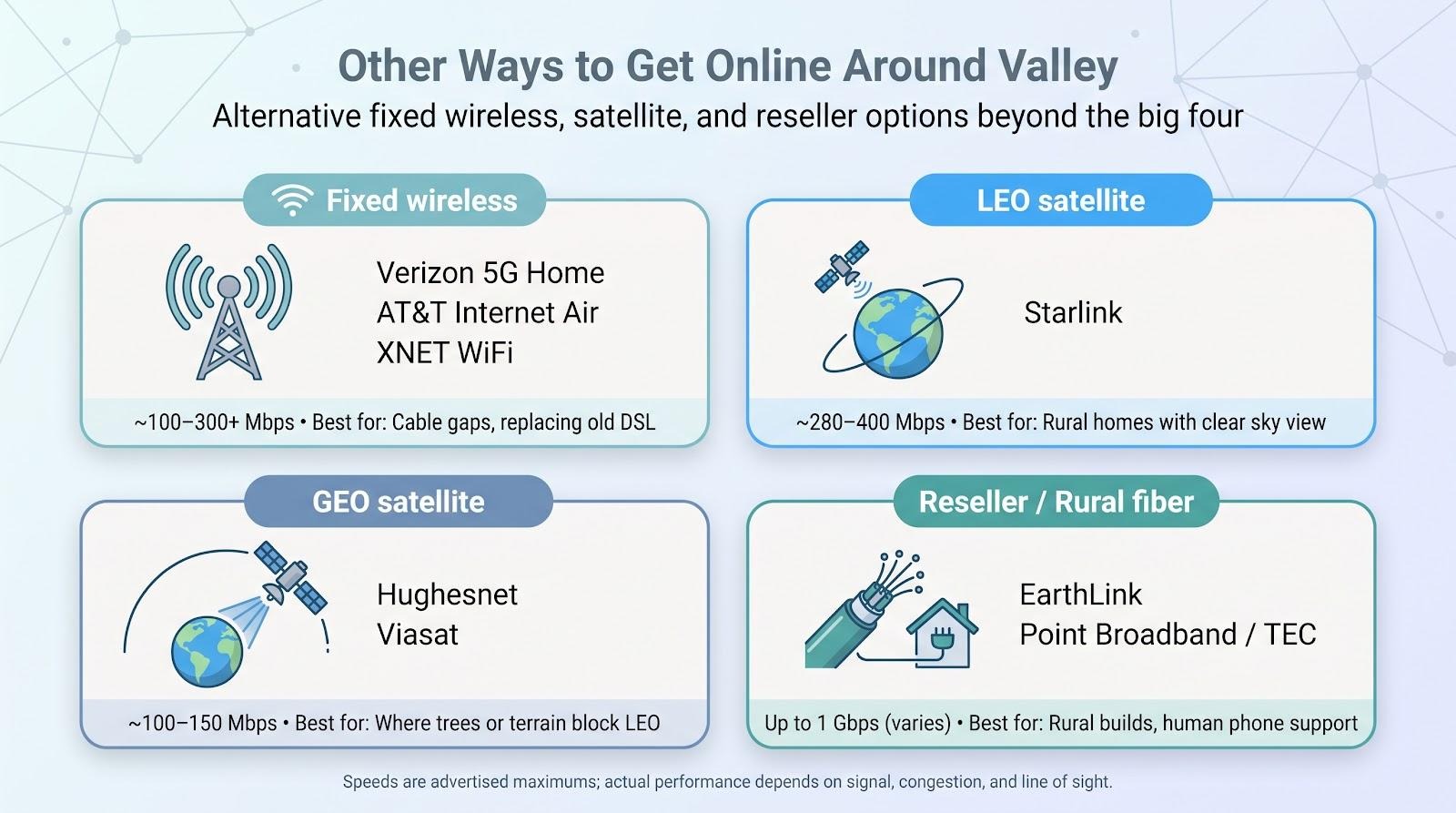
| Provider | Connection Type | Advertised Download Speed* | When It Makes Sense |
|---|---|---|---|
| Verizon 5G Home | Fixed wireless | Up to 300 Mbps | You already carry an unlimited Verizon mobile plan and want one bill |
| AT&T Internet Air | Fixed wireless | Up to 300 Mbps | Replaces aging DSL while you wait for an AT&T fiber build |
| Starlink | Low-Earth-orbit satellite | 280-400 Mbps | Nearly county-wide line of sight and lower latency than GEO birds |
| Hughesnet | GEO satellite | 100 Mbps | Works where trees block Starlink but light browsing still matters |
| Viasat | GEO satellite | 100-150 Mbps | Slightly larger data caps than Hughesnet and month-to-month “Unleashed” plan |
| EarthLink | Reseller (varies) | Up to 425 Mbps | Human phone support on top of whichever underlying network serves you |
| XNET WiFi | Fixed wireless | Claims 2 Gbps | Treat as unverified until the address checker confirms it |
| Rural fiber co-ops and grant builds | Fiber (county fringe) | 1 Gbps | Check ADECA’s awarded-projects map for your address |
If none of the big four reach you, start with Starlink for raw speed, Verizon 5G Home for a flat bill, or EarthLink if you prize live phone support. Always ask any reseller, “Whose truck shows up when something breaks?” before you sign.
Advertised vs. real-world speed: How fast is Valley?
Provider sites trumpet neat rounds (300 Mbps, 1 Gig, 5 Gig), but neighborhood tests tell a different story.
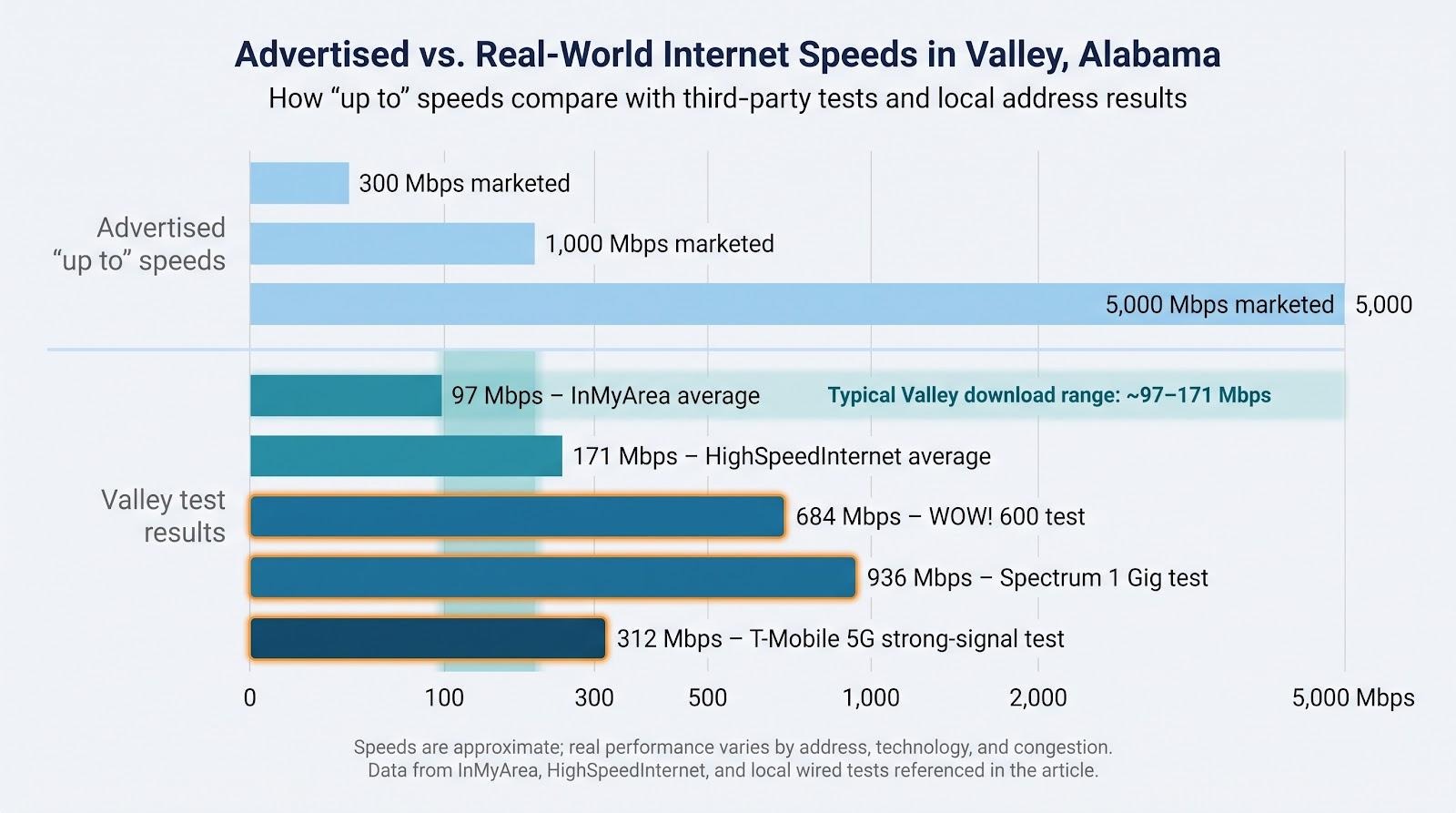
Third-party measurement data set the baseline for Valley’s typical performance. InMyArea lists an average 97 Mbps download across 2,143 local tests (accessed September 2, 2026). That average underscores a key point: your speed depends more on the wire, or tower, serving your porch than on a ZIP-code average.
WOW! publishes its own measured medians for these cable tiers in its network-management disclosure, taken 6 pm to 11 pm: Internet 600 delivered 671 Mbps down, 48 Mbps up and 12 ms latency; the 1.2 Gbps tier delivered 1,029 Mbps down, 58 Mbps up and 8 ms. Spectrum and T-Mobile publish typical speeds on their Broadband Facts labels rather than peak-hour medians, so compare like with like: label typical speed against label typical speed.
Always start with the plan’s FCC broadband label. Typical speeds and latency better predict day-to-day reality than glossy “up to” numbers. If your own tests fall well below the roughly 100 Mbps citywide average, check your home network first, then call the provider.
Fiber, cable, and “fiber-powered” internet: Know the difference
Marketing blur can make every service sound like fiber. Here’s what the terms actually mean, and why upload speed and latency vary so much.
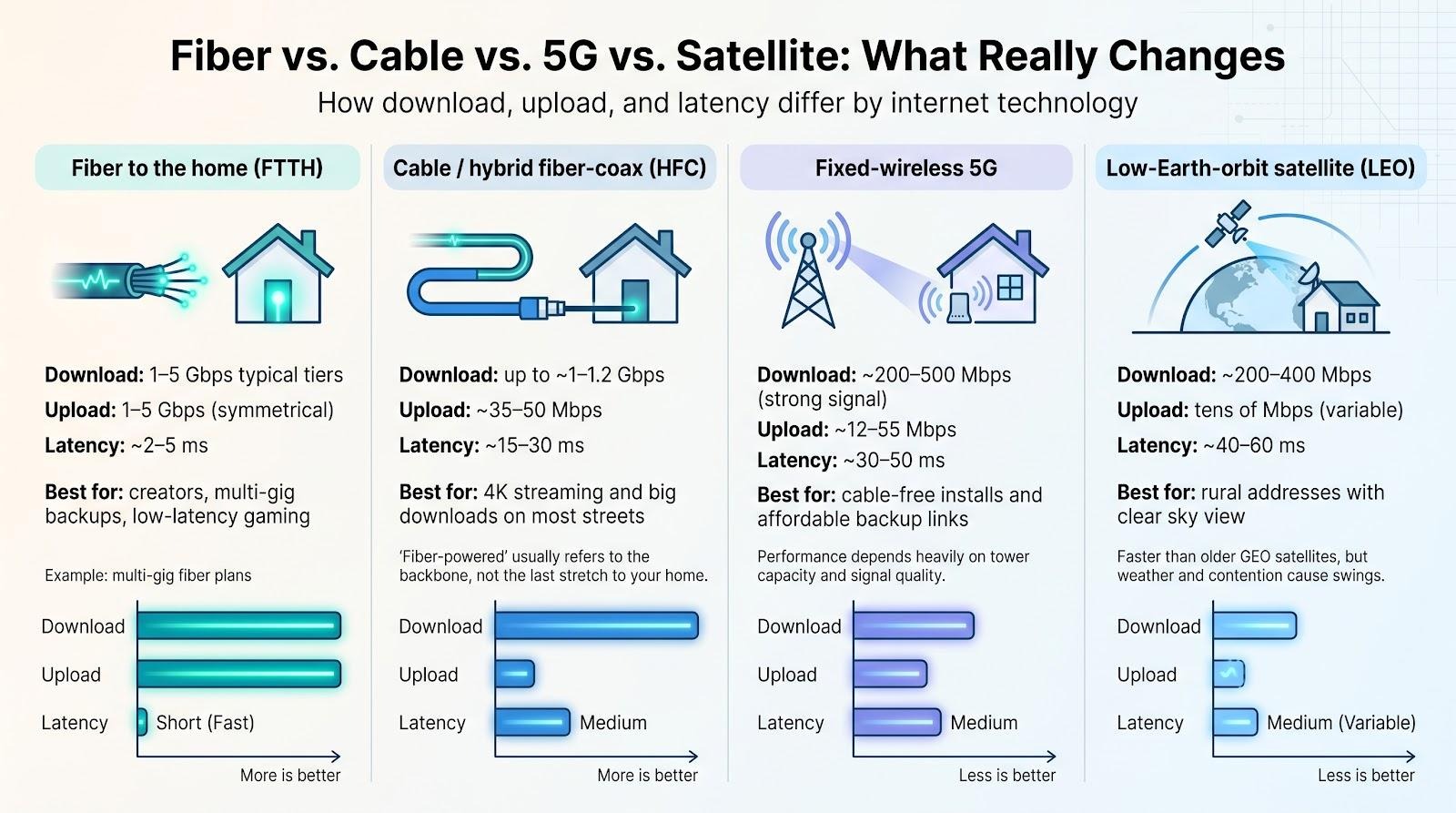
- Fiber to the home (FTTH) runs glass strands all the way to your router. Light carries data in both directions, which is how AT&T’s 5-gig plan posts symmetrical speeds and latency often under 5 ms (FCC label, September 2026).
- Cable / hybrid fiber-coax (HFC) uses fiber in the backbone but switches to copper for the last few hundred feet. Download rates can exceed a gigabit, yet uploads are typically 35-50 Mbps because that shared copper leg has limited upstream capacity. Spectrum’s Valley page, for instance, sells a 1-gig plan but caps uploads near 40 Mbps while branding the service “fiber-powered,” a nod to the backbone, not your living room.
- Fixed-wireless 5G skips wires completely, beaming data from a cell tower to a window-mounted gateway. With a strong signal, downloads reach 200-500 Mbps and uploads sit in the teens to mid-50s, better than cable but well below fiber. Tower congestion can drop speeds toward fast-LTE levels.
- Low-Earth-orbit satellite (LEO) blankets almost any address that has sky view. Latency improves to 40-60 ms compared with the 600-plus milliseconds of older GEO satellites, but weather and network contention still create bigger swings than land-based lines.
In short: fiber = symmetrical and very low latency; cable = high download, modest upload; 5G = flexible mid-range; LEO satellite = connectivity everywhere else. Matching your expectations to the right pipe prevents disappointment when that speed-test needle stops short of symmetrical.
Upgrades on the horizon: Projects that could reshuffle Valley’s leaderboard
Two public programs are poised to expand coverage in and around Chambers County between 2026 and 2028. First, Alabama’s Capital Projects Fund grants, administered by ADECA, have funded Spectrum last-mile builds in unserved parts of Chambers County; ADECA’s awarded-projects list (adeca.alabama.gov/awardedprojects) shows which census blocks are included. Second, Alabama’s federal BEAD program has a Final Proposal on file with ADECA that mixes fiber and low-Earth-orbit satellite subgrants, with construction obligations running four years from award. Neither program publishes a Valley street list yet, so watch ADECA’s project map and local permit notices rather than a date. Until crews break ground, Valley remains a cable-first, address-by-address market.
How much speed does a smart home really need?
A single 4K Netflix stream needs about 15 Mbps downstream, and a 1080p Zoom call tops out near 4 Mbps in each direction. Stack a few streams, cameras, and laptops, and the numbers add up, but rarely to two gigabits. Size your plan for the busiest hour, not for bragging rights.
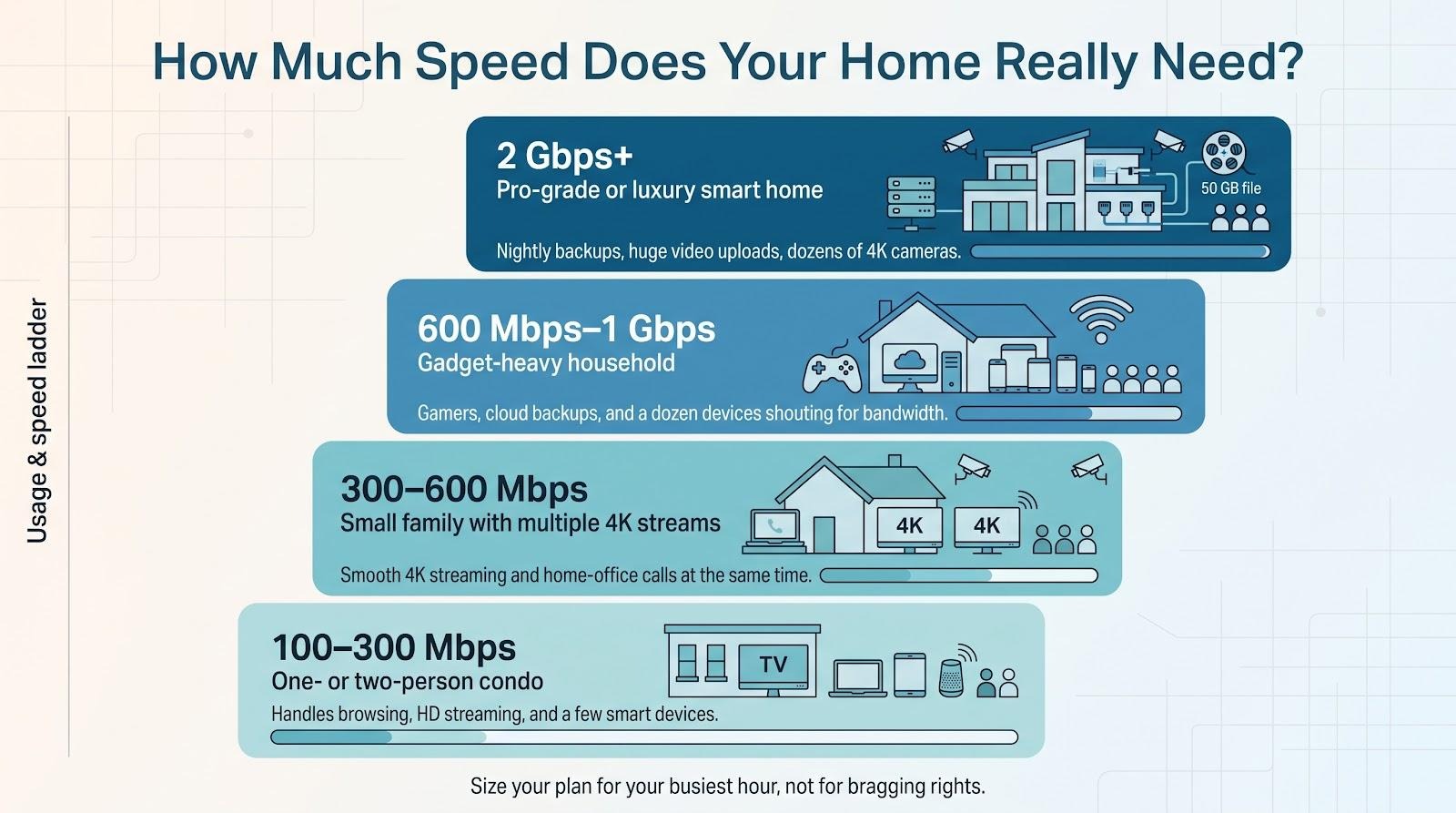
- One- or two-person condo (100-300 Mbps). Handles browsing, an HD movie, a smart-speaker update, and the occasional Zoom without breaking a sweat.
- Small family with multiple 4K streams (300-600 Mbps). Keeps two simultaneous UHD shows plus a home-office call smooth while security cams sync in the background.
- Gadget-heavy household (600 Mbps to 1 Gbps). Covers gamers, cloud backups, and a dozen devices shouting for bandwidth at once, with 35-50 Mbps upload on cable or 200 Mbps-plus on fiber.
- Pro-grade or luxury smart home (2 Gbps+). Needed only if you push multi-gig video files to the cloud, run nightly NAS backups, or wire dozens of 4K cameras, and only after your router, switches, and client ports support 2.5 GbE or faster.
Rule of thumb: start with the tier that meets last night’s peak load (check your gateway’s usage graph), test for a week, and upgrade only if you still see buffering, upload stalls, or latency above 40 ms during Zoom calls. Dollars saved on unused megabits often fund better Wi-Fi gear, the upgrade that most visibly erases dead zones.
Expert optimization tips: Squeeze every megabit
Most “slow” moments start inside the house, not at the curb. Try these quick, evidence-backed fixes before paying for a bigger plan.
- Run a wired baseline. Connect a laptop directly to the gateway and test. If you see the advertised speed here but not over Wi-Fi, the ISP isn’t the bottleneck.
- Re-position the router. Lift the gateway to an open, central shelf; vendor field tests show a 10-25 percent whole-home boost.
- Choose mesh over extenders. Single-band extenders cut bandwidth roughly in half on each hop; a tri-band mesh with wired back-haul preserves full speed at every satellite.
- Check port speeds. A multi-gig plan capped by a 1 GbE WAN jack tops out near 940 Mbps after protocol overhead. Look for a 2.5 GbE WAN/LAN port or add a USB-based multi-gig adapter to your desktop.
- Pick a cleaner Wi-Fi channel. In apartments, move 5 GHz networks to channels 149, 153, 157, or 161, which often face less interference than 36-48.
- Test at peak hours. If speeds dive at 9 pm but not 10 am, capture screenshots and open a support ticket; many ISPs issue credits for node congestion.
- Add inexpensive fail-over. A dual-WAN router plus a prepaid 5G or LTE hotspot (about 90-120 dollars for hardware) keeps smart locks and work calls alive during an outage.
These tweaks cost far less than jumping from 600 Mbps to 1.2 Gbps and often erase the evening slowdowns you actually notice.
Ten-point buying checklist
Before you sign (or cancel) service, run through these questions.
- Is the plan available at my exact address? ZIP look-ups miss block-by-block gaps. Complete the full address check.
- What technology reaches the house? Fiber, cable, 5G, or satellite changes upload speed and latency.
- What are the label’s typical speeds and latency? Typical > “up to.” Look for download, upload, and ping.
- How much bandwidth do we use at 9 pm? Run a speed test during peak hour, then choose the next tier up.
- What happens to price after month 12? Note the promo rate, standard rate, and any price-lock fee.
- Is equipment included, rented, or optional? A modem listed as “included” today can become an 18-dollar line item later. Check the fee box on the broadband label.
- Any data cap, priority threshold, or throttle? Unlimited down doesn’t help if uploads slow after 500 GB or you hit a deprioritization limit.
- Is there a contract or early-termination fee? Cable and 5G are usually month to month; reseller fiber may require a one-year term.
- Can our current Wi-Fi gear move the advertised speed? A gigabit plan on a Wi-Fi 5 router averages 450-600 Mbps across the room.
- What’s the fallback when the main line drops? Dual-WAN router, prepaid hotspot, or at least phone tethering: decide now, not during a storm.
Print or bookmark the list and check each box before you click “order.”
Frequently asked questions
What’s the fastest internet you can order in Valley today?
AT&T’s 5-gigabit fiber tier is the top spec, but it reaches only about 1.6 percent of addresses (BroadbandNow, September 2, 2026). For most homes, WOW!’s 1.2-gig cable plan is the quickest widely available option.
Does Valley have real fiber or only “fiber-powered” cable?
Yes, true FTTH exists, just sparsely. AT&T covers about 1.6 percent of homes with fiber; services branded “fiber-powered” use coax for the last stretch.
Why does my 1-gig cable plan test near 940 Mbps?
Gigabit Ethernet tops out around 940 Mbps after protocol overhead, so a 940 reading usually means the line and port are healthy.
Is 5G home internet reliable enough to replace cable?
At strong-signal addresses T-Mobile’s own typical-speed disclosure puts the Rely plan at 170-354 Mbps down and 12-55 Mbps up, with latency in the tens of milliseconds. Tower congestion can cut those numbers in half, so use the 15-day trial and test at 9 pm before dropping cable.
Which provider offers the best upload speed?
AT&T Fiber leads at up to 5 Gbps symmetric. Cable uploads run 35-50 Mbps; 5G fixed wireless ranges 12-55 Mbps depending on signal strength.
Do any Valley plans have data caps?
Spectrum, WOW!, AT&T Fiber, and T-Mobile 5G list unlimited residential data. Some satellite and reseller plans still meter high-priority data after 100-300 GB.
Is Starlink fast enough for gaming?
Average latency is 40-60 ms, fine for casual or strategy games but borderline for twitch shooters that need sub-30 ms ping. GEO satellite sits closer to 600 ms.
Can I bring my own modem to save fees?
Spectrum lets you use an approved DOCSIS 3.1 modem; you’ll still need your own router. WOW!’s modem is included, so savings are minimal. AT&T Fiber and 5G gateways are provider-locked.
I work from home. Which provider shows the fewest outages?
Local data are limited, but fiber lines historically see fewer incidents than cable, and cable beats fixed wireless. Add a cellular fail-over router if uptime is mission-critical.
When will Spectrum offer multi-gig uploads in Valley?
Charter has not announced a Valley construction date for faster uploads.
Don’t see your question? Drop it in the comments and we’ll update this list each quarter.
Conclusion
Valley residents face a patchwork of internet options, but understanding true availability, typical performance, and contract fine print makes it easier to land the right plan. Use the tables, checklists, and speed-test advice above to zero in on the best service for your exact address, and keep an eye on the coming build-outs that could bring fiber (or faster cable) to your block over the next two years.
