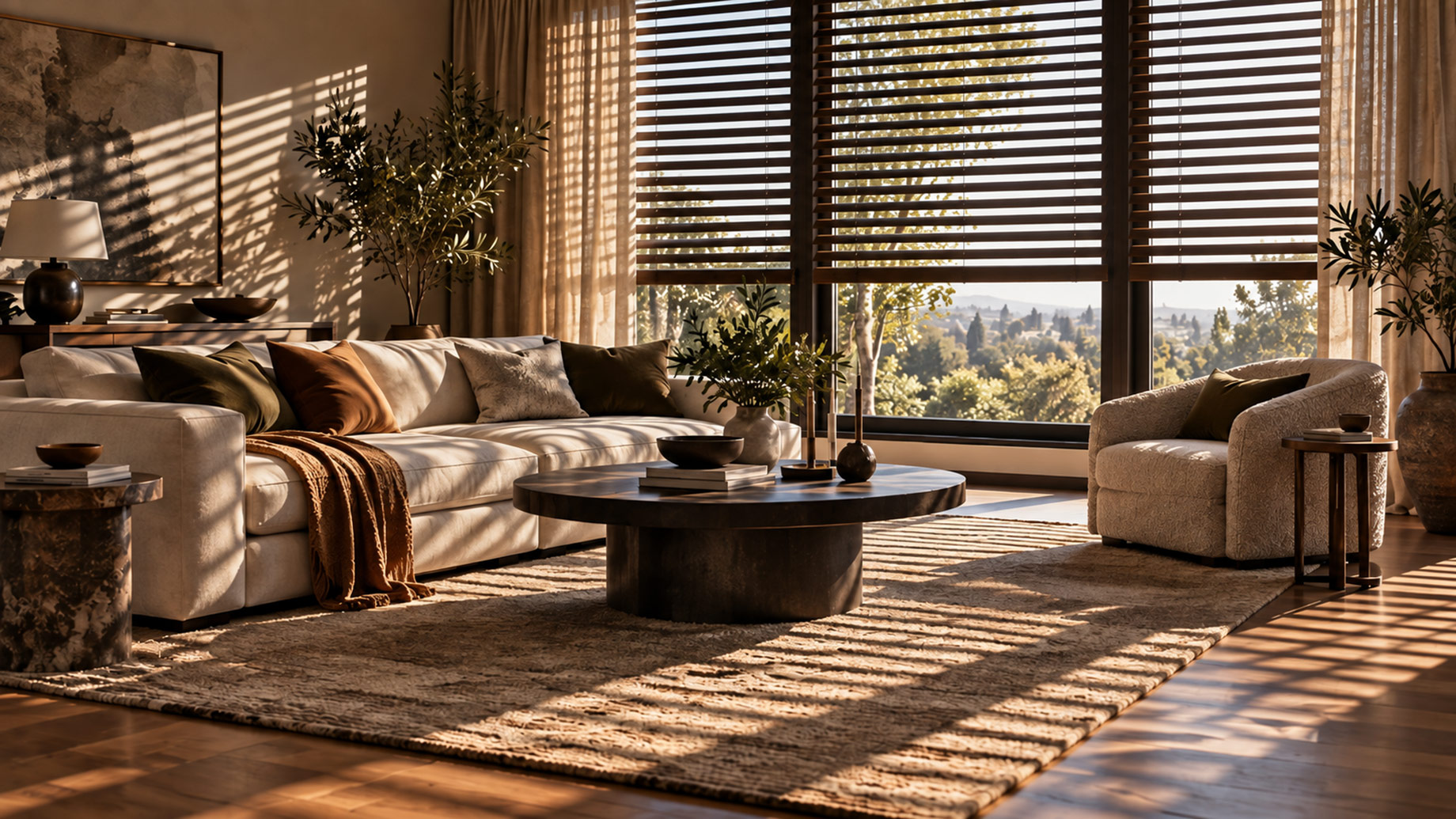
Minimalism had a good run. It also left a lot of American living rooms looking like waiting areas. Bare white walls, one flat roller shade per window, nothing on any surface that the eye actually wants to land on. If your rooms are technically clean and somehow still boring, the window is usually the culprit, because a single sheet of fabric gives light nowhere to go and nothing to catch on. Custom window blinds fix that in a way no flat panel can, and they do it with something free that arrives every morning: sunlight and the shadows it throws. The 2027 direction lands in the same place, and Blinds To Go‘s recent trend coverage describes it well: minimalism softened by texture and layering rather than thrown out. Here is how to use slats to put depth back into a flat room, and who should skip them.
Shadows Are the Whole Point of Blinds
Tilt a set of wood blinds halfway and watch what happens to the floor. Light comes through in bands, stretches across the boards, climbs the leg of a chair, and bends where it hits the rug. Tilt them the other way and the whole thing flips: light bounces off the ceiling and the room fills with a soft indirect wash instead. That is a lighting system you operate with two fingers, and it changes hour by hour as the sun moves. A roller shade gives you one setting, a flat diffused glow, and it gives you the same setting at 9 a.m. and 5 p.m. Slats give you a room that looks different all day.
Depth You Can Actually See
The shadows do more than look good. They build depth. A roller shade is a plane, flat against the glass, reading as one uninterrupted surface. Blinds are a stack. Every slat casts a thin line of shade onto the one below it, so the window itself has real thickness before any light even comes through. Stand across the room and the difference is obvious: one window reads as a rectangle of fabric, the other reads as an object with structure to it.
Wood Blinds and Wood-Look Floors: Relate, Don’t Match
Most homes now have wood or wood-look flooring, which raises the obvious question: should the blinds match it? No. Matching is the single most common mistake here, and it backfires twice. Luxury vinyl and laminate use a printed grain that repeats every few planks, while real wood blinds have grain that never repeats. Put a near-match beside it and the floor suddenly looks like a photograph of wood, because the eye now has something real to compare it to.
The better move is to relate the two instead. Share the undertone, warm with warm or cool with cool, but separate the value. Light oak floors take a mid or dark walnut blind beautifully. Dark floors come alive under a lighter honey or natural bamboo slat. If you want the safest option in a room with busy flooring, go with a painted or white slat and let the floor do the talking. The goal is a conversation between the two surfaces, not a twin set.
Curtains and Drapery Still Belong Here
None of this means blinds work alone. The strongest windows going into 2027 run two layers. Blinds handle the structural job, precise light control, glare, and privacy, while drapery handles softness, height, and color. Linen or cotton panels hung wide and high frame the opening, hide the hardware, and bring movement that hard slats never will. The contrast is the point: rigid against fluid, wood against woven. It is also where a roller shade quietly loses, because once the curtains are open there is nothing left to look at. Blinds keep contributing either way.
Can Blinds Be Blackout? No, and Anyone Who Says Otherwise Is Selling You Something
This one deserves a straight answer, because it is the most common disappointment in the category. Blinds cannot be true blackout. Even fully closed, a slat blind leaks light in three places: through the route holes where the lift cords pass through each slat, along the hairline seams between slats, and around the sides of an inside mount. You can reduce it. Cloth tapes, the fabric strips that run down the face of the blind, cover the route holes and cut a noticeable amount of light while making the blind look far more custom. Cordless systems eliminate some holes entirely. But reduced is not blackout.
If you need a genuinely dark bedroom or nursery, the blind is not the product. A blackout cellular or roller shade with side channels, or a lined blackout drape, does that job properly. The practical answer for most people is a layered one: blinds for daytime control and character, blackout drapery or a blackout shade behind them for sleep.
Who Should Skip Blinds
Blinds are not the right call everywhere, and the honest test is light. If your windows face north and never catch direct sun, the shadow play that makes slats worth it simply does not happen. You get the lines and the texture, but not the daily light show, and a woven wood or textured roller shade may serve that room better for less money.
Very tall or very wide windows are the other place to think twice. A full-height blind on a two-story window is heavy to raise, stacks into a thick bundle at the top that eats into your view, and often needs to be split into multiple units with visible gaps between them. Wide sliders run into the same problem. Those openings are usually better served by panel tracks, verticals, or motorized roller shades. Real wood also warps in steamy bathrooms, so use faux wood there instead.
Everywhere else, the case is simple. Stop trying to make the window disappear. Let it throw shadows.
