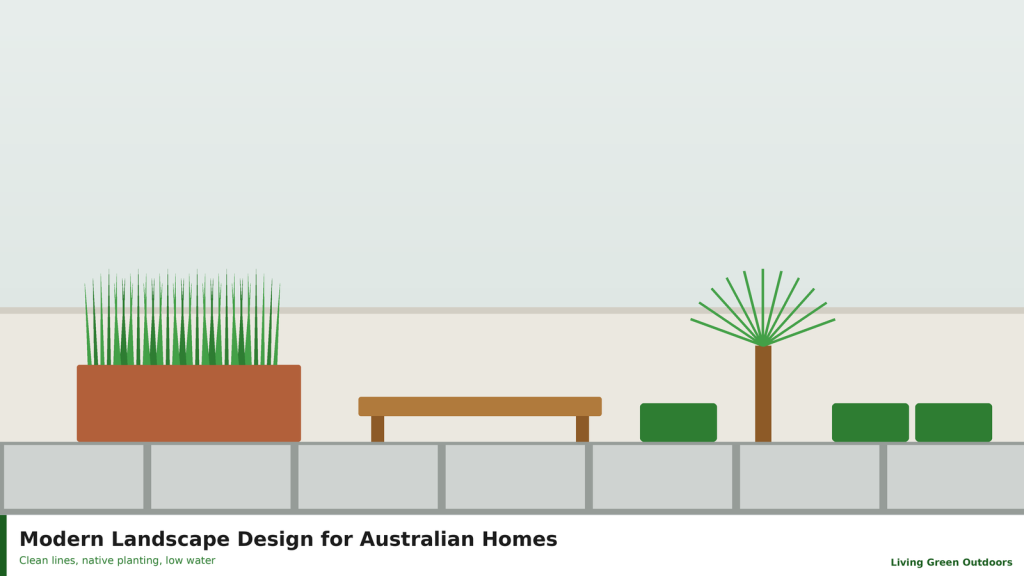
Featured illustration (original artwork) — alt: A modern Australian garden with clean lines and native planting.
Modern landscape design gets misread as cold and sparse, all grey concrete and not much else. Done well in an Australian setting, it is the opposite. Clean and uncluttered, yes, but warm, green and built around the way we actually live outdoors. The trick is taking the modern look and grounding it in plants and materials that suit the local climate.
Here is what a modern garden actually looks like when it is designed for an Australian home rather than a European one.
Clean lines and clear geometry
Modern design leans on strong, simple shapes. Rectangular paving, straight or boldly curved garden beds, defined edges and a clear structure you can read at a glance. The opposite of the fussy, busy cottage garden. This restraint is what makes a space feel calm and considered rather than chaotic, and it is surprisingly forgiving to maintain because there is less going on.
The geometry does not have to be rigid to be modern. A single sweeping curve through a lawn, or one strong diagonal across a courtyard, can be just as clean as a grid of squares. What matters is that the shape is deliberate and you can read it, rather than a vague edge that wanders because nobody decided where it should go.
Native planting, used architecturally
The smartest modern Australian gardens use natives as design elements, not as an afterthought. Strappy lomandra and dianella give you structure and movement. Mass-planted grasses read as a single clean sweep rather than a jumble. A feature grass tree or a sculptural grevillea becomes a living centrepiece. The result is contemporary and unmistakably local, and it copes with heat and drought far better than the imported look-alikes.
A restrained palette
Modern design picks a few materials and repeats them rather than using one of everything. Concrete, timber, a single stone, maybe corten steel for a warm rust accent. Carrying two or three materials through the whole garden ties it together. The same discipline applies to plants: a shorter list, repeated with confidence, looks more designed than a collection of singles.
Designing for water, not against it
Any modern Australian garden worth the name is built to handle our climate. That means drought-tolerant planting, smart use of mulch, and drip irrigation rather than thirsty lawns and sprinklers fighting the heat. Permeable paving and gravel that let rain soak in rather than run off are both practical and part of the clean modern look. A garden that needs constant water to survive a Sydney summer is not modern, it is just high-maintenance.
Indoor and outdoor as one space
A defining feature of modern Australian homes is the blur between inside and out. Large openings, a deck or paved area that sits flush with the interior floor, and an outdoor space furnished like a room. The garden becomes part of the living area rather than something you look at through glass. Getting the levels and the flow right between the two is where this idea succeeds or falls flat.
Small choices sell the effect. Carrying a similar flooring tone from inside out, lining up a doorway with a path or a feature beyond it, and keeping sightlines clear all make the two spaces read as one. When it works, the backyard stops feeling like a separate place and starts feeling like another room you happen to walk outside to reach.
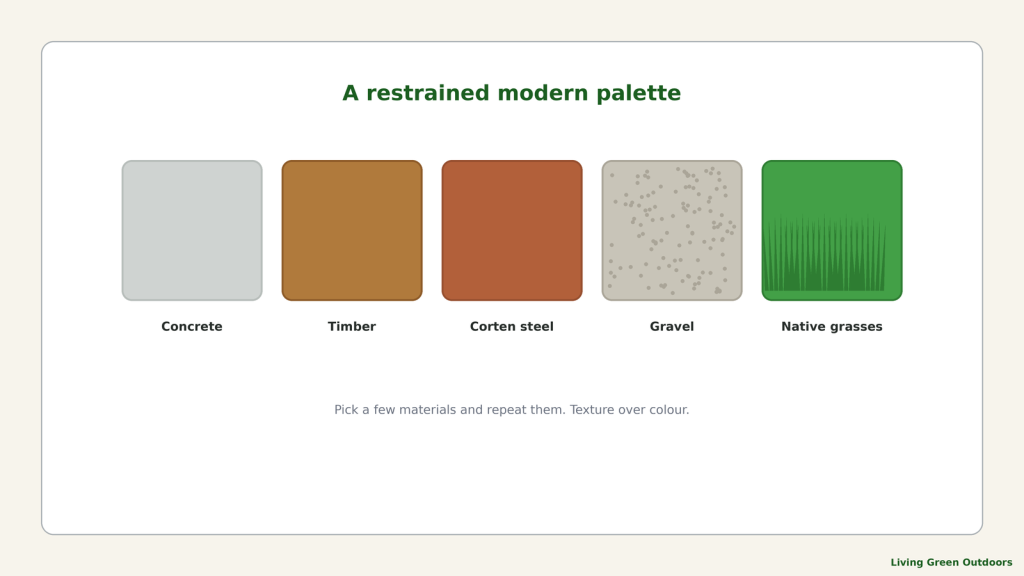
A restrained modern materials palette.
Lighting as part of the design
Modern landscapes treat lighting as a built-in element, not a string of solar lights added later. Warm uplighting on a feature tree, low lights washing along a wall, a soft glow that lets the space be used after dark. Planned from the start, lighting extends the hours you get out of the garden and gives it a second life at night.
Texture instead of colour overload
Where a traditional garden chases flowers and colour, modern design plays with texture and form. The fine softness of grasses against the hard face of a concrete wall. Smooth pebbles beside rough timber. Bold leaf shapes against a plain backdrop. It is a quieter palette that ages well and does not depend on everything being in bloom to look good.
Modern works on a small block too
You do not need a big yard for this. If anything, the clean modern approach suits small courtyards and townhouse gardens better than a busy cottage style, which feels cramped in a tight space. A single material underfoot, a feature plant or two, a built-in bench and a screen for privacy can turn a pocket-sized courtyard into a proper outdoor room. Restraint reads as generous when space is tight.
Sustainability is built in, not bolted on
The modern Australian garden and a sustainable one are close to the same thing. Native and drought-tolerant planting, less lawn, permeable surfaces that let rain recharge the soil, a rainwater tank feeding the irrigation, and compost closing the loop on green waste. None of it looks like a compromise. It just happens to use less water, less power and less of your time, which is the whole point.
Making it work on a real block
The honest part: a clean modern look is harder to pull off than a relaxed cottage garden, because there is nowhere to hide. Wonky edges, uneven paving and a bed that does not quite line up all show. The structure has to be right, which is where careful modern landscape design earns its keep. A good design also suits the house. A modern garden in front of a heritage cottage looks out of place, so the style should follow the architecture.
Low-maintenance is a feature, not a compromise
One of the quiet wins of modern design is that it tends to be easier to look after. Fewer plant varieties, hardy natives, mulched beds and less lawn all mean less work. You are not trading a beautiful garden for a high-maintenance one. Done right, the modern approach gives you both, a sharp-looking space and your weekends back.
If a modern garden is what you are after, it is worth getting the structure and planting plan right before any concrete is poured. Living Green Outdoors can help translate the look you want into something that suits your block and the Australian climate. The easiest first step is to talk to the team about what is realistic for your space.
Modern, but liveable
The best modern Australian gardens are not minimalist for the sake of it. They are clean, structured spaces built around native plants, smart water use and a strong connection to the house. Get the bones right, choose materials and plants that suit the climate, and you end up with a garden that looks contemporary, lives well and does not run you ragged keeping it alive. That last part is the real win. A garden that looks sharp and still gives you your Sunday back is worth far more than one that only photographs well.