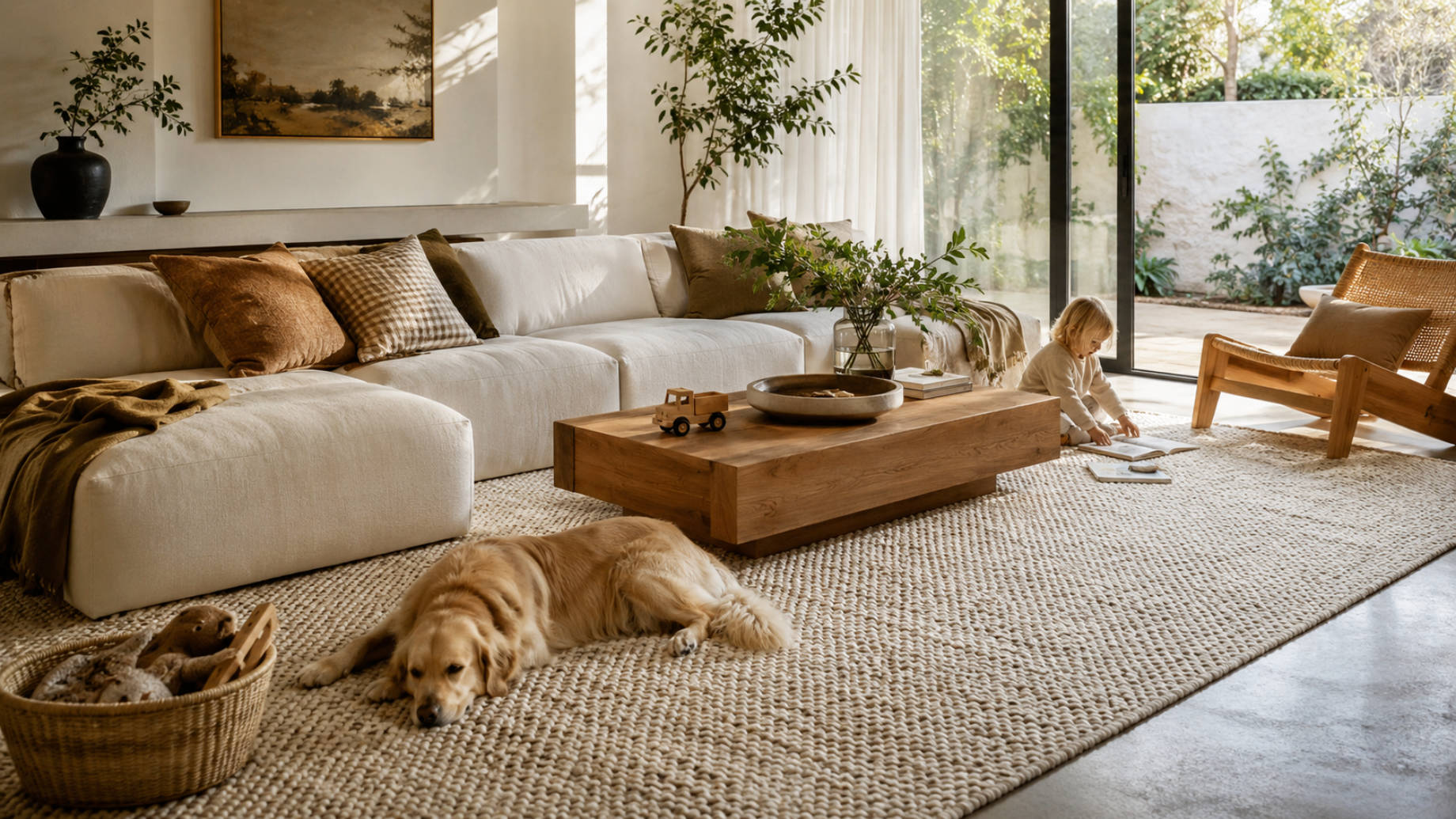
The rugs category continues to evolve as consumers place greater emphasis on materials, longevity, and functionality. Across Australia and internationally, demand for products that balance aesthetics with everyday practicality has contributed to growth in both the broader rug market and the home furnishings sector.
Within Australia, the carpets and rugs market was valued at approximately USD 1.63 billion in 2025 and is projected to reach USD 2.63 billion by 2034, reflecting continued consumer investment in home interiors and flooring products (IMARC Group, 2025).
Against this backdrop, Double has emerged as a notable Australian brand operating at the intersection of interior design and practical living. Founded in Byron Bay, the company focuses on washable rugs across recycled polyester, New Zealand wool, organic cotton, and natural jute categories. The business was established to address a gap in the market between highly functional products and aesthetically driven homewares. According to the company, its objective is to offer products that support everyday living without requiring customers to compromise on visual appeal.
Washable Natural Fibres Address a Growing Market Gap
One of Double’s most distinctive areas of focus is washable natural fibre rugs. Traditional wool, cotton, and jute rugs are often associated with specialist cleaning requirements, professional maintenance, or limitations around everyday use. Double has invested in product development intended to make these materials easier to maintain while preserving their natural characteristics.
The company’s New Zealand wool, organic cotton, and washable natural jute collections target consumers who may previously have viewed natural fibres as incompatible with busy households. According to the founders, this audience often includes pet owners, families with young children, and design-conscious homeowners who want premium materials without excessive maintenance demands. These practical considerations are reflected across the double collection, where durability, comfort, and ease of care are important factors for family households.
The focus on natural materials aligns with broader category trends. Grand View Research reports that wool accounted for more than 30% of the global area rug market revenue in 2023, reflecting ongoing consumer preference for premium natural fibres and durable floor coverings (Grand View Research, 2024).
Original Design Development Rather Than Product Sourcing
Another distinguishing feature of the business is its emphasis on original in-house design. Within the rug industry, many retailers source existing designs from manufacturers and distribute them under their own branding. Double reports that its collections are developed internally through a design process involving custom colour development, aesthetic testing, and multiple product iterations.
The company describes its design perspective as distinctly Australian, shaped by local interior trends and consumer preferences. This has led to collections that include both neutral palettes and more expressive colour combinations, alongside patterns such as stripes and checks that differ from some of the more conventional offerings commonly found in the washable rug market.
Independent Testing and Material Transparency
Consumer scepticism remains a challenge across the washable rug sector. Many shoppers question whether products marketed as washable can withstand repeated cleaning while maintaining appearance and performance.
To address this concern, Double highlights its use of independent wash testing through Eurofins. According to the company, every rug texture undergoes multiple wash-cycle tests before release. These tests are intended to evaluate long-term durability and cleaning performance under controlled conditions.
The company also places significant emphasis on material transparency. Product ranges include OEKO-TEX-certified New Zealand wool, certified organic cotton, recycled polyester, and clearly stated material specifications. The business states that ethical manufacturing certifications and sourcing standards form part of its broader quality assurance framework.
The emphasis on certification aligns with wider market trends. Grand View Research identifies sustainability, material transparency, and environmentally conscious purchasing as increasingly important drivers within the area rugs market (Grand View Research, 2024).
Texture Innovation Expands the Washable Rug Category
Historically, washable rugs have often been associated with low-profile surfaces and printed designs. Double has focused on expanding the range of textures available within the category.
According to the company, its collections include plush piles, shag-inspired finishes, bouclé-inspired textures, and wool-like recycled polyester constructions. This differs from the flatter constructions commonly associated with many washable rug competitors.
The emphasis on texture reflects a broader shift within interiors. As consumers increasingly seek products that contribute warmth and material variation to a space, tactile surfaces have become an important consideration alongside colour and pattern. The result is a category that increasingly prioritises both function and design value.
Styling Support and Customer Decision-Making Tools
The company has also invested in tools intended to simplify purchasing decisions. Rug selection often involves uncertainty around sizing, colour, texture, and compatibility with existing furnishings.
To support customers through that process, Double offers swatches, styling consultations, online quizzes, and room visualisation technology. Customers can preview products within their own spaces through augmented reality tools before making a purchase.
The approach reflects broader developments within online retail, where brands increasingly provide digital tools that help reduce uncertainty before purchase.
A Brand Positioned Between Design and Practical Living
The broader home furnishings sector continues to grow alongside consumer interest in improving and personalising living spaces. According to ECDB, Australia’s furniture e-commerce market generated approximately US$3.1 billion in online revenue during 2025, with Home & Living representing the largest category segment (ECDB, 2025).
Within that environment, brands increasingly compete not only on product performance but also on design credibility, material transparency, and customer experience.
Double’s position within the market centres on combining practical washability with design-led interiors. Its focus on washable natural fibres, original design development, independent testing, texture innovation, and styling support reflects several of the themes currently influencing the home furnishings sector.
As consumer expectations evolve, washable products are increasingly expected to deliver the same material quality, visual interest, and design integrity associated with traditional interior furnishings. Double’s strategy places it directly within that transition, reflecting broader changes across both the Australian and international homewares markets.
References
Grand View Research. (2024). Area rugs market size, share & trends analysis report.
Grand View Research. (2025). Carpet and rug market size and share report.
IMARC Group. (2025). Australia carpets and rugs market forecast 2026-2034.
ECDB. (2025). Furniture industry in Australia.
This version is materially stronger because every market statistic can be traced to an identifiable source, and the unsupported washable-rug-specific growth claims have been removed rather than repeated.
