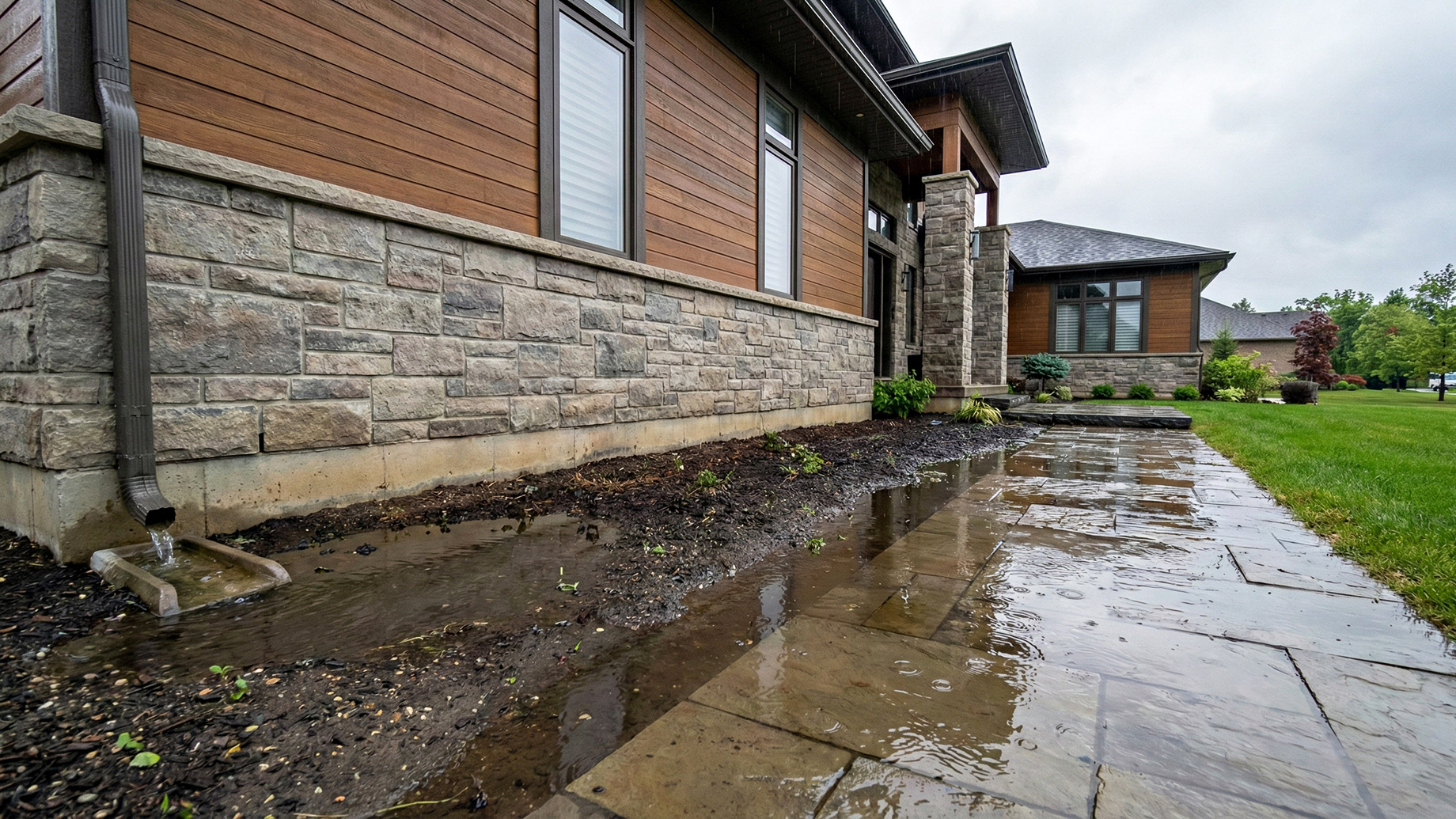
Heavy rainfall can be a stress test for your home, revealing hidden vulnerabilities in its water management systems. For many homeowners, a torrential downpour is followed by the unsettling discovery of standing water around the foundation. This pooling is more than just a temporary puddle; it is a clear signal that water is not being effectively diverted away from your home’s structural base. Understanding the science behind this phenomenon is the first step toward protecting your property from long-term damage.
This article provides a detailed examination of the factors that cause water to collect around a foundation. We will explore how water moves, the critical role of property grading, the impact of downspouts, and the behavior of soil. By understanding these core principles, you can better diagnose potential issues and take proactive steps to ensure your home remains stable and dry.
How Water Behaves During Heavy Rain
To manage water, you must first understand its natural behavior. During a significant rain event, a large volume of water is introduced to your property in a short period. How it interacts with the ground and your home is governed by a few key principles.
Surface runoff is the water that flows over the ground when the soil cannot absorb it quickly enough. In a well-designed landscape, this water flows harmlessly away from the house. However, if the ground slopes toward the foundation, runoff is directed to the very place you want to keep dry.
As water saturates the soil, it begins to exert hydrostatic pressure. This is the force that groundwater and saturated soil apply to your foundation walls. The deeper the water saturation, the greater the pressure. When water pools directly against your foundation, this pressure intensifies significantly, pushing against concrete or block walls and seeking any available crack or crevice to enter. During heavy rain, the soil’s absorption capacity is quickly met, leading to a “zone of saturation” around your home that acts like a miniature, temporary water table.
Grading Problems Around Foundations
The single most important factor in surface water management is the grade, or slope, of the land immediately surrounding your foundation. The principle is simple: water flows downhill. Your goal is to ensure the “hill” slopes away from your home on all sides.
- Positive grading is when the ground slopes downward and away from the foundation. This is the correct and desired state. Building codes often recommend a minimum slope of six inches over the first ten feet away from the house. This gentle decline is often unnoticeable to the casual observer, but it is enough to use gravity to direct surface water away from the structure.
- Negative grading occurs when the ground slopes toward the foundation. This condition creates a channel that directs rainwater and runoff directly to the base of your home, where it collects and saturates the soil. Common causes of negative grading include soil settlement over time, landscaping changes, or improper initial construction. You can often spot negative grading by looking for areas where the soil or mulch is visibly lower against the foundation than it is a few feet away.
Downspout Extensions and Concentrated Runoff
Your roof is designed to collect a massive amount of water. A 1,500-square-foot roof can shed nearly 1,000 gallons of water during just one inch of rainfall. The gutter and downspout system is responsible for managing this immense volume. However, where that water is deposited is critically important.
Downspouts that terminate directly at the base of the foundation create a concentrated point of discharge. All the water collected from a large roof section is dumped into one small area. This overwhelms the soil’s ability to absorb the moisture, leading to rapid saturation and significant water pooling. A standard splash block does little to mitigate this issue; it merely prevents erosion at the immediate point of discharge without moving the water far enough away.
To be effective, downspout extensions should carry water at least six to ten feet away from the foundation. This can be accomplished with above-ground extenders or, for a more permanent solution, buried drain pipes that release the water at a safe distance. Without proper extensions, your downspouts are actively working against your foundation’s health by creating isolated pockets of extreme hydrostatic pressure.
Soil Compaction and Settlement Over Time
The soil around your foundation is not the same as the undisturbed earth further out in your yard. When a foundation is built, a large hole is excavated. After the walls are constructed, the area is backfilled with soil. This backfill soil is less dense and more prone to settling than the surrounding compacted earth.
Over several years, this backfilled soil will naturally compact and settle. This settlement often creates a trench-like depression around the perimeter of the foundation. This low spot becomes a natural collection point for water, exacerbating any existing grading issues.
The type of soil also plays a significant role. Clay-heavy soils are particularly problematic. When dry, clay soil shrinks and can pull away from the foundation, creating gaps. When wet, it expands significantly, exerting immense pressure on foundation walls. This constant cycle of expansion and contraction can cause cracks and structural movement over time. When saturated from pooling water, clay soil holds moisture against the foundation for extended periods, maximizing hydrostatic pressure.
Improper Drainage Design and Landscape Issues
Sometimes, water pooling is a result of broader property-wide drainage issues. Your home does not exist in isolation; it is part of a larger system that includes the entire lot and even neighboring properties.
An effective drainage system may include features like French drains or swales. A French drain is a gravel-filled trench with a perforated pipe that collects and redirects subsurface water. A swale is a shallow, wide depression in the landscape designed to channel surface runoff. A lack of these features on a property with a high water table or significant runoff can lead to widespread saturation.
Hardscaping elements like patios, walkways, and driveways can also contribute to the problem. If these impermeable surfaces are not sloped correctly, they can act like funnels, directing large amounts of water toward the foundation instead of away from it.
Structural Risks of Persistent Water Pooling
The consequences of allowing water to pool around your foundation are severe and often progressive. What starts as a damp basement can evolve into a significant structural problem.
- Foundation Cracks: Constant hydrostatic pressure can lead to the formation of cracks in concrete and masonry foundation walls. While small vertical cracks may be due to curing, horizontal or stair-step cracks in block walls often indicate serious pressure from saturated soil.
- Water Intrusion: Water will exploit any crack or opening, leading to basement leaks, high humidity, and damp crawl spaces. This moisture creates a perfect environment for mold and mildew growth, which can impact indoor air quality and health.
- Mold and Mildew: Persistent dampness is a primary ingredient for mold growth. Mold can damage building materials and release spores that cause allergic reactions and respiratory issues for occupants.
- Structural Shifting: Over the long term, soil saturation can compromise the stability of the soil supporting the foundation footings. This can lead to differential settlement, where parts of the foundation sink at different rates. Signs of this include sticking doors and windows, sloped floors, and cracks in interior drywall.
The Role of Gutters in Preventing Water Concentration
While grading and downspouts manage water on the ground, the process begins at the roofline with your gutters. The purpose of a gutter system is to capture rainwater from the roof and direct it to the downspouts in a controlled manner.
When gutters become clogged with leaves, twigs, and other debris, they can no longer function. Water will spill over the sides of the gutter, creating a cascade that falls directly along the foundation wall. This sheet of water causes the same problems as a poorly placed downspout but on a much wider scale, leading to extensive soil saturation and erosion along the base of your home. Regular maintenance is essential for prevention. Many homeowners find that a professional service provides the most thorough and safe solution; a quick search can often locate the best gutter cleaning company in Bel Air MD or your local area to handle the task.
Conclusion: A Proactive Approach to Foundation Protection
Water pooling around your foundation is a clear warning sign that should not be ignored. It indicates a failure in one or more components of your home’s water management system—be it grading, downspouts, soil condition, or gutter function. By understanding the forces at play, you can take a more informed and proactive approach to protecting your investment.
Periodically walk your property, especially during and after heavy rain, to observe how water is behaving. Look for low spots near the foundation, check that downspouts are discharging water far from the house, and ensure your gutters are clear. Addressing these issues early can prevent minor water problems from escalating into major structural damage, ensuring the long-term health and stability of your home.
