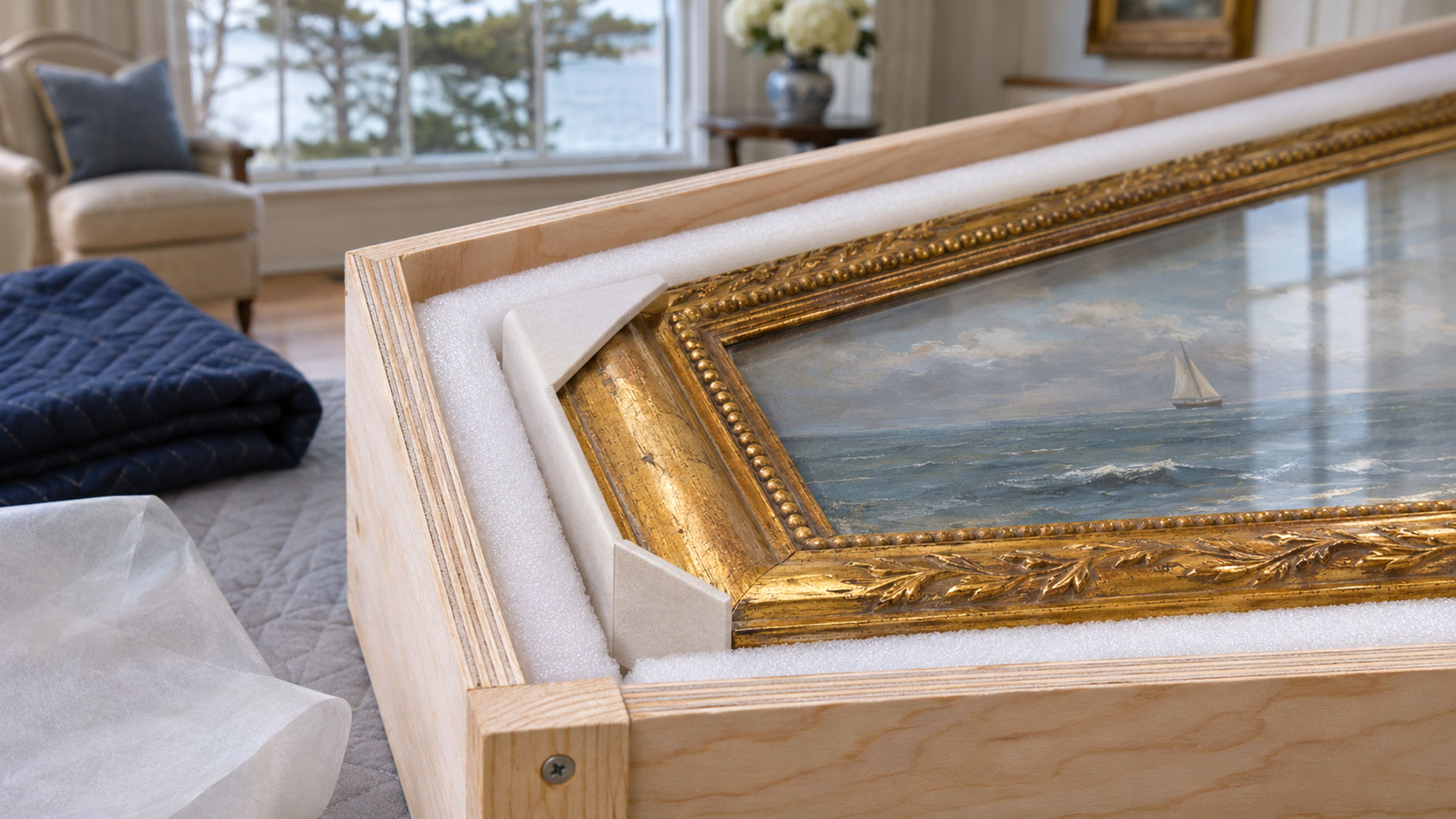
Integrity Movers, one of the most experienced moving companies in Portland, Maine, has spent more than a decade helping families relocate across Greater Portland and the Southern Maine coast. One lesson holds true on every job: a painting, a tall case clock, or a mahogany highboy does not travel like a box of kitchenware. It needs planning, the right materials, and people who understand how the coast affects fragile things.
Why Coastal Maine Is Hard on Art and Antiques
Conservators generally recommend keeping art and antiques at a stable relative humidity of roughly 40 to 55 percent, with temperatures in the mid-60s to low 70s Fahrenheit. Coastal Maine rarely cooperates. Summer fog pushes outdoor humidity close to saturation, while a heated house in January can dry out to 20 percent or lower.
Key insights:
- Salt air accelerates corrosion of silver, bronze, and brass hardware, as well as gilded frames.
- Humidity swings make wood panels and veneers expand and contract, cracking paint layers and loosening joints.
- Freeze-thaw cycles mean a piece moved from a cold truck into a warm room can collect condensation on its surface.
- Damp storage in basements or seasonal cottages invites mold on paper, textiles, and canvas.
Before the Truck Arrives: Inventory, Appraisal, and Insurance
Document Everything
Photograph each piece from several angles, noting existing scratches, cracks, or flaking. Record dimensions, maker, and provenance. That record becomes your condition report if you ever need to file a claim.
Understand Valuation Coverage
This is where many owners are caught off guard. Basic released-value protection on interstate moves pays just 60 cents per pound per item, so a 10-pound oil painting worth $25,000 would be covered for about $6. Get a current appraisal, ask about full-value protection, and check whether a fine-art rider on your homeowners policy covers items in transit.
Custom Crating, Specialty Packing, and Climate Control
Paintings under glass, marble sculpture, and stone-topped furniture belong in custom wooden crates with foam bracing, not cardboard. Canvas works should be wrapped in acid-free glassine, because plastic pressed directly against a surface traps moisture.
If a closing date slips, short-term storage becomes necessary. For a collection, that means climate-controlled space, not an unheated unit. Ask how storage is monitored and protected from pests.
How much does it cost to hire movers in Portland?
For a local move around Portland, Maine, expect to pay anywhere from a few hundred dollars for a studio or one-bedroom apartment to several thousand for a larger house. Most local crews bill by the hour, and a team of two or three movers with a truck usually costs somewhere between $130 and $200 per hour. If you need white-glove handling, the price increases to cover custom crating, specialized labor, and additional protection. Building a crate for a single painting or sculpture can add a few hundred dollars per piece, depending on its size. The only way to get an accurate number for an art collection or other high-value items is to schedule an in-home or video walkthrough with the moving crew.
What are the hidden costs of moving?
- Long carries, stairs, and tight entries that add labor time
- Shuttle trucks for driveways a full-size truck cannot reach
- Custom crating and specialty packing materials
- Storage when closing dates don’t line up
- Full-value protection upgrades
- Appraisals and condition reports
- Reinstallation of chandeliers, mirrors, and heavy artwork
How far in advance should I book movers?
Book at least six to eight weeks ahead for a standard move and eight to twelve weeks for white-glove service, especially between May and September, when Southern Maine’s moving season peaks.
Timing Around Winter and Mud Season
Winter moves are workable when crews protect pieces from cold and stage them indoors before unwrapping. Mud season, roughly March into April, brings soft gravel driveways and seasonal weight limits on posted roads, which can keep heavy trucks off some rural routes. Late spring and early fall offer the steadiest conditions for sensitive pieces.
Access at Waterfront, Gated, and Hillside Properties
Prouts Neck’s narrow private lanes, Cape Elizabeth’s ledge driveways, and the steep lots along Falmouth Foreside all complicate access. Picture a shingle-style cottage where the truck stops a quarter mile from the door. The crew shifts to a shuttle truck, then hand-carries a crated seascape down a granite path. That works only with a site visit beforehand and coordination with gate staff or the homeowners’ association.
What to Look for in Experienced Local Movers
When comparing moving companies in Portland Maine, look past the hourly rate. Ask about training in art and antique handling, crating capability, and how the crew has handled coastal properties before. A company that knows local roads, seasonal patterns, and building access will plan around problems before they arise.
Movers in Saco, Maine and Westbrook, ME
Moves between Saco’s beach neighborhoods and Westbrook’s older mill-era homes often mean summer traffic on Route 1, narrow streets, and steep interior stairways, all of which affect scheduling and handling.
Movers in Brunswick, Maine and the Midcoast
Longer runs up the coast call for climate-aware routing so pieces never sit for hours in a hot or freezing truck.
Questions to Ask Before Hiring
- Do your crews have specific training in art and antique handling?
- Do you build custom crates, or work with a partner who does?
- What valuation coverage do you offer, and what does it cost?
- Is your storage climate-controlled and monitored?
- Will someone visit both properties before moving day?
What items are not worth moving?
- Furniture that won’t suit the scale or style of the new home
- Inexpensive prints and reproductions that cost more to crate than to replace
- Damaged pieces where restoration would exceed their value, unless they carry real sentimental weight
- Paint, propane, and other hazardous materials movers cannot legally transport
Settling In: Placing and Acclimating Your Collection
Practical steps:
- Let crated pieces rest 24 to 48 hours before unpacking so they adjust gradually to indoor conditions.
- Hang works away from direct sun, radiators, fireplaces, and heat vents.
- Avoid exterior walls facing the ocean, where temperatures and moisture fluctuate most.
- Place a hygrometer near important pieces and adjust with a humidifier or dehumidifier as seasons change.
Where White-Glove Moving Has Limits
- It cannot reverse existing damage or instability in fragile pieces.
- Museum-grade works may still need a conservator’s assessment before travel.
- Coverage only helps if your documentation is accurate and complete.
- No one can control the weather, so a flexible schedule remains essential.
Conclusion
The objects we carry from home to home say a great deal about what we value. A seascape bought on a first anniversary or a grandmother’s chest cannot be replaced by an insurance check. Before moving day arrives, it is worth asking a simple question. Which pieces would you be heartbroken to lose, and has your moving plan truly been built around them?
