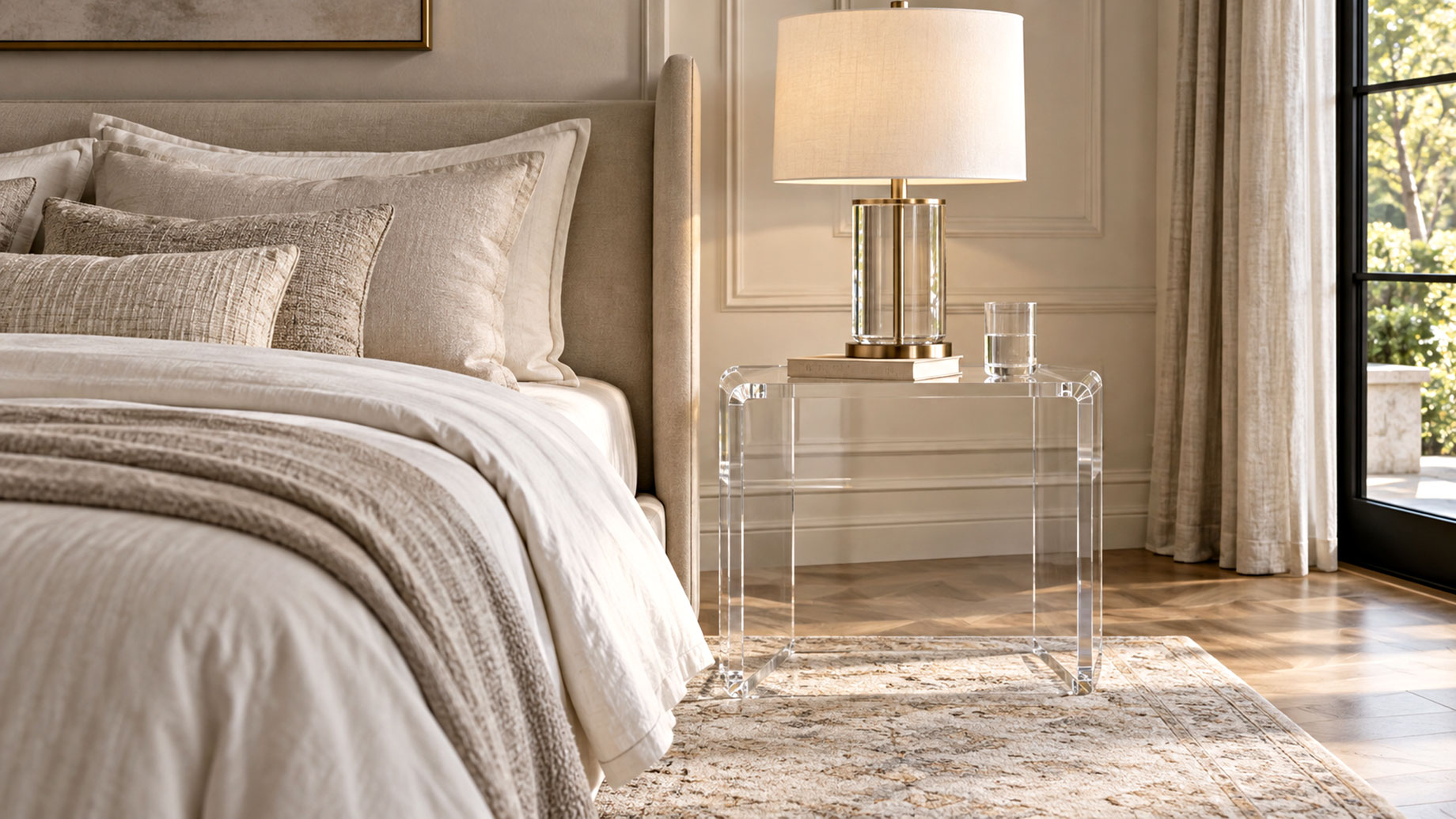
A bulky walnut nightstand can make even a carefully designed primary suite feel crowded. Swap that piece for clear acrylic and the same corner suddenly breathes. The room feels bigger without a single wall moving.
That optical trick is why see-through furniture keeps showing up in high-end homes. Take a modern clear acrylic (perspex) nightstand for your bedroom and you keep every function of a bedside table with almost none of the visual weight. You still get a lamp, a book, and a glass of water within arm’s reach. The difference is that the furniture holding them no longer dominates the corner.
Skeptics call acrylic cheap. That reaction usually comes from party rental chairs, not from the thick cast pieces sitting in design showrooms. The material has a long, surprisingly glamorous history, and it solves a problem that solid wood simply cannot.
Why does clear furniture make a room feel larger?
Solid furniture eats light. A dark wood nightstand absorbs light and reads as a solid mass you have to walk around. Acrylic does the opposite. Light passes through, bends slightly at the beveled edges, and reaches the wall behind it. Your eye reads the outline as a suggestion rather than a wall.
Designers lean on this in tight primary suites, glass-walled condos, and any room where the bed sits close to a window. Transparency also lets the floor finish or the rug pattern remain visible underneath the piece, which extends the visual line of the room. If you have paid for wide-plank oak or polished concrete, a transparent nightstand lets those finishes remain part of the composition.
Clear acrylic can also be a practical alternative to glass in a bedroom, particularly when resistance to everyday knocks matters. Near a nightstand where you set down a mug at 6 a.m., that can be a useful consideration. Acrylic is not indestructible, however, so the thickness, construction, and intended use of the piece still deserve attention.
The origin story most people get wrong
Acrylic sheets arrived commercially in the 1930s, and one of the first industries to fall for them was Hollywood. Set designers wanted furniture and props that looked futuristic and could be moved fast under hot lights, and clear plastic delivered both. The material then spread into aviation windows and display cases before landing back in interiors during the 1970s, when clear seating and tables became shorthand for a modern home.
The technical side of that story is well documented by standards bodies that govern how plastics get specified and tested for optical clarity and durability, including the Society of Motion Picture and Television Engineers, whose early work with projection and display materials helped push clear plastics into mainstream production. What matters for your bedroom is simpler: check the manufacturer’s specifications for clarity, durability, and resistance to yellowing rather than assuming every clear piece will perform identically.
Clear acrylic versus glass, wood, and metal
Here is how the options stack up when you are standing in a showroom trying to decide.
| Material | Visual Weight | Care | Best for |
|---|---|---|---|
| Cast acrylic | Nearly invisible | Soft cloth and mild soap, following the manufacturer’s guidance | Small rooms and glass-walled condos |
| Tempered glass | Low, with a crisp appearance | Suitable glass cleaner; attention to streaks and fingerprints | Formal, minimal interiors |
| Solid wood | Heavy and grounding | Cleaning and care suited to the finish | Large rooms needing warmth |
| Polished metal | Medium and reflective | Finish-appropriate cleaning to remove fingerprints | Industrial and loft spaces |
Wood still wins when a room feels echoey and cold and you want the furniture to anchor it. Acrylic wins when the room is already beautiful and you do not want to cover any of it up. That is the trade in one sentence.
A quick styling routine you can actually follow
Clear furniture gets a bad reputation when people treat it like an empty shelf. A transparent surface does not visually conceal clutter, so everything sitting on it becomes part of the composition. Run through this when you set the piece up.
- Pick one tall object and one low object. A slim lamp plus a stack of two books. That is the whole arrangement.
- Choose matte textures. Ceramic, linen, and brushed brass give the transparent surface something to contrast with. Too many shiny objects can turn into visual noise.
- Keep roughly two-thirds of the tabletop clear. The empty space is part of the design, not something you need to fill.
- Run the lamp cord discreetly behind a rear edge or leg rather than across the front. Transparent furniture makes cable management especially noticeable.
- Wipe with a clean, soft microfiber cloth and mild soapy water, following the manufacturer’s care instructions. Skip ammonia sprays.
Placement matters as much as styling. Pull the nightstand a few inches off the wall and assess it from the doorway. A little separation can make the outline easier to appreciate and prevent the piece from looking pressed into the corner.
What about resale and cost?
Spending real money on plastic can sound strange until you compare it with a designer lacquer cabinet. Well-made acrylic can sit in a similar price band to quality hardwood pieces. Look beyond the material label and examine the thickness, edge finishing, joints, stability, and overall construction before deciding whether the price is justified.
There is also a labor angle worth knowing. Furniture manufacturing, including the skilled cutting and finishing that goes into acrylic pieces, is part of an American production workforce tracked by the Bureau of Labor Statistics, which counts furniture and related product manufacturing among the country’s established goods-producing sectors. Buying from a maker who finishes pieces domestically supports that part of the production chain.
For collectors and history-minded buyers, the material’s cultural arc from 1930s movie sets to 1970s living rooms to today’s minimal interiors is documented in the design archives covered by Smithsonian Magazine, which has traced how once-futuristic plastics became collectible objects in their own right. Some earlier pieces command substantial prices, but that does not establish what a contemporary nightstand will be worth in ten years. Choose it for its design, construction, and usefulness rather than an assumed resale return.
Choosing the right size for your bed
The top of the nightstand should land within an inch or two of your mattress top. Too low and you reach down in the dark. Too high and it crowds the headboard. Aim for roughly two feet of width in a standard bedroom, and go narrower if you are squeezing between the bed and a window.
Check the leg profile before you buy. Splayed legs feel lighter and more mid-century. Straight square legs read as more architectural. Rounded or wavy edges soften a room with a lot of hard angles, giving you another way to connect the piece with the surrounding design.
One more thing: check the actual product weight and load rating before it arrives. A transparent appearance does not tell you how heavy or stable a piece will be. Panel thickness, proportions, and construction all deserve attention, especially if your cat treats the nightstand as a launch pad. Avoid choosing on appearance alone; inspect the joints and check for wobble where possible.
Where this leaves your bedroom
Transparent furniture offers more than a passing visual effect. It addresses a practical design problem: how to keep everything you need within reach without blocking the view of a room you have carefully put together. The piece should recede. What stays is the light, the floor, and the architecture behind it.
So before you fill that empty corner beside the bed with another heavy box, stand in the doorway and ask what you would rather see. A more open-looking corner, or another solid piece of furniture?
