Why buyers want smaller homes but refuse to compromise on personalization
Something counterintuitive is happening in the American housing market. Buyers are accepting smaller homes in greater numbers than at any point in the past decade and a half. But they’re not accepting less personalization — quite the opposite. According to a 2025 NAHB report on home buyer preferences, buyers want their homes to feel like they were designed specifically for them — significantly different from their neighbors’, reflective of how they actually live. The closet is one of the clearest expressions of this demand: a daily-use space that should fit the specific person using it, not a generic profile of what an average wardrobe looks like.
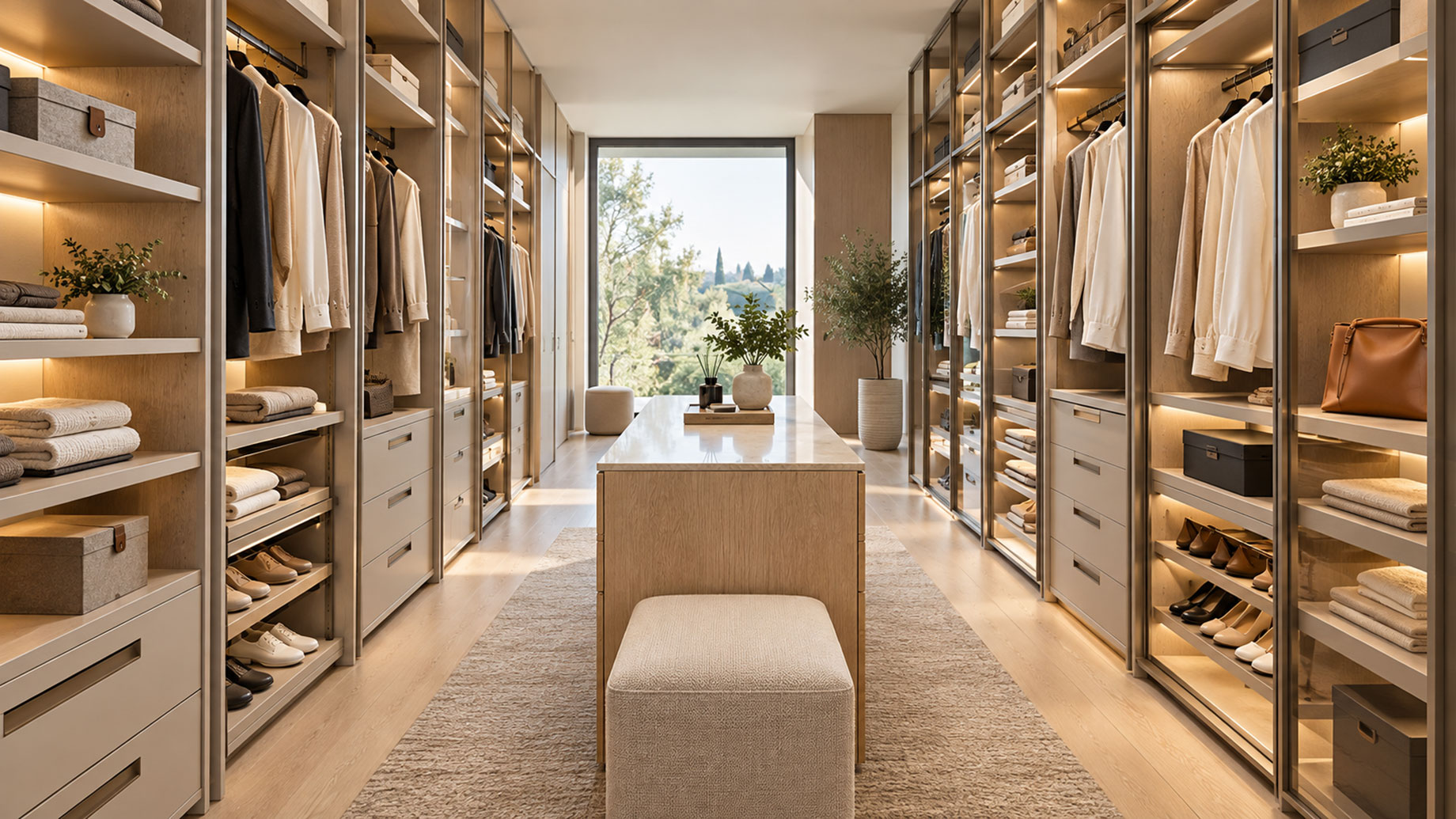
A modular walk-in closet system is the most direct architectural response to this demand — not just at installation, but across the life of the space. Ornare’s modular closet collections are built on a system architecture that allows the interior configuration to be modified, expanded, or reorganized as the household’s needs evolve, without replacing the structural framework that defines the closet.
The hidden cost of closets that can’t change
A custom walk-in closet built on a fixed internal structure — a predetermined allocation of hanging space, shelving, and drawers that made sense when it was specified — becomes a poor fit the moment life changes in any meaningful way. Wardrobes shift from formal-heavy to casual-dominant as work patterns change. A closet designed for two becomes a closet for one. A child’s wardrobe of small, frequently replaced items gives way to a teenager’s very different storage needs. None of these changes are unusual. All of them can render a fixed-configuration closet functionally obsolete while its materials still look brand new.
The answer isn’t a larger closet. It’s a smarter one: a system designed from the outset to be reconfigured as needs change, without the cost and disruption of a full replacement. In a genuinely modular high end closet system, the fundamental building blocks — hanging modules, drawer units, shelving towers, door panels, lighting systems — can be added, removed, or recombined without structural modification of the closet itself. The bones stay; everything inside adapts.
The closet that moves with you
Stefan Schattan, CEO of Ornare, points to an aspect of quality closet ownership that most buyers don’t anticipate when they make their initial investment: “We have clients who move to a new home and take their entire closet system with them. That says something significant — not just about the quality of what we build, but about the importance of ongoing support. A closet isn’t a one-time purchase. It’s a relationship that needs to be maintained and adapted as life changes.”
The portability of a well-built modular wardrobe system is a function of both construction quality and the availability of technical support from the manufacturer. A modular system that can’t be serviced — because the product line has changed, because components are no longer available, or because installation support has been discontinued — loses its primary advantage over a fixed installation. The choice of brand matters as much as the choice of system.
Designing for the family that keeps changing
The households that benefit most from modular closet design are those in active transition: growing families whose children’s wardrobe needs shift dramatically every few years; couples whose professional wardrobes evolve as careers change direction; empty nesters who suddenly find half their closet underused. For each of these situations, a modular system provides a straightforward path to reconfiguration — one that doesn’t require renovation, doesn’t generate significant waste, and doesn’t require the household to live through a weeks-long construction project.
Ornare’s Infinite collection makes this flexibility visible in its design: continuous floor-to-ceiling panels that read as a single resolved architectural surface, regardless of how the interior is configured. Change everything inside; the exterior remains coherent.
