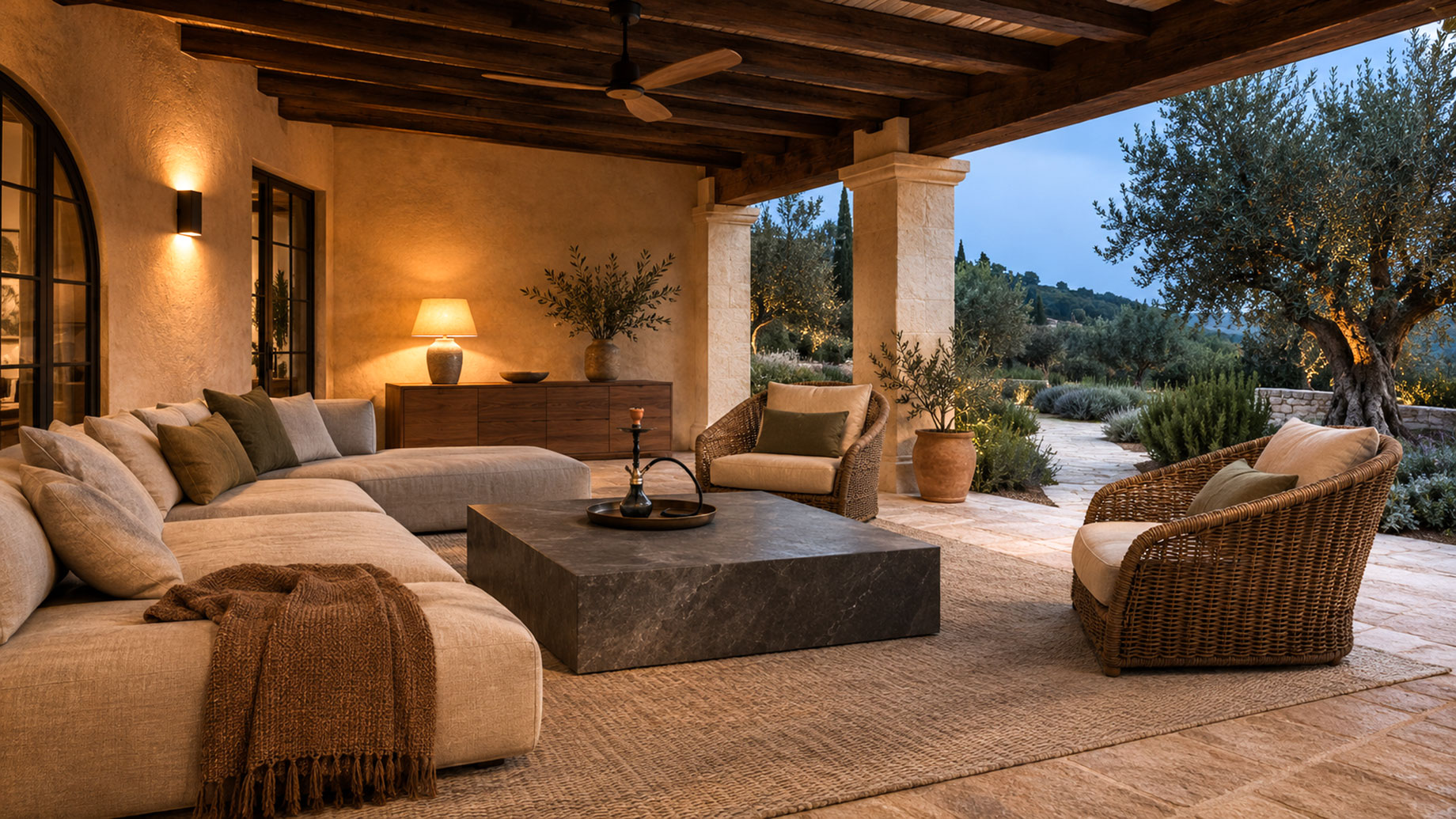
Every serious house has a place for a drink. A bar cart in the living room, a wet bar off the terrace, a cabinet with the good glasses in the den. Nobody questions it, because making someone a drink is part of how a house entertains. Over the past few years a second ritual has been showing up in the same rooms, and in the briefs for new builds and renovations from Miami to Dubai to Los Angeles: the hookah, set on a low table, tended for an hour or two after dinner while the conversation runs on.
Like the bar, it works beautifully when the space is planned for it and looks like clutter when it is not. Here is how to think about a hookah lounge as a designed space, which turns out to be less about the pipe and more about everything around it.
Where it goes
The first decision is location, and it is usually the one that gets made last. A hookah produces smoke, so it wants air. In warm climates that points straight to the covered terrace, the pool cabana or the loggia, which is where most of the best examples end up: a low table, deep seating, a ceiling fan, and a view. In colder markets it means a room with a window that opens, or a conservatory, or a lower-level lounge with its own ventilation. What it does not mean is the formal living room with the silk drapes.
If the house is being designed from scratch, treat the hookah lounge the way you would treat a cigar room: a dedicated zone with its own extraction, hard surfaces, and a door. If it is a retrofit, the covered outdoor space is almost always the right answer, and it has the advantage of making the lounge a destination rather than a corner of a room that is already doing something else.
Start with the table, not the pipe
A hookah is used at table height by people seated low. That rules out the dining table and points to a coffee table or a low side table with floor space around it. The table needs to be stable, because a tall pipe on a wobbly surface is a problem, and it needs a surface that can take a little heat and a little ash. Stone, slate, concrete and sealed hardwood are fine. Lacquer, and marble you care about, are not.
Plan the seating so people face each other and can reach the hose without standing: a sectional, a pair of low chairs, floor cushions on a rug. The arrangement is the same one you would use around a fire pit, and the logic is the same. The hookah is a centerpiece, and the room is composed around it.
The pipe as an object
The modern hookah has become a design object in its own right. Stems in brushed stainless steel or anodized aluminium, bases in clear or smoked glass, handles turned from walnut or carbon fibre, pieces that would not look out of place next to a Tom Dixon lamp. Choose it the way you would choose a floor lamp: scale first (a compact model for a side table, a taller piece for the floor beside a sofa), then finish, matching the metal to what is already in the room. Monochrome setups, black on black or steel on clear, read the cleanest. The ornate brass pieces of a generation ago fight with almost everything, and the retailers that specialise in contemporary hookahs built as design objects have largely stopped carrying them.
One pipe is enough. Two on the same table reads as a shop display, and a collection belongs in a cabinet, lit, the way a collection of decanters would be.
The pieces that make it work
This is where most people under-plan. The pipe is a one-time purchase; the small components are what the evening depends on, and they need a home.
A tray under the pipe catches ash and protects the table. A clay or ceramic bowl, a heat-management lid in place of foil, a set of tongs, a small charcoal burner and a supply of disposable hose tips are the working set. If you are outfitting a lounge from scratch, Hookah Vault’s complete hookah checklist is the shopping list, and it is shorter than you would expect.
Give all of it a drawer or a lidded box within reach of the table, the same way the bar tools live near the bar cart. A good-looking tray can stay out and doubles as display. The rest should disappear when it is not in use. In a purpose-built lounge, a shallow built-in cabinet at table height, with a stone top for the burner, solves the whole problem in one piece of joinery.
Light, air and heat
Candles and lamps, not overhead light. The pipe looks best lit from the side, and a glass base picks up a flame the way a decanter does. Outdoors, a ceiling fan on low keeps the air moving without blowing the coals; indoors, extraction above the table is worth specifying early, because it is expensive to add later. The charcoal burner belongs on a stone or metal surface, never on the table itself, and never near drapery or a thatched roof.
Heat is the detail that separates a lounge that gets used from one that gets photographed once. Natural coconut coals take ten minutes to light and burn clean for an hour; the quick-light discs that come in starter kits smell chemical and run hot, and they are the reason most first attempts at home disappoint. Plan a place to light coals that is not the kitchen hob.
What to avoid
Starter kits that bundle the cheapest version of every component. Quick-light charcoal. Plastic hoses in loud colours. Pipes with mixed metals and decorative patterns that do not belong to any room you would otherwise design. Putting the lounge somewhere with no air. And the biggest one: no storage plan, so the whole setup lives on the table permanently and the lounge turns into a shelf.
The room it makes
Done well, a hookah lounge does what a well-planned bar does. It gives the house a way to keep an evening going, it looks considered when it is not in use, and it tells guests something about how the people who live there like to spend their time. In the markets where it has become standard, buyers now ask about it the way they ask about the wine room. The pipe is the visible part. The planning is in the pieces around it.
Hookah tobacco is for adults 21 and over. Nicotine is an addictive chemical.
