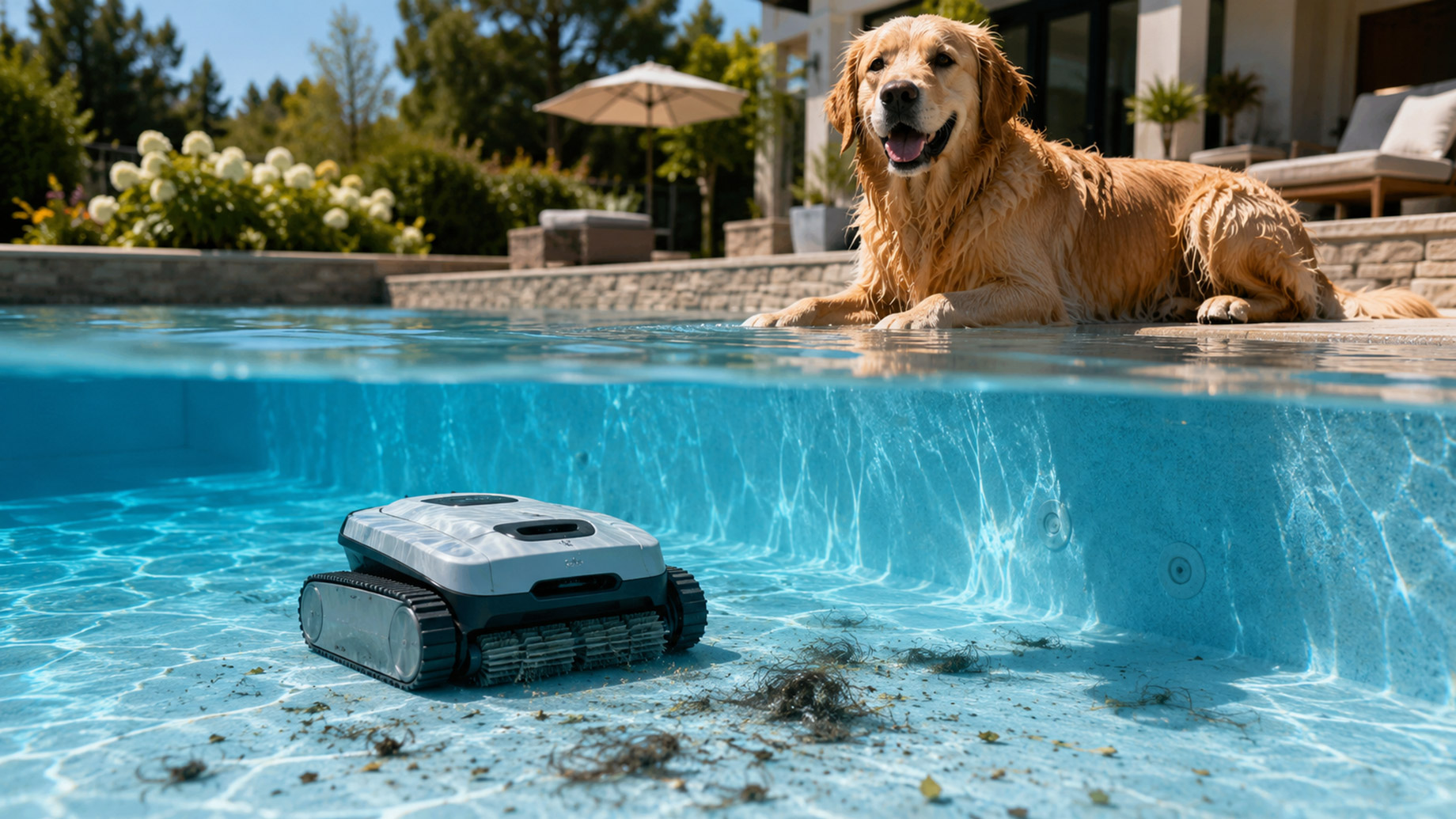
Allowing your family dog to swim is one of the greatest joys of backyard pool ownership during the sweltering summer months. Retrievers, spaniels, and other water-loving breeds happily spend hours diving for toys, paddling around the shallow end, and cooling off on the tanning ledge. However, while canine companions make for excellent swimming partners, they introduce a massive, almost instantaneous maintenance nightmare for your aquatic environment. Professional pool technicians operate under a general rule of thumb: in terms of biological and physical contamination, allowing one large dog into your pool is the exact equivalent of hosting fifty human swimmers at the same time. This massive influx of organic material completely overwhelms standard maintenance routines. To keep your water safe, clear, and mechanically sound without completely destroying your primary plumbing system, you must deploy an all-in-one robotic pool cleaner to intercept the heavy shedding before it enters your underground pipes.
The Biological and Physical Impact of Canine Swimmers
To fully grasp why a swimming dog creates such a severe maintenance challenge, you must look closely at what they are physically bringing into the water. Unlike humans who bathe regularly, a dog’s coat is a magnet for environmental debris. When your dog jumps into the deep end, they immediately release a massive cloud of dry topsoil, lawn fertilizers, microscopic pollen, and grass clippings directly into the water column.
More concerning than the yard dirt is the biological contamination. Dogs naturally produce heavy amounts of specialized skin oils and dander designed to protect their coats from the elements. When submerged in heavily chlorinated water, these oils are instantly stripped from the skin and dispersed into the pool. These thick canine oils float to the surface, creating a stubborn, sticky scum line along your perimeter tiles while simultaneously consuming your available free chlorine at an astonishingly rapid rate.
The most visible and destructive element, however, is the sheer volume of hair. A dog’s coat consists of a thick, coarse topcoat and a fine, dense undercoat. When the animal paddles, the physical resistance of the water aggressively pulls thousands of loose hairs from both coats. This hair does not behave like human hair; the fine undercoat hairs rapidly tangle together in the water, forming thick, dense mats that act like heavy wet felt.
Why Primary Filtration Fails Against Pet Hair
The standard defense mechanism for any swimming pool is the primary circulation system, consisting of the skimmer baskets, the main floor drain, the circulation pump, and the massive filter tank. Relying on this system to manage heavy canine shedding is a guaranteed recipe for catastrophic mechanical failure.
When floating dog hair is pulled into the skimmer lines, it rarely stays neatly inside the plastic skimmer basket. The fine, slippery undercoat hairs easily bypass the wide plastic grating and travel deep into the underground plumbing. Once inside, these hairs encounter the primary circulation pump. Because the pump’s impeller spins at thousands of revolutions per minute, it twists the loose dog hair into incredibly tight, restrictive ropes. These ropes wrap securely around the motor shaft, creating immense friction that can cause the pump motor to overheat, warp the plastic housing, and ultimately fail.
If the dog hair manages to survive the pump impeller and reaches your primary filter tank, the situation becomes even worse. Whether you use a sand, diatomaceous earth, or pleated cartridge filter, dog hair acts exactly like reinforced concrete rebar. The hair binds with the thick canine skin oils and the environmental dirt, creating an impenetrable, greasy mat directly over the filter media. This instantly blinds the microscopic pores of your filter, causing the internal pressure of the tank to skyrocket. Water flow drops to a trickle, circulation halts, and your pool will turn green with algae in a matter of days. You must intercept the hair mechanically on the floor before the main drain sucks it into the plumbing.
Hardware Adjustments for Maximum Hair Extraction
Utilizing an independent, motorized extraction unit is the only safe way to remove pet hair, as it traps the debris entirely inside its own chassis, completely isolating the threat from your primary pool plumbing. However, operating your hardware in an environment filled with heavy animal fur requires several deliberate, proactive adjustments to the machine itself.
If you drop a machine into a hair-filled pool without proper preparation, it will quickly choke. Implement the following mechanical adjustments to ensure flawless extraction:
- Swap the Filter Basket: Never use an ultra-fine, pleated filter panel when cleaning up after a pet. The combination of fine undercoat hair and thick dog oils will instantly seal the microscopic pleats shut, starving the machine of the hydraulic suction it needs to move. Always install your standard, high-flow mesh basket. This allows the high-velocity water to pass through while effectively trapping the thick clumps of matted fur.
- Inspect the Scrubbing Rollers: Foam PVA brushes are excellent for gripping slippery slopes, but they are highly porous and easily trap fine dog hair. If your machine features interchangeable brushes, swap to the standard PVC or rubber-bladed brushes. These rigid rubber blades aggressively sweep the hair upward into the intake ports without allowing the strands to tangle around the brush axle.
- Monitor the Top Exhaust: The top impeller is the beating heart of your extraction hardware. During heavy shedding season, you must physically inspect this exhaust port after every single cleaning cycle. Shine a bright flashlight down into the plastic fan blades. If you see dog hair beginning to wrap around the metal motor shaft, use long needle-nose pliers to gently extract the hair ring before it causes rotational friction and drains the internal battery.
A Step-by-Step Recovery Protocol for Dog Days
To effectively clear your pool after a long afternoon of canine swimming, you must execute a strict, highly logical maintenance sequence. Attempting to run your automated hardware while the dogs are still actively splashing or while the water is highly turbulent will simply scatter the hair further.
Follow this exact protocol to restore your water to a pristine, hair-free state:
- Execute an aggressive surface skim: The moment the dog leaves the pool, use a deep-bag leaf rake to manually scoop out the massive floating clumps of hair. Dog hair floats for roughly an hour before becoming fully waterlogged, so addressing the surface immediately prevents a massive volume of debris from ever reaching the floor.
- Institute a static settling phase: Turn off your primary circulation pump and any decorative water features. You must stop all underwater currents. Allow the pool to sit completely undisturbed for a minimum of four hours. This forces the microscopic dander, the heavy yard dirt, and the waterlogged undercoat hairs to sink completely to the plaster.
- Deploy the automated hardware: Once the water column is perfectly clear and the debris is resting motionless on the floor, gently lower your extraction machine into the deep end hopper. Allow it to run a complete, uninterrupted floor-only cycle to vacuum the heavy, concentrated mats of sunken fur.
- Perform an immediate, high-pressure purge: When the cycle is complete, you must immediately remove the machine from the water and extract the filter basket. Do not let the wet dog hair dry inside the machine, or it will cement itself to the plastic mesh. Use a high-pressure garden hose nozzle to violently blast the greasy hair and dander out of the basket, neutralizing the odor and preparing the machine for its next run.
By understanding the severe mechanical threat that pet hair poses to your primary plumbing, adjusting your internal filtration baskets, and following a methodical settling and extraction routine, you can safely enjoy swimming with your dog. Your independent hardware takes the brunt of the biological abuse, ensuring your expensive underground pipes remain clear and your pool water stays flawlessly clean all summer long.
