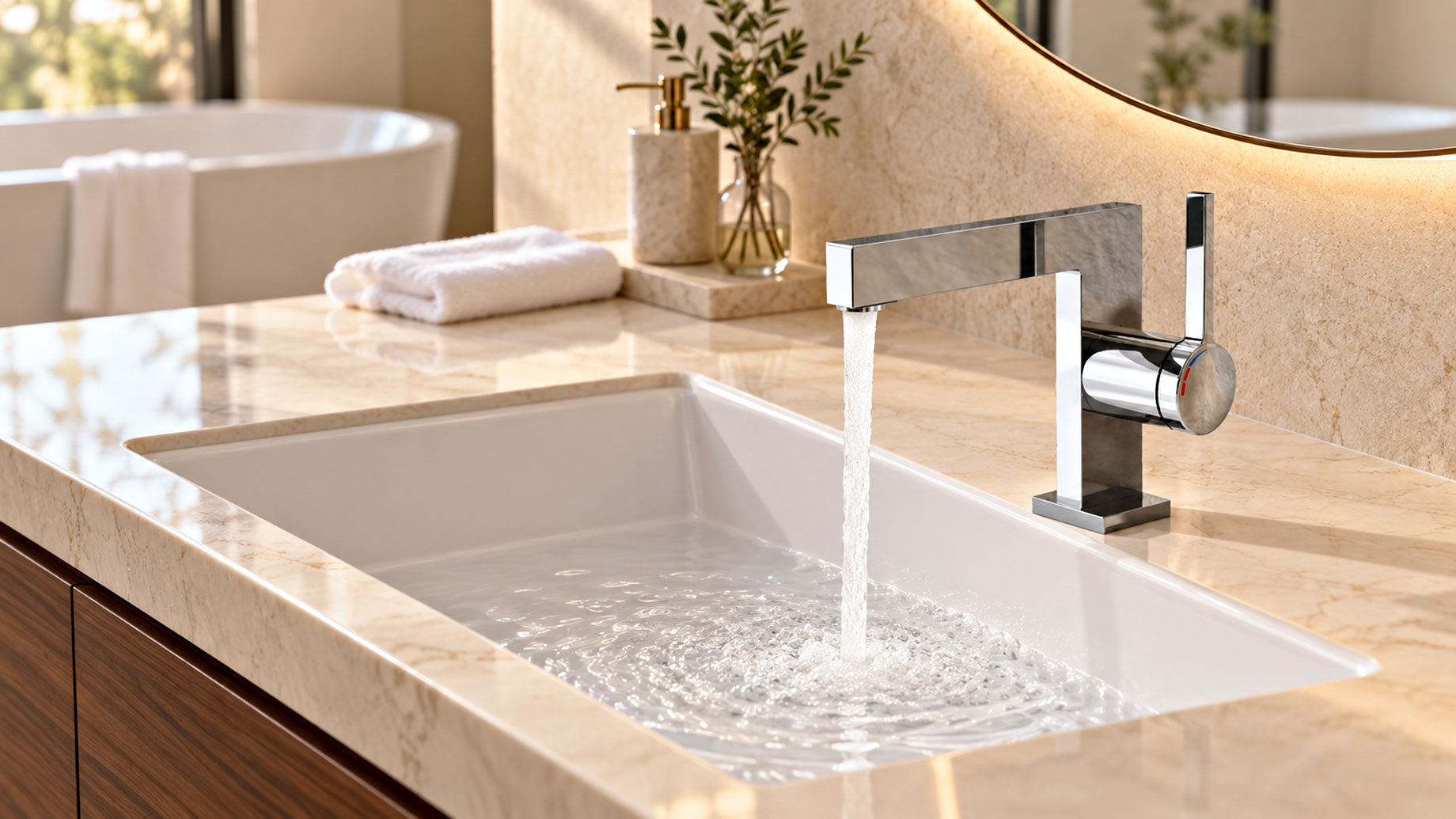
In a carefully designed bathroom, the smallest fittings can change how the larger surfaces are perceived. A sharply drawn chrome spout can bring definition to pale stone. A curved bath filler can echo the outline of a freestanding tub. Conversely, several individually attractive pieces can compete when their proportions, finishes and positions have been considered separately.
Choosing taps is therefore part of designing the room itself. The aim is to establish a relationship between the basin, bath and shower while allowing each fitting to suit its particular job. That relationship becomes convincing through a few deliberate decisions.
Choose a common design language
Start with the room’s strongest permanent features. A vanity with flat drawer fronts and a rectangular basin provides a different setting from panelled cabinetry and an oval washbowl. Let those elements guide the shape of the fittings before choosing a finish.
Look closely at the details that distinguish one design from another: the thickness of the spout, the shape of its outlet, the handle profile and the base. Two taps can share a polished silver finish yet feel unrelated because one is slender and angular while the other is heavily rounded.
Consistency does not require identical silhouettes everywhere. A rectangular basin mixer and a curved bath filler can sit comfortably together when their visual weight and finish feel balanced. Repeating one or two characteristics is often enough.
Resolve the basin and tap as a pair
The vanity is frequently the most closely observed part of the bathroom. Its fittings need to work at arm’s length as well as looking composed from the doorway.
When comparing Bathroom Sink Taps, assess spout reach and outlet height against the actual basin. A tall fitting may suit a countertop bowl but dominate a shallow inset basin. A compact fitting can look elegant yet leave insufficient space for comfortable handwashing if the bowl and mounting position are poorly matched.
Check the handle’s full movement, particularly beside a raised splashback or behind a vessel basin. Leave enough room to wipe around the base. These small clearances help preserve the uncluttered appearance that attracted you to the design in the first place.
Give the bath fitting a considered position
A freestanding bath creates a strong outline, and its filler becomes part of that composition. Positioning deserves as much attention as the fitting itself.
Before selecting Bathtub Taps, consider the view from the entrance and the space needed to approach, enter and clean around the bath. A floor-mounted filler can provide a sculptural accent, but it needs a location that does not obstruct movement. Wall-mounted or deck-mounted arrangements may suit a more compact layout.
Ask the installer to confirm that the outlet reaches properly over the bath rim and that the selected fitting suits the available services. Visual balance cannot compensate for an awkward reach to the controls or an unsuitable mounting arrangement.
Keep the shower composition legible
Behind a glass enclosure, shower fittings remain visible from much of the room. Consider the showerhead, controls, hand shower and hose together, including their relationship with tile joints and storage niches.
When reviewing Shower Taps, choose the functions you will use regularly. Additional outlets also introduce more controls and coordination requirements. A straightforward arrangement can feel particularly refined when its placement is clear and comfortable.
Concealed and exposed systems create different visual effects. Neither is automatically the better choice. Confirm compatibility, installation requirements and future service access before committing to a particular appearance.
Compare finishes in the room’s light
A finish name is not a reliable substitute for a sample. Products described as brushed brass, nickel or bronze can differ in colour, sheen and texture between ranges.
Where possible, place samples beside the chosen tile and cabinetry, then examine them in daylight and under the intended lighting. Include the smaller visible metal pieces: basin wastes, shower enclosure fittings, towel rails and cabinet handles.
If mixing finishes, give each a clear role. Chrome plumbing fittings with a warmer mirror frame can look deliberate; several nearly matching gold tones may appear accidental. Keep the palette restrained enough that differences read as choices.
Make the final selection with maintenance in mind
Before ordering, record model references, finishes, mounting arrangements and included components. Check cleaning instructions and the availability of replacement parts. For concealed fittings, establish how routine servicing will be carried out.
A cohesive bathroom earns its sense of luxury through repeated use: a handle that moves comfortably, a spout that suits the basin and surfaces that remain easy to care for. When those details receive the same attention as the stone and cabinetry, the whole room feels more thoughtfully made.
