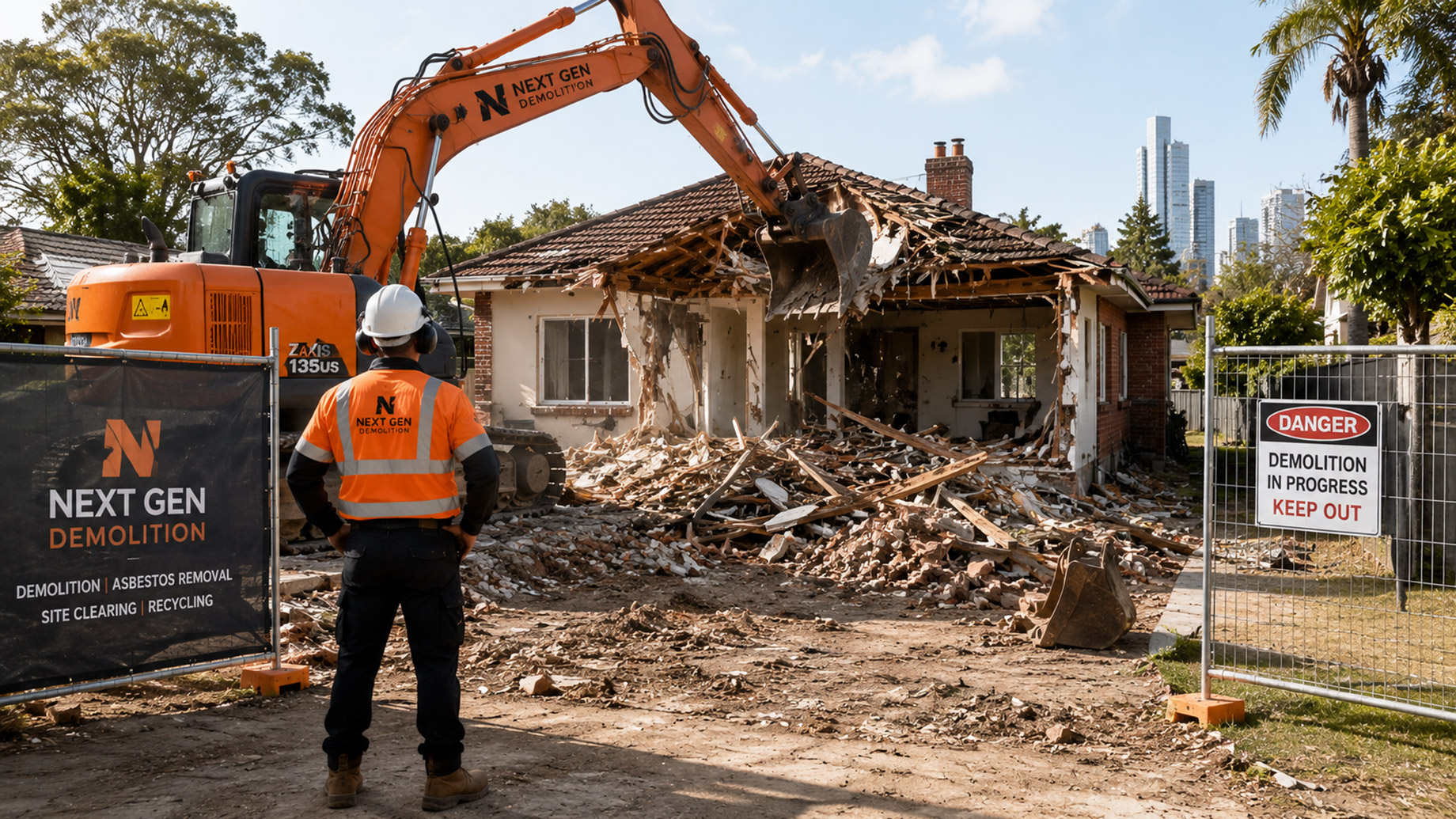
Brisbane property owners planning a custom build often start by demolishing the existing structure on site. The decision sits at the intersection of project timeline, council compliance, hazardous-material handling, and waste-stream management. The right specialist reads the property’s structure, asbestos-likelihood profile, and access conditions before quoting. The wrong choice produces 6 to 12 weeks of delay on the front end of the build.
The same disciplined evaluation that informs other consequential property decisions translates to demolition contractor selection. Specialist firms like Next Gen Demolition handle the spectrum of work that house demolition in Brisbane projects require. The work covers residential and commercial demolition, asbestos removal, and bridge demolition across the broader Brisbane and Gold Coast catchment. A residential demolition is the controlled removal of an existing structure including foundations, slab, and ancillary outbuildings, leaving the lot ready for the next build. The decision rewards a few hours of structured homework before signing the contract.
Why Has Brisbane Demolition Become More Strategic?
Three structural shifts have moved demolition into more strategic territory for Brisbane custom-build projects. The first is the asbestos-discipline shift. Pre-1990 Brisbane homes commonly contain asbestos in eaves, internal walls, vinyl flooring, and roof sheets. This produces handling and disposal requirements that did not apply to demolitions a generation ago.
The second is the waste-stream framework. Brisbane City Council and broader Queensland regulations now require specific tracking of construction-and-demolition waste streams. The third is the timeline-compression shift. Custom-build owners increasingly want a 6-to-10-week clean transition from existing structure to ready-to-build pad rather than the 12-to-16-week loose timeline of the prior decade.
The same kind of long-horizon thinking visible in coverage of delayed roof replacement risks carries through to the demolition-decision side of the build.
What Should Property Owners Verify Before Signing?
Six criteria belong on every shortlist. The table below summarises what Brisbane property owners should weigh before commitment.
| Criterion | What to Verify | What a Strong Answer Looks Like |
|---|---|---|
| Demolition specialisation | Residential and commercial focus | 70%+ caseload on demolition |
| Asbestos handling | Licensed asbestos removalist on staff | Class A or B asbestos licence current |
| Council and permit pathway | Demolition approval managed | Recent approved permits documented |
| Waste-stream management | Sorted disposal across streams | Documented tracking to recyclers |
| Insurance coverage | Public liability appropriate to risk | 10 to 20 million dollar cover |
| Timeline commitment | Documented start and completion | Written milestone schedule |
A contractor who provides clear answers across these six points signals counsel worth retaining. A contractor who deflects on any of them signals a generalist taking on demolition occasionally rather than as a specialty. Asking these questions early saves real money on the build’s front end.
Which Demolition Categories Reward Specialist Counsel Most?
Three demolition categories reward contractor depth more than the others:
- Pre-1990 timber-and-asbestos homes where the asbestos-handling adds meaningful complexity and where licensed removalists are required by Queensland regulation
- Tight-access inner-Brisbane sites where the existing structure sits close to neighbours and where machinery access requires specialised small-footprint equipment
- Heritage-overlay properties where Brisbane City Council’s character-protection rules add documentation, photo-record, and partial-retention requirements beyond standard demolition
The Australian Government’s asbestos awareness guide outlines the worker-side framework that translates to residential demolition contexts. The US Environmental Protection Agency’s lead awareness page covers complementary hazardous-material thinking. The same kind of design-discipline thinking visible in coverage of Tim Clarke design studio translates to the site-prep side of luxury custom builds.
What Common Mistakes Surface in Brisbane Demolition Selection?
Several patterns recur. The first is choosing on price alone. The cheapest demolition quote often skips careful asbestos identification, which produces handling-cost surprises mid-project.
The second is treating the council-permit pathway as the contractor’s full responsibility without owner-side verification. The owner remains legally responsible for permit compliance even when the contractor handles the paperwork.
The third is overlooking the disconnection-and-services step. Power, gas, water, and telecommunications all require formal disconnection by the relevant utility before demolition can proceed.
The fourth is forgetting the salvage-and-recovery question. Some Brisbane homes contain reclaimable timber, fixtures, or fittings that produce material salvage value when handled by a contractor with established second-hand market links. The fifth is signing without reviewing the public-liability coverage. A residential demolition operating without 10-to-20-million-dollar cover puts the property owner at meaningful risk if a neighbouring structure or vehicle is damaged.
What Is the Bottom Line for Brisbane Custom-Build Owners?
The demolition decision rewards property owners who plan rather than improvise. The window for thoughtful preparation typically runs from the design-development phase through to the contractor-comparison phase. The right specialist coordinates the asbestos-handling, the waste-stream management, the council-permit pathway, and the disconnection-and-services sequencing rather than treating each as a separate engagement.
Whether the property sits in inner-Brisbane, the outer suburbs, or across the broader Gold Coast catchment, the criteria translate cleanly. The first contractor conversation should answer specific questions about specialisation, licensing, council pathway, and timeline commitment. Property owners who run real comparison processes early end up with cleaner build start-dates than owners who default to whichever contractor was recommended first. Pre-engagement preparation pays back across the entire build, often saving 4 to 8 weeks of avoidable delay on the front end of the project.
Frequently Asked Questions
How Long Does a Typical Brisbane House Demolition Take?
A typical pre-1990 Brisbane home with asbestos handling runs 5 to 10 working days from site mobilisation through to cleared pad. Standard timber homes without asbestos can run 3 to 7 working days. Larger or heritage-overlay properties can run 2 to 4 weeks. Site-access constraints and weather can shift the schedule by 2 to 5 days in either direction.
What Does a Brisbane Demolition Cost?
Standard residential demolition in Brisbane runs 18,000 to 35,000 Australian dollars for a typical pre-1990 timber-and-asbestos home. Larger homes, brick-and-tile properties, or heritage cases can run 35,000 to 70,000 dollars. The cost includes contractor fee, asbestos handling, waste disposal, and pad preparation. Salvage credits can offset 1,000 to 5,000 dollars on properties with reclaimable materials.
Do I Need a Council Permit for Demolition?
Yes, in nearly all Brisbane cases. The Brisbane City Council demolition approval pathway requires submission of plans, asbestos reports, and waste-management documentation. Heritage-overlay properties carry additional character-assessment requirements. Specialist contractors typically manage the permit pathway as part of the engagement. The permit timeline runs 4 to 12 weeks depending on the property’s complexity.
Can I Live in the House During Pre-Demolition Stages?
Generally no, once active site work begins. Property owners typically vacate 1 to 2 weeks before site mobilisation. The disconnection-of-services step requires the property to be unoccupied. Some property owners use the gap as a moving-out and storage-organisation window. Specialist contractors coordinate the move-out timing with the demolition schedule.
