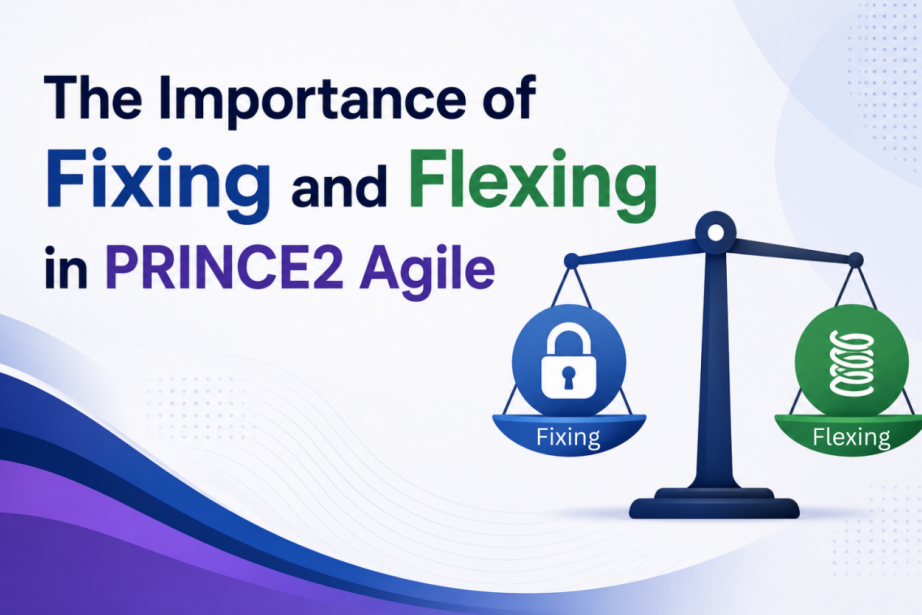
Projects rarely follow the exact path that teams expect. Changing priorities and unexpected challenges can easily affect progress. PRINCE2 Agile Foundation and Practitioner (Version 2) helps professionals manage these changes without losing control of project objectives. One of its most valuable concepts is Fixing and Flexing, which creates the right balance between stability and adaptability. It allows teams to protect what matters most while remaining flexible where change adds value.
In this blog, we will explore the importance of Fixing and Flexing in PRINCE2 Agile and its role in delivering successful projects.
Table of Contents
- What is Fixing and Flexing in PRINCE2 Agile?
- Understanding the Value of Fixing and Flexing in PRINCE2 Agile
- Conclusion
What is Fixing and Flexing in PRINCE2 Agile?
Fixing and Flexing is one of the core concepts of PRINCE2 Agile. It helps project teams decide which parts of a project must remain unchanged and which parts can adapt as work progresses. The idea is to protect the most important project objectives while allowing enough flexibility to respond to changing business needs or customer feedback.
In this approach, certain elements such as time or project governance are often fixed because they are essential to project success. Other elements, such as the scope of lower priority features or the way work is delivered, can be adjusted when necessary. This allows teams to deliver value without affecting the project’s overall goals.
By combining structured project management with Agile ways of working, Fixing and Flexing helps organisations maintain control while remaining responsive to change. It supports better decision making and increases the chances of delivering successful projects even when priorities evolve.
Understanding the Value of Fixing and Flexing in PRINCE2 Agile
Below are the key importance of Fixing and Flexing in PRINCE2 Agile supports successful projects while maintaining control and adaptability:
Protects the Most Important Project Objectives
Certain components are essential to any successful project and cannot be sacrificed. Budgets, timelines, company objectives, and quality standards are a few examples of these. Resolving these issues guarantees that the project will continue to produce the desired results.
Teams can also change things like the sequence in which elements appear or how tasks are carried out. This leaves space for improvement without compromising the overall success of the endeavour. Organisations lower needless risks while preserving stakeholder confidence by safeguarding important goals.
Makes Change Easier to Manage
In nearly all contemporary projects, change is anticipated. Market conditions, customer expectations, and corporate priorities can all change rapidly. Teams that are resistant to change frequently find it difficult to maintain project progress.
Where flexibility is most beneficial, PRINCE2 Agile promotes it. Before making decisions, teams assess the impact of each change rather than viewing it as a disturbance. This establishes a methodical technique for adjusting without losing sight of predetermined results.
Improves Customer Satisfaction
From the start of a project until its conclusion, customer needs may change. Projects frequently need to be modified in order to provide the greatest potential outcome as fresh feedback becomes available.
Teams can respond to important client feedback while maintaining the project’s agreed-upon restrictions thanks to the idea of mending and flexing. Because their recommendations may be taken into consideration without causing needless delays, customers feel involved throughout the delivery process. Stronger bonds and increased trust in the finished product result from this.
Reduces Project Risks
When teams know exactly which components are set in stone and which are subject to change, projects become more predictable. Without these restrictions, needless modifications could raise prices, cause delivery delays, or lower quality.
Project teams can make decisions more quickly when new demands come up if flexible and fixed regions are defined early. This lessens uncertainty and enables hazards to be controlled before they develop into serious issues. More consistent project performance is supported by a methodical balance between control and flexibility.
Encourages Better Team Collaboration
Effective communication within the project team is essential to successful delivery. Discussions become more focused and effective when everyone is aware of the project’s established priorities and flexible areas.
Team members are aware of where changes can be made rather than arguing over every tiny modification. This improves collaboration and enables everyone to work toward common goals. When making daily project decisions, having clear expectations also boosts confidence.
Supports Faster Decision Making
Projects frequently call for fast reactions to evolving circumstances. Delays in making decisions can hinder development and lower productivity. To decide what can change and what should be protected, teams need a clear framework.
This clarity comes from fixing and flexing. Project managers are able to promptly determine whether new demands impact fixed or flexible aspects. This expedites decision-making while guaranteeing the security of crucial business goals.
Balances Control with Agility
Many businesses fear that they may lose project control as they become more Agile. By fusing flexible delivery methods with established governance, PRINCE2 Agile eliminates this worry.
Teams are given the flexibility to modify their strategy as needed while maintaining crucial project controls. Organisations can maintain their competitiveness without compromising accountability thanks to this balancing. Additionally, it enables projects to adapt to changes in business while keeping constant supervision.
Conclusion
Modern projects require both structure and adaptability to achieve successful outcomes. Understanding Fixing and Flexing in PRINCE2 Agile helps organisations respond confidently to change while protecting their most important project objectives. This balanced approach improves collaboration and delivers greater value for customers.
Professionals looking to strengthen their project management skills can expand their knowledge through PRINCE2 Agile Foundation and Practitioner (Version 2) with The Knowledge Academy, a global training provider, to confidently manage projects in today’s fast-changing business environment.