What does luxury mean when the power goes out? For a modern villa, uninterrupted comfort can be just as important as expansive architecture, premium finishes, or sophisticated automation. A grid outage can quickly affect air conditioning, refrigeration, security, water systems, communications, and other services that residents normally take for granted.
Villas also tend to have more complex electrical profiles than conventional homes. Multiple cooling zones, pool equipment, pumps, elevators, smart-home systems, lighting, and entertainment technologies can create substantial and sometimes highly variable demand. That makes backup power more than a matter of keeping a few lights on; it becomes part of how the property is designed to operate.
Solar generation combined with battery storage can provide a more integrated approach to resilience. When storage is considered alongside the property’s electrical architecture, equipment spaces, and energy-management controls from the beginning, it can support both everyday efficiency and outage readiness. Battery storage should be treated as part of the villa’s infrastructure rather than an appliance added after construction.
Why Energy Resilience Matters in Modern Villas
Modern villas increasingly rely on electricity for far more than basic lighting and household appliances. Air conditioning may need to maintain several indoor zones at once, while refrigeration, water pumps, pool equipment, and security systems can continue operating around the clock. During an outage, losing any one of these services can affect comfort, convenience, or important property functions.
Connectivity is also part of modern residential resilience. Internet equipment, surveillance cameras, access controls, smart-home hubs, and communications systems can help maintain visibility and control over the property. Reliable lighting and selected water systems can be equally important, particularly when an outage lasts for several hours rather than a few minutes.
This makes energy resilience a design consideration rather than simply an emergency feature. Developers, architects, and installers need to understand which systems are essential, which can be temporarily reduced, and which should operate normally during an outage. The question, therefore, is not simply how large a battery should be, but what should remain powered when the grid goes down?
Whole-Home vs. Critical-Load Backup
Once a villa’s essential energy needs are identified, the next decision is how broadly the backup system should operate. A whole-home backup strategy is designed to keep most or all circuits running during a grid outage. It generally requires greater battery capacity, higher inverter capability, and enough power to handle periods when several demanding systems operate simultaneously. For large villas, this approach can provide an experience closer to normal operation when the grid is unavailable.
Critical-load backup takes a more targeted approach. Rather than supporting every circuit, the system prioritizes services that matter most to safety, comfort, and continuity. Essential lighting, refrigeration, security, communications, water systems, and selected HVAC circuits may remain powered while less important loads are temporarily disconnected.
| Backup approach | Best suited for | Main advantage | Main consideration |
| Whole-home backup | High-resilience villas | Maximum continuity | Higher capacity and cost |
| Critical-load backup | Essential services | Targeted backup | Some loads remain offline |
| Load-managed backup | Complex villas | Balances capacity and resilience | Requires intelligent controls |
No approach is universally better. The appropriate strategy depends on the villa’s load profile, expected outage conditions, solar generation, available space, budget, and the level of continuity the project requires.
Design Around the Villa’s Real Electrical Loads
Battery planning becomes more complex when a villa contains several high-demand systems. Total energy consumption matters, but designers also need to distinguish between energy capacity and power capability. Battery capacity, typically expressed in kilowatt-hours (kWh), indicates how much energy can be stored, while power, expressed in kilowatts (kW), relates to how much electricity the system can deliver at a given moment. Both matter when several loads operate together.
Air conditioning is often a major consideration because several zones may call for cooling simultaneously. Pool and water pumps can add recurring demand, while their operating schedules may offer opportunities for coordination with solar generation. Security equipment may consume less power but remain a high-priority load because it supports property protection and monitoring.
Elevators require particularly careful project-specific assessment. Their electrical characteristics, emergency operation requirements, and applicable safety provisions should be reviewed with the relevant electrical and elevator professionals rather than assumed from general household calculations. Ultimately, battery sizing isn’t just about kWh; inverter and system design must also account for power demand, surge requirements, and operating priorities.
Battery Architecture: From Appliance to Infrastructure
Treating battery storage as infrastructure means considering the electrical architecture before selecting equipment. Understanding voltage meaning is essential when architects and engineers decide between low-voltage and high-voltage battery architectures. Low-voltage systems can be appropriate for certain residential configurations, while high-voltage architectures may suit different power levels and system designs. Neither approach is automatically better for every villa.
The decision should account for inverter compatibility, current requirements, cable sizing, installation conditions, scalability, and the wider electrical design. As system capacity and power requirements increase, these factors can influence how the battery, inverter, protection equipment, and distribution system work together. A well-designed architecture should also consider applicable electrical standards and manufacturer specifications rather than selecting a voltage class in isolation.
This infrastructure approach also makes future expansion easier to consider. If a developer expects additional solar generation, higher electrical demand, or changes to the property’s energy-management strategy, the battery architecture and associated equipment should be evaluated for compatibility with those future requirements.
Architectural Integration and Equipment-Room Planning
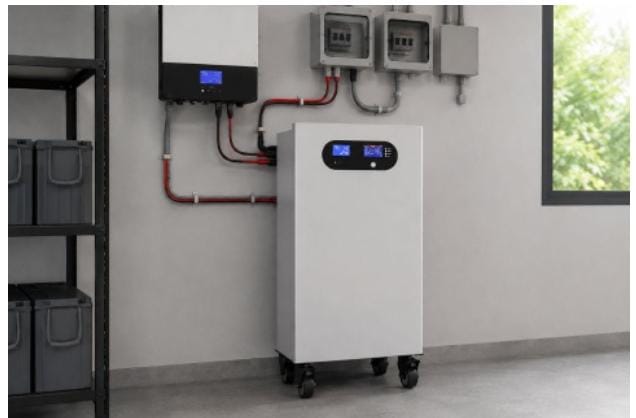
Battery storage is easier to integrate when its location is considered during the architectural and electrical planning stages. A dedicated equipment or utility area can provide appropriate access for inspection and maintenance while keeping energy equipment separate from primary living spaces. The location should also account for ventilation, temperature, humidity, and potential exposure to water or flooding.
In a luxury villa, visual integration matters as well. Equipment can sometimes be placed behind architectural screening or within a dedicated service area, but appearance should never take priority over safe operating conditions. Noise from inverters or cooling equipment should also be considered when selecting a location near bedrooms, living areas, or outdoor entertainment spaces.
Equipment-room planning should leave enough room for servicing, inspection, ventilation, and any manufacturer-required clearances. Considering these requirements before construction is substantially complete can reduce the risk of expensive modifications later. The objective is not simply to hide the battery, but to make its presence compatible with the villa’s architecture and long-term operating needs.
Solar, Battery Storage, and Smart-Home Controls
Solar generation and battery storage become more useful when they operate as part of a coordinated energy strategy. Rather than treating each component separately, the system can be designed around a simple flow: solar → loads → battery → backup → grid. During periods of strong solar production, available energy can serve household demand while surplus generation charges the battery for later use.
Smart-home and energy-management controls can add another layer of coordination. Depending on the system, flexible loads such as pool pumps or selected HVAC equipment may be scheduled around solar availability, while battery reserves can be protected for periods when grid reliability is uncertain. Monitoring can also give project teams and property owners greater visibility into consumption, generation, battery status, and system performance.
For developers and installers, this makes storage part of the property’s broader energy-management strategy rather than a component used only during outages. Suppliers such as Avepower can contribute to project discussions involving battery architecture, inverter compatibility, system integration, and long-term energy-management requirements. Intelligent controls can improve resilience and energy use without automatically requiring a much larger battery.
Designing for Coastal and Tropical Villa Conditions
Tropical and coastal environments introduce additional considerations for villa energy-storage systems. High temperatures and humidity can affect equipment operating conditions, while salt-laden air can increase corrosion risks for exposed components. Heavy rainfall and potential flooding also make equipment location, enclosure protection, drainage, and installation practices important parts of the overall design.
Thermal management should follow the battery and inverter manufacturer’s specified operating limits rather than relying on generic assumptions about climate suitability. Ventilation and equipment-room design can help maintain appropriate conditions, while regular inspection can identify moisture, corrosion, or other environmental issues before they become larger problems. Outdoor or semi-exposed equipment may also require environmental protection appropriate to the installation conditions.
These considerations are particularly relevant to developers working across tropical markets. Developers planning tropical villas can evaluate the best LiFePO4 battery brand Philippines based on inverter compatibility, usable capacity, environmental limits, documentation, and local service responsibility. The objective is to assess the complete storage solution and its long-term operating environment rather than judging a system on battery chemistry alone.
Collaboration Starts Before Installation
Energy resilience works best when battery storage is considered during the early stages of villa development. Architects can plan suitable equipment spaces, access routes, visual integration, and ventilation without having to redesign finished areas later. Developers can establish budgets, project standards, service expectations, and long-term performance objectives before equipment is selected.
Installers bring practical expertise in electrical integration, commissioning, protection, and system configuration. Storage suppliers and OEM/ODM partners can contribute battery architecture, BMS capabilities, inverter compatibility, technical documentation, support, and project-specific requirements. Bringing these stakeholders together early can reduce compatibility problems and create a more coordinated system.
The result is a project in which solar generation, storage, electrical distribution, building systems, and architectural requirements are considered together. Energy resilience should be planned before installation—not added as an afterthought.
Conclusion
Energy resilience is becoming an important part of what makes a modern villa genuinely comfortable and dependable. A successful system begins with the property’s real electrical loads and connects backup priorities, solar generation, battery and inverter architecture, equipment-room planning, environmental conditions, and smart energy controls into one coordinated strategy.
Treating storage as infrastructure also changes when key decisions are made. Instead of finding space for a battery after construction, project teams can plan for accessibility, thermal conditions, aesthetics, maintenance, compatibility, and future scalability from the outset. For developers, installers, and energy brands, this approach can create more practical and cohesive resilience solutions. Avepower can support project teams exploring integrated energy-storage solutions for modern residential applications, providing a starting point for discussions around system design and project requirements.
FAQs
1. How much battery storage does a luxury villa need?
It depends on the villa’s energy consumption, critical loads, desired backup duration, solar generation, and peak power requirements. The system should be sized for both energy capacity and power demand.
2. What is the difference between whole-home and critical-load backup?
Whole-home backup is designed to support most or all villa circuits during an outage. Critical-load backup focuses on essential systems such as lighting, security, refrigeration, communications, water systems, and selected HVAC.
3. Can battery storage power air conditioning during an outage?
Yes. A properly designed battery system can support air conditioning, but the battery capacity, inverter power, compressor characteristics, and other loads operating at the same time must be considered.
4. Where should battery storage be installed in a villa?
Battery systems should be located in a suitable equipment or utility area with appropriate ventilation, maintenance access, temperature management, environmental protection, and manufacturer-required clearances.
5. Are battery storage systems suitable for tropical and coastal villas?
Yes, when they are properly selected and installed for the environment. Temperature, humidity, salt-laden air, corrosion, flooding, ventilation, enclosure protection, and maintenance requirements should all be considered.