| TL;DROpen shelves are display, and visitors read them that way. Anything that sits on an open shelf in a client room becomes part of what the room says about you.Doors are the exception, not the rule. In one large commercial range of office bookcases, 18 of 144 units have doors and only 3 lock.The federal tip-over standard for furniture made after September 1, 2023 covers clothing storage. It excludes bookcases and office furniture, so anchoring a tall case is your job.Commercial guidance says units over 42 inches tall generally need an anti-tip anchor kit, and the kit is often sold separately.Short version: most client rooms want both. Closed doors below desk height for the files, open shelves at eye level for a handful of things worth looking at, and a strap into the wall either way. |
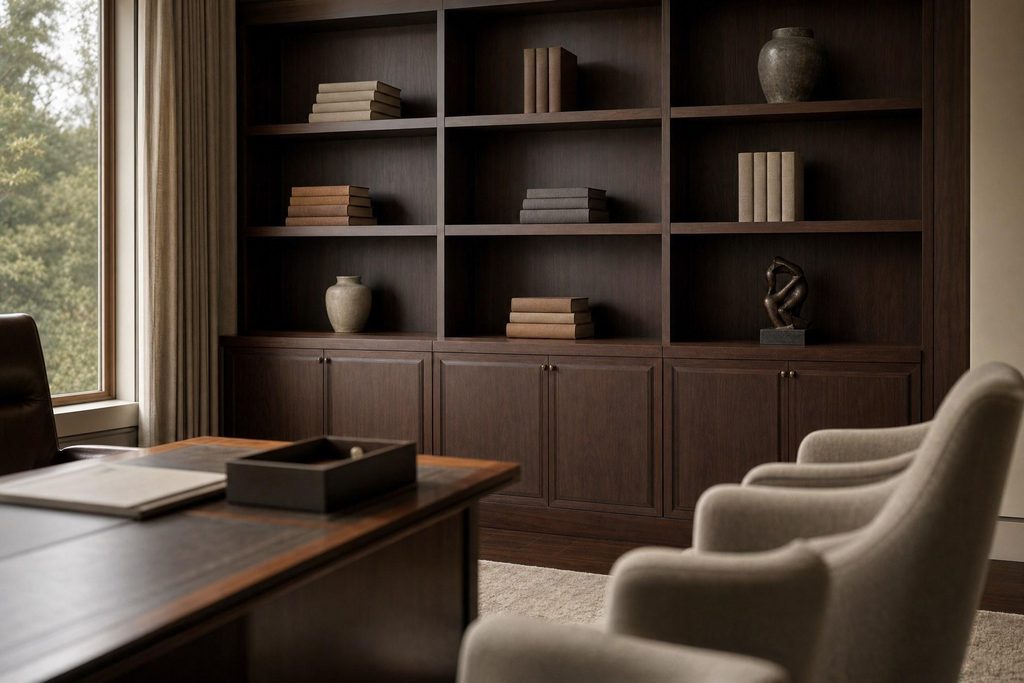
From the guest chairs, the bookcase is the backdrop to every conversation. Whatever sits on the open shelves gets studied while you talk.
In a room clients see, the choice between open shelving and a closed case comes down to one question: what in this room has to stay out of sight? Anything confidential, messy or merely ordinary belongs behind a door. Open shelves should hold only what you would be happy to have a client study for ten minutes while you finish a call. Most offices have some of each, which is why the best answer is usually a split case rather than a pure version of either.
Start with what has to stay hidden
List what actually lives in the room before you look at a single bookcase. Client files, signed agreements, printer paper, chargers and cables, the box of spare business cards. In an advisor’s office or a small law practice, some of that list is confidential, and confidential paper wants a door and probably a lock.
Locking cases are scarcer than people expect. Browse a commercial range of office bookcases and shelving and the filters make the point quickly: of 144 units, 18 come with doors, 3 lock, and the other 126 are open. Many manufacturers sell add-on hinged, sliding or roll-front doors that turn an open case into a cabinet, so a favorite open design can sometimes be closed later. Check that before you buy, not after.
The useful rule is simple. If it would embarrass you on the evening news, or breach a client’s trust, it goes behind a door. Everything else is a styling decision.
What open shelving tells a visitor
Open shelves work like a resume that nobody asked to see. A client sitting across the desk has nothing to do for the first few minutes but look around, and the shelf behind you is the biggest thing in their line of sight. Whatever sits on it gets read as part of you.
So style the open shelves for that reader, and keep them thin. A few books, laid flat and upright in turns. One object with a story. A plant if somebody will water it. Leave real gaps, because a shelf packed edge to edge reads as storage no matter how good the things on it are. Light the few things you keep, too. The Pinnacle List’s guide to lighting high-ceilinged rooms suggests aiming smaller lights at books and ceramics instead of washing the whole room at one level, and a styled shelf is the obvious place to try it.
And keep the shelves honest. If a shelf needs filler to look full, the case is too big for what you own. A smaller case, or a low one under a window, looks more confident than a tall one padded out.
The split case: doors below, open above
The hybrid is the design most client-facing rooms end up with, because it puts each kind of storage where it belongs. Doors sit low, where files and supplies are heavy and dull and where a seated visitor’s eye does not land. Open shelves sit at eye level and above, where a few chosen things get seen.
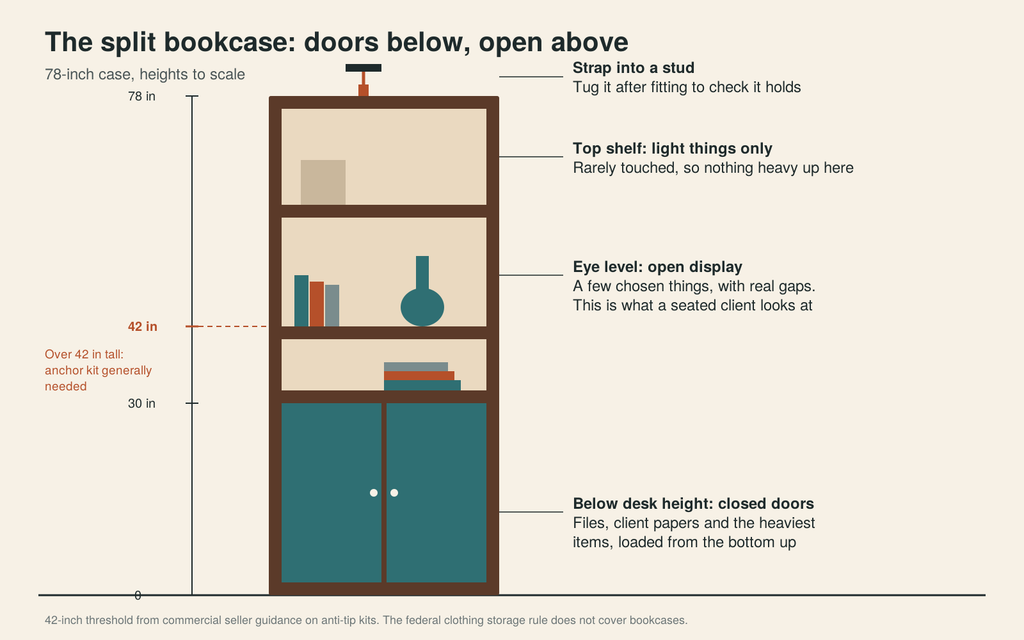
Heavy and private goes low and behind doors. Light and chosen goes high and in the open.
Here is how the four common types compare, with example prices from the same commercial range (starting prices, shipping included):
| Type | What a visitor sees | What it hides | Example |
|---|---|---|---|
| Open bookcase | Everything | Nothing | 35 x 14 x 74 in, three adjustable shelves, $1,169 |
| Glass doors | Everything, behind glass | Dust, not clutter | 32 x 18 x 65 in, $879 |
| Solid doors throughout | A cabinet face | Everything | 36 x 12 x 78 in with doors and five shelves, $1,199 |
| Lower doors, open above | A curated top half | Files and supplies below | 32 x 13 x 78 in, three adjustable shelves, $1,269 |
Glass is the compromise people reach for and often regret. It keeps dust off, which matters for anything you want to keep looking good, but it hides nothing. A glass case full of binders still reads as a case full of binders.
Tall cases: the federal tip-over rule does not cover yours
This is the part that catches people out. The 2022 STURDY Act led to a mandatory federal stability standard for furniture made after September 1, 2023, and it is easy to assume that standard covers anything tall with shelves. It does not. The Consumer Product Safety Commission’s clothing storage unit guidance limits the rule to free-standing bedroom-type storage at least 27 inches tall, and lists bookcases and office furniture among the products that are not in scope.
So the stability of a 78-inch office bookcase is down to how you install it. CPSC’s Anchor It campaign is blunt about the fix: anchor furniture with drawers, doors and shelves to the wall. Commercial sellers say much the same thing in their own terms. Units over 42 inches tall generally need an anti-tip kit, a wall bracket and strap that is often an add-on rather than in the box.
Three habits make a tall case safer whatever its type:
- Strap it into a stud or a proper wall anchor, then tug the strap to check it holds.
- Load from the bottom up. Laminate and veneer shelves in commercial lines are typically rated for 40 to 80 pounds each, and that assumes the weight is spread evenly.
- Keep the heaviest things behind the lower doors, which is one more argument for the split case.
The shelf behind your chair
Every client meeting has a backdrop, and on a video call it is often the only part of your office anyone sees. Treat the shelf directly behind your chair as the most visible surface you own. Keep it open and keep it sparse, and put everything else behind a door that closes. A visitor should leave having noticed one or two things on that shelf, and nothing at all about the files.