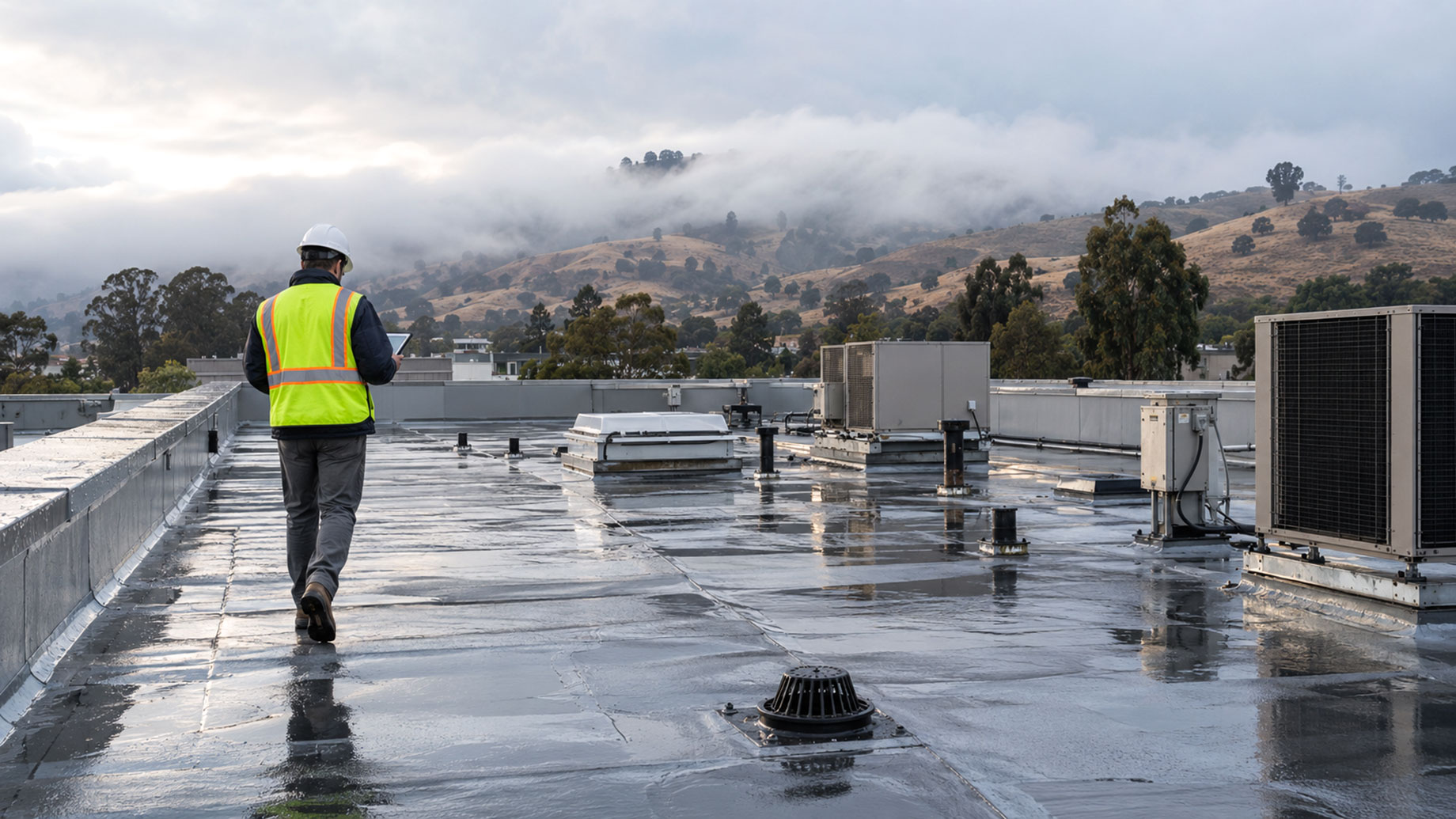
A commercial roof can escape an investor’s attention until a tenant reports a leak. By then, a small maintenance issue may have become an urgent repair, with added costs for water damage and tenant disruption.
Bay Area owners have two reasons to plan ahead. Concentrated winter rain and successive storms can expose drainage problems and worn roof details. California’s 2025 Energy Code, Title 24, Part 6, also applies to permit applications submitted on or after January 1, 2026, so larger roof projects may need a fresh compliance review.
Treat roof maintenance as part of property due diligence, not simply a vendor contract renewed each year. A useful program should document roof condition, address routine problems, define storm response, and help you plan repairs across your buildings.
Key Takeaways
- Start with twice-yearly inspections. Spring and fall visits, plus checks after severe weather, are a useful baseline. Confirm your roof manufacturer’s requirements.
- Account for local conditions. Specify storm-response terms and require a code review when planned work moves beyond routine maintenance.
- Investigate hidden moisture. Nondestructive surveys can identify suspected wet areas, with targeted sampling used to confirm findings when needed.
- Keep the records. Inspection reports, photos, and repair invoices help document compliance with warranty terms.
- Make portfolio reports comparable. Consistent condition scores, remaining-life ranges, and repair priorities support better budgeting.
What a Real Maintenance Program Includes
The phrase “roof maintenance” can mean anything from a quick drain check to a documented inspection with mapped findings. A proposal should explain exactly what happens during each visit and what you receive afterward.
Elevate’s building owner guidance recommends inspections twice a year, in spring and fall, and after severe weather. The National Roofing Contractors Association also emphasizes regular inspections and proper maintenance. Use that guidance as a starting point, then adjust the scope to your roof system, warranty, and site conditions.
Must include
- Two scheduled inspections per year, each followed by a written report, unless the roof’s requirements call for more frequent visits.
- A defined response after major storms, including how visits are requested and prioritized.
- A clear allowance and approval process for minor repairs, using materials and methods compatible with the roof and warranty.
- Drainage housekeeping: clearing drains, scuppers, and gutters, and documenting areas of standing water.
- A photo log tied to a roof plan so the same locations can be compared over time.
- Reports delivered to the owner in a format that can be stored with warranty records.
Nice to have
- Access to nondestructive moisture surveys when visual findings raise questions.
- A condition score and estimated remaining-life range for each roof.
- Coordination with rooftop trades, especially solar and HVAC contractors.
- A repair and maintenance budget covering the next one to three years.
If a proposal omits an item from the first list, clarify who will handle it and at what cost before comparing prices.
Bay Area Factors That Change Your Scope
A mixed-use building in Oakland and a flex campus in Sunnyvale may need different access arrangements, inspection priorities, and response plans. Three factors deserve explicit attention in the scope.
Climate and storm sequences
Bay Area roofs often move from long dry periods into concentrated winter rain. Debris can block drains, and repeated storms can leave little time to identify and repair leaks. Ask providers what triggers a post-storm check, how quickly crews can respond when access is safe, and what the report will include. Separate emergency leak response from a broader post-storm inspection; they serve different purposes.
The 2025 Energy Code
The California Energy Commission states that projects with permit applications submitted on or after January 1, 2026, must comply with the 2025 Energy Code. Routine upkeep and larger roof alterations can have different requirements, so the scope of work matters.
A maintenance coating does not automatically carry the same requirements as a reroofing project. Cool-roof and insulation requirements can depend on the work involved, roof area, building type, climate zone, and applicable exceptions. Ask the provider to flag potential code implications before pricing a larger project. Your design team and local permitting authority should confirm the requirements using official California Energy Commission and California Building Standards Commission resources, rather than relying solely on a contractor’s summary.
Solar, HVAC, and rooftop traffic
Solar arrays, mechanical units, and the traffic needed to service them create additional inspection points. Ask how the program addresses walkway pads, access around equipment, and coordination with other contractors. Documenting conditions before and after rooftop work can help identify damage and clarify repair responsibilities.
Finding Moisture Without Tearing Up the Roof
Guessing about hidden moisture can lead to unnecessary replacement or repeated patches over wet insulation. Two common nondestructive survey methods can help narrow the search before targeted sampling.
- Infrared surveys use thermal imaging to identify temperature patterns that may indicate wet insulation. ASTM C1153 describes this approach. Under suitable conditions, a survey can cover a large area and produce a map for further investigation.
- Electrical-impedance scanning uses contact equipment to detect electrical-property differences that may indicate concealed moisture. ASTM D7954 covers this method. It can complement infrared imaging where the roof assembly and survey conditions make it suitable.
Neither method proves the condition of the roof on its own. Roof materials, assembly details, weather, and surface conditions affect results. Ask why a method suits your roof and how the provider will confirm suspected wet areas, including selective test cuts or core samples where appropriate. Any sampling should be approved and properly repaired.
Results should be mapped to a roof plan, with the survey’s limitations explained. A folder of thermal images without location references is difficult to use for repair decisions or future comparisons.
Keeping Warranties Intact
A manufacturer’s warranty comes with conditions. These may include regular inspections, prompt notice of leaks, approved repairs, and records showing what work was done. A maintenance agreement should help you meet the terms of your specific warranty, not imply that coverage is automatic.
Keep these items for every roof:
- The original warranty, including registration or transfer paperwork.
- Dated inspection reports and accompanying photo logs.
- Repair invoices identifying the contractor and materials used.
- A roof access log showing which trades visited and when.
- Records of rooftop additions, such as solar arrays or mechanical units, including any required approvals.
Some manufacturers offer warranty extensions for eligible roofs maintained under specified programs. Ask whether your roof qualifies and request the written terms. Do not assume that a maintenance contract alone extends coverage.
Review the warranty before signing a service agreement. Check that inspection frequency, repair procedures, notification deadlines, and documentation requirements align. A provider should review those obligations before recommending a scope.
A Portfolio Playbook for Investors
Across several buildings, inconsistent reports make it harder to decide where repair funds should go first. Each roof should be described in comparable terms, while still accounting for differences in roof type, age, and use.
Standardize the deliverables
Ask every provider for the same core outputs:
- A condition score using a consistent scale with clear definitions.
- An estimated remaining service life expressed as a range, with key assumptions noted.
- A repair list separating urgent work from items that can wait.
- Maps of suspected moisture and other deficiencies, with photos linked to roof locations.
- A one- to three-year plan with budget ranges for each roof.
Dura-Foam’s RoofCare program describes a reporting approach suited to this comparison: per-roof condition scores, estimated remaining service life, and maintenance plans, supported by moisture and deficiency maps and location-tagged photos. Its program page uses illustrative sample figures, so use those examples to assess the report format rather than to benchmark your own roofs. For a multi-property comparison, a Bay area roof maintenance program can be assessed against these same deliverables, with property-specific scope and pricing confirmed in writing.
A mini RFP checklist
Include these items in your request for proposals so responses can be compared line by line:
- Inspection frequency and triggers for post-storm visits.
- Available moisture-survey methods and the roof types each method suits.
- A redacted sample report from a comparable property.
- Data ownership, delivery format, and retention period.
- How minor repairs are priced, approved, and documented.
- Coordination with solar, HVAC, and other rooftop trades.
- Safety procedures and current insurance certificates.
- The process for identifying code questions on coating and alteration projects.
What Maintenance Costs and How to Frame Value
Pricing depends on roof size, system type, condition, access, and service level. Compare proposals using the same scope rather than a universal price per square foot. Confirm whether the annual fee includes minor repairs, drainage cleaning, storm visits, moisture surveys, and reporting, or whether those services cost extra.
A seam repaired during a scheduled visit may prevent a more disruptive leak later. Drainage cleaning can also address a manageable problem before heavy rain. These are practical reasons to maintain a roof, but they do not establish a guaranteed savings percentage or service-life extension.
For investors, predictability is often the more useful measure. A documented program helps distinguish recurring maintenance costs from likely capital work. Ask providers to separate known repair needs from allowances and contingencies, and to explain the assumptions behind any savings estimate.
Shortlisting Bay Area Providers
Once the scope is clear, ask for evidence that each provider can deliver it. Focus on how the work will be performed, documented, and coordinated at your properties.
- Safety practices. Ask how crews handle fall protection, restricted access, and unsafe weather conditions.
- Documentation samples. Look for a roof plan, referenced photos, prioritized repairs, and a summary an asset manager can use.
- Post-storm capacity. Confirm response windows and how calls are prioritized when several properties need help at once.
- Trade coordination. Ask how the provider records conditions before and after solar or mechanical work.
- Code awareness. Confirm when the provider recommends involving your design team or permitting authority.
Program structures differ. Some emphasize scheduled inspections and service visits; others add moisture surveys and portfolio reporting. When comparing providers, check the actual deliverables rather than relying on tier names. Dura-Foam offers Monitor, Protect, and Manage tiers, with increasing visit frequency and services. That structure gives owners a way to match oversight to roof condition and in-house capacity, but the property-specific scope and pricing should be confirmed in writing.
Before signing, compare a sample report with the promised scope. It should show both what was inspected and what still needs attention.
Red Flags and Contract Language
Vague contract terms can leave important work unassigned. Resolve these points before service begins.
- “Best effort” response terms. Define triggers, response windows, and any weather or safe-access limitations. Distinguish an initial response from completion of repairs.
- No reporting standard. Require a dated report after each visit, with a roof plan, referenced photos, and prioritized findings.
- No post-storm provision. Specify how inspections are authorized and whether they are included in the fee.
- No way to investigate hidden moisture. Establish how further surveys are recommended, approved, and priced when visual findings warrant them.
- Broad exclusions. Read what is excluded from minor repairs and drainage work. Set a clear approval limit for additional charges.
- Records held only by the contractor. Require delivery of reports, photos, and logs after each visit, with an agreed retention period.
- Replacement recommendations without evidence. Ask for documented findings, repair alternatives, and survey or sampling results where appropriate.
- No process for code questions. Require notice when proposed work may need a permit or further compliance review.
A 30-60-90 Day Action Plan
Set a schedule early enough to complete priority work before seasonal rains. Active leaks and urgent safety issues should not wait for the full rollout.
First 30 days
Gather warranties, prior inspection reports, and repair invoices for each roof. Schedule baseline inspections and drainage cleaning. Prioritize buildings with known leaks, recurring standing water, or heavy rooftop traffic, and address urgent findings immediately.
Days 31 to 60
Pilot the program on one or two roofs, ideally one in good condition and one with unresolved concerns. Test the report format, repair approval process, and provider communication. Authorize a moisture survey where inspection findings justify it.
Days 61 to 90
Combine the findings into a portfolio summary with condition scores, remaining-life ranges, and repair priorities. Use it to develop the next maintenance and capital budget. Before approving a coating or reroofing project, have the applicable permit and energy-code requirements confirmed for that specific scope. This final review belongs in commercial roof maintenance planning.
Protecting the Asset Above the Tenants
A useful maintenance program combines regular inspections, timely repairs, clear records, and evidence-based planning. Whether you choose Dura-Foam’s portfolio-focused approach or another local provider, those deliverables should guide the decision. Match the agreement to each roof’s needs, retain the documentation, and resolve code questions before larger work begins. The result is a better basis for managing both the building and its budget.
