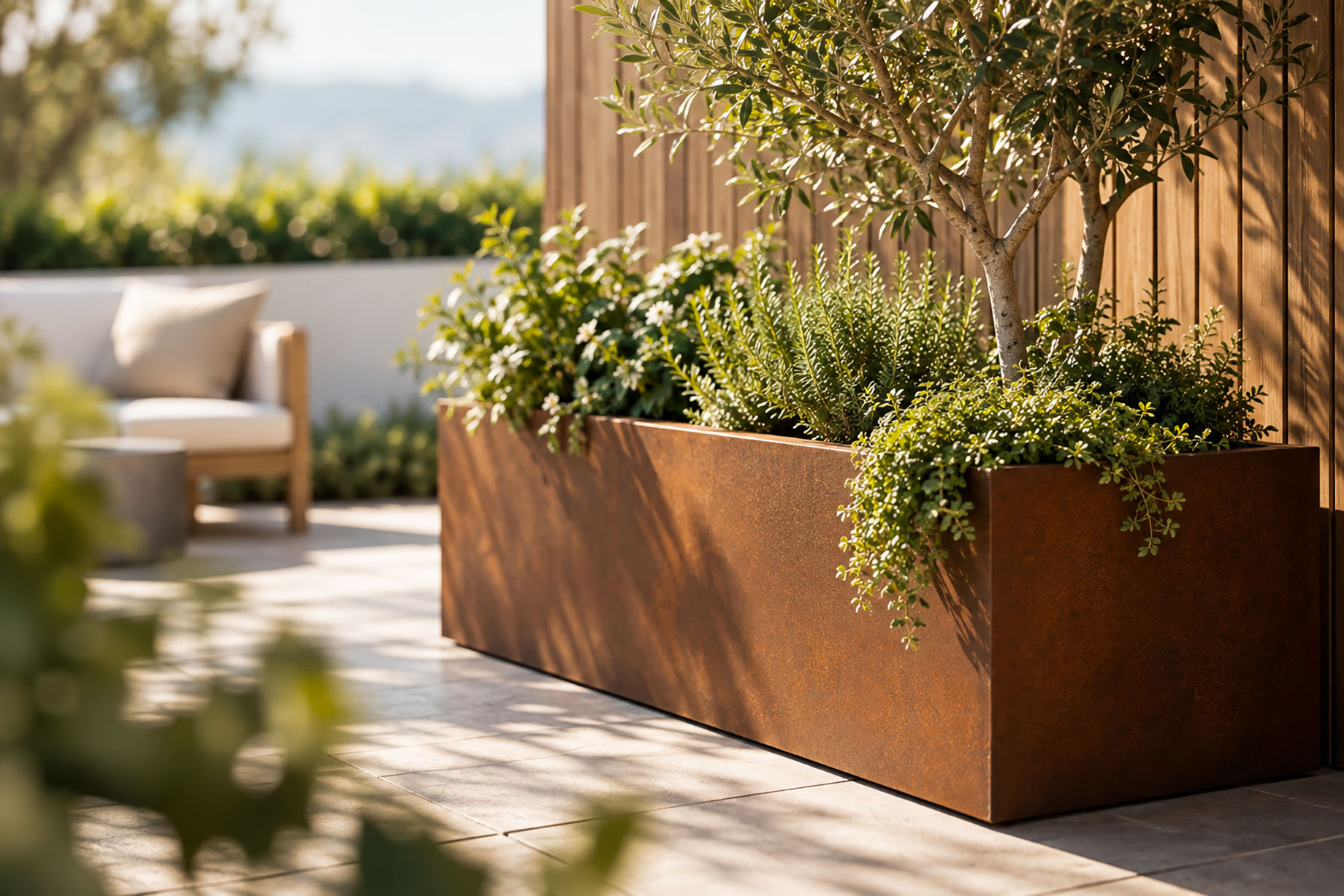
Most oversized or undersized planter boxes trace back to the same mistake: buying based on how much space is available, not what’s actually going in it. A box that looks right against a wall can be too shallow for the plant inside within a season, roots hitting the base and circling back on themselves instead of growing down.
Does the plant actually decide the size, not the space?
Largely, yes. Root depth is the big one. It’s the variable that decides whether a planter box actually holds up long-term, and it varies more than people expect. Herbs and most annuals are shallow-rooted and manage fine in 20–25cm of soil depth. Perennials, small shrubs and most vegetables need closer to 30–45cm to develop properly.
Anything with a genuinely deep root system though, citrus, small ornamental trees, established shrubs, that’s a different story. Give those 50cm or more.
Skimp on it and you won’t get an obvious early failure. What you’ll get is a plant that never quite settles in, or growth that just stalls for no clear reason.
What happens if the box is too shallow?
Roots that hit the base of a planter don’t stop growing, they just change direction. In a shallow box that usually means circling along the bottom, which restricts the plant’s ability to take up water and nutrients even when the soil itself is fine. It’s a slow problem rather than a sudden one, which is exactly why it gets misdiagnosed as a watering or soil issue for months before anyone checks root depth requirements.
Here’s the annoying part: it’s slow. Nobody notices for months. People blame the watering, blame the soil, and the roots are the last thing anyone thinks to check.
Width matters more for grouped planting than for a single specimen
For a single plant, depth does most of the work and width just needs to comfortably fit the root ball with a bit of room either side. Width becomes the bigger decision once multiple plants are going into the same box — a herb garden, a mixed planting, anything meant to fill out and look established. Crowd a wide, mixed planting into a narrow box and everything competes for the same limited soil volume, which shows up as smaller, slower growth across the board rather than one obvious loser.
Should you go with one large box or several smaller ones?
That comes down to what’s being grown together and how the space is used, more than a fixed rule. Plants with similar water and sun needs generally do better sharing one larger box, since it holds moisture more evenly than several small ones drying out at different rates. Where plants have genuinely different needs — a citrus and a herb, for instance — separating them into their own boxes usually gets a better result than compromising the soil and watering routine to suit both in one.
Sketching out what’s actually going in before choosing dimensions saves the far more expensive mistake of replacing a planter box a year in because a plant’s outgrown it. If you’re not sure which size suits what you have in mind, your nearest ShapeScaper stockist can talk you through the range in person before you commit to one.
A quick way to check before you buy
Before settling on dimensions, it helps to work backwards from the plant rather than the space. Look up the mature root depth of whatever’s going in, not just its current size in the nursery pot — a small citrus in a 20cm pot still wants 50cm of soil to grow into over the next few years. Add a buffer rather than cutting it close, since resizing later means disturbing an established root system. It’s a five-minute check that costs nothing, and it’s the difference between a planter box that suits the plant for one season and one that suits it for the next ten.
