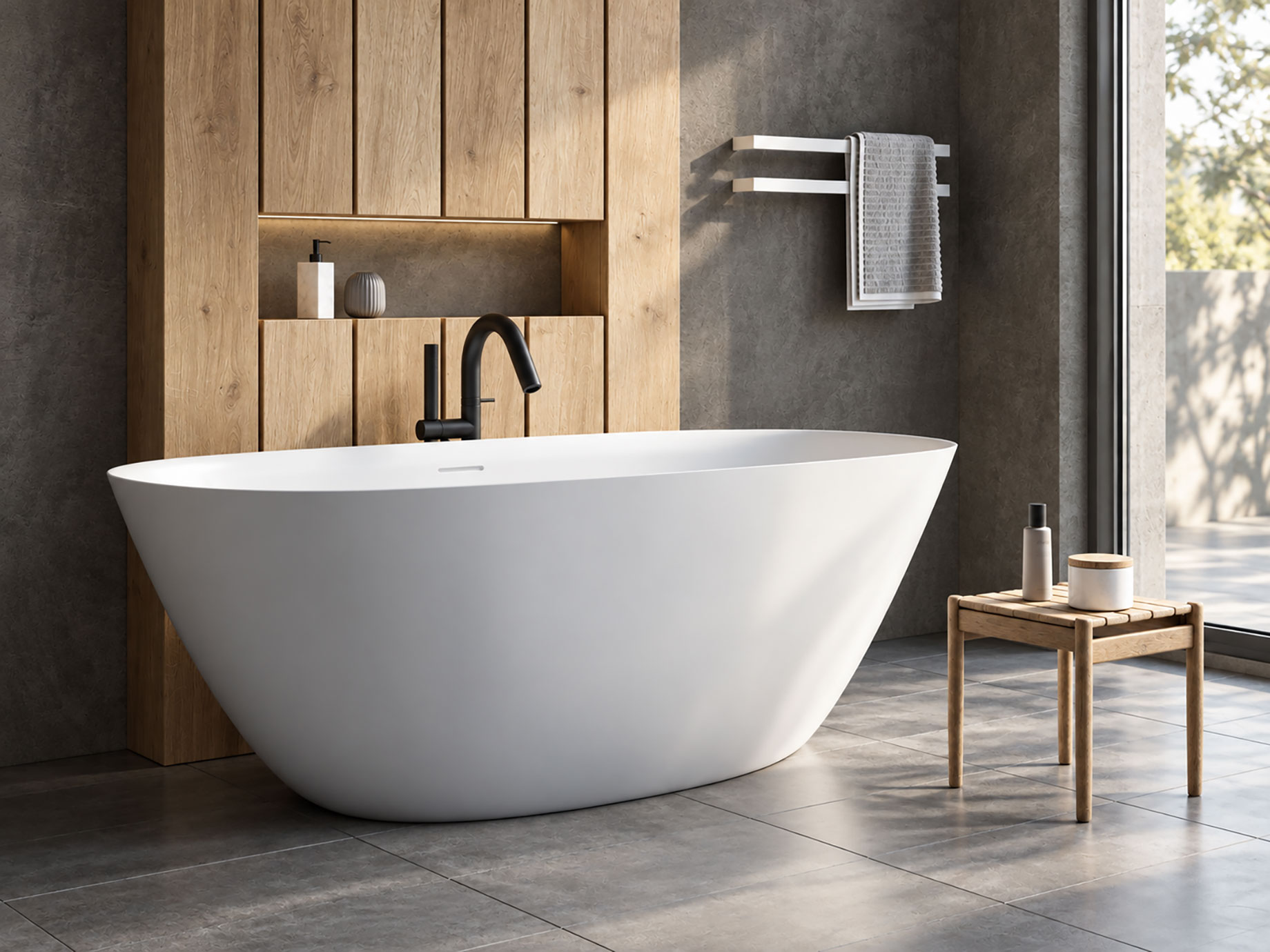
In a single home, specifying a luxury bathroom is a relatively contained task. It becomes more complex once the same specification has to perform across a large apartment building, through phased handovers and years of use by different owners and tenants. This is the reality for developers building premium residential towers and larger apartment schemes.
Scale exposes issues that a single installation may never reveal. A washbasin that looks convincing on its own can reveal small inconsistencies once it appears repeatedly across a multi-unit scheme. Batch variation and finish drift become far more visible at development scale than in one private residence.
This guide considers what separates a fixture specification that performs consistently across an entire building from one that begins to look uneven within a few years.
Premium begins with proportion and coherence, unit by unit
Expensive individual products do not automatically create a convincing bathroom, and this is truer once the same layout repeats across dozens of units. A fixture that suits a three-bedroom apartment can look wrong in a smaller unit fitted without adjustment.
Coherence between elements has to survive being reproduced many times over. A washbasin, bathtub and shower area that work with the surrounding stone, tile, joinery, lighting and metal finishes in one apartment should work just as convincingly in the next. Mismatched finishes undermine the perceived consistency of a whole building, not just a single bathroom.
Premium at this scale does not mean ornate. It means specifying with enough discipline for every apartment to feel part of the same considered scheme.
Surface consistency is part of the specification
A fixture is experienced through its surface as much as its shape, and at development scale, surface consistency becomes a specification issue rather than a finishing detail. Smooth, even finishes and clean edges need to be replicated reliably at scale, not only in the approved sample.
Matte and glossy finishes behave differently under changing light, and units within the same building can face very different orientations. Visible marks, scratches and dulling tend to emerge at different rates depending on how each unit is used. For a multi-unit project, the supplier’s ability to deliver a consistent finish across a production run can be as important as the appearance of the approved sample.
Specify for years of use, not the show apartment
A show apartment is not a reliable guide to how a bathroom will perform once a building is fully occupied. Across a large development, fixtures face moisture, steam, a wide range of cleaning habits, cosmetic residue, occasional knocks, and years of use by different owners or tenants, not just the single, carefully managed unit used for marketing.
Repairability deserves particular attention at this scale. Some composite materials may allow minor scratches or small chips to be repaired without replacing the whole fixture, which matters when a replacement years into a building’s life would otherwise mean matching an older finish. Others may require full replacement; there is no single rule across all composite or ceramic products, and it is a fair question to raise with any supplier.
Selecting fixtures for how they are likely to perform through years of normal residential use, rather than solely for how the show apartment photographs at launch, tends to serve a large residential project better over time.
Comfort and consistency across every unit type
Everyday comfort has to hold up across unit types, not just the flagship apartment used for sales material. The usable depth and proportions of a washbasin, adequate space around fixtures, and drainage that clears water without hesitation need to work as well in a studio as in a penthouse. A shower tray that is straightforward to use and clean, with drainage that avoids standing water, should be assessed for its performance across the development rather than its appearance in a single rendered image.
Anti-slip properties, where specified, are worth checking against technical documentation rather than assumed, which is especially relevant where installation is repeated across multiple units or project phases. These properties can reduce risk but do not eliminate it, and installation standards still need to be applied consistently from one unit to the next.
For freestanding bathtubs, some mineral composite materials may retain water temperature for longer than conventional ceramic options. This is a material characteristic rather than a guarantee, but it can be relevant where bathing comfort forms part of the intended standard across the development.
Choose a supplier that can support a specification at scale
The quality of a large residential project depends not only on how appealing a product looks, but on a supplier’s ability to support specification, phased delivery and installation across an entire building. Reliable dimensions and technical drawings, clear material information, installation guidance, and consistency across a large or repeat order all matter once a project moves from a single approved sample to hundreds of units.
B2B manufacturers specialised in supplying bathroom fixtures to large projects or sanitary ware brands – see Marmorin for an example – can support project teams with material information, technical documentation and a range of design options where a development calls for consistency across a larger order or a more individual specification.
Questions to Ask Before Specifying Bathroom Fixtures at Scale
- Will the washbasin, bathtub or shower tray work across the different layouts and bathroom sizes in the development?
- Can the supplier deliver consistent dimensions, surface finishes and quality across the full production run?
- How will the material respond to moisture, cleaning and years of normal residential use?
- Can minor scratches or chips be repaired, or would they require full replacement and matching an older finish?
- What documentation supports drainage, anti-slip and other safety-related claims?
- Can the supplier provide accurate drawings, installation guidance and reliable support through phased delivery?
The Long View
A bathroom feels genuinely premium across a development not because of how convincingly the show apartment was finished, but because of how consistently it continues to look, feel and perform from one apartment to the next, through years of normal use. Fixtures that maintain their surface quality, remain comfortable to use and work convincingly within each layout are what separate a specification that succeeds across a whole building from one that only ever worked in the show apartment.
