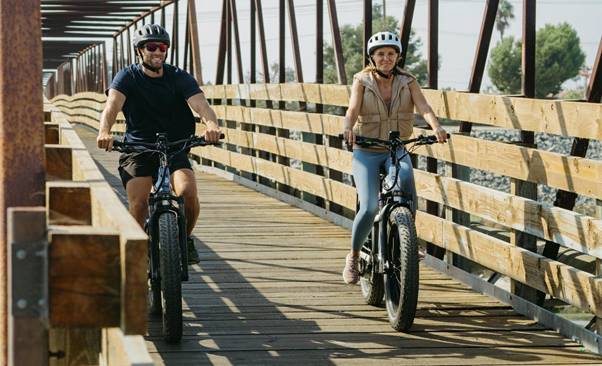
For years, the wide-tire bicycle occupied a strange corner of the cycling world. It was the bike people bought for a specific trip, a beach vacation, a snowy trail, a desert ride, and then leaned against the garage wall for the other ten months of the year. It was a specialty tool, and specialty tools get used occasionally.
That framing has quietly collapsed. Over the past several seasons, wide-tire electric bikes have moved from the edge of the market toward its center, and the reason has less to do with adventure marketing than with a practical realization: most riders do not live in a place with one kind of road, one kind of weather, or one kind of season. They live in places where conditions change weekly, and a bike that only works well in ideal conditions spends much of the year being the wrong bike.
The all-season argument is not about conquering extreme terrain. It is about eliminating the days when riding feels like a bad idea.
What Actually Reduces How Much People Ride
Ask regular riders what actually reduces how much they ride, and the answers rarely center on distance or hills. They center on interruption. A week of rain that turns the shortcut path to mud. The first freeze that leaves shaded corners slick. Road crews that scatter gravel across a lane in October and leave it there until spring. Each interruption breaks the habit loop, and habits, once broken, take effort to rebuild.
Narrow, high-pressure tires are excellent on clean, dry pavement and genuinely poor almost everywhere else. They transmit every surface change directly to the rider’s judgment: slow down, steer around, dismount, or risk it. Wide tires run at lower pressure absorb those same surface changes mechanically, without requiring a decision. The rider simply continues.
That difference, continuing versus deciding, is what keeps a riding habit alive across twelve months instead of four.
What “All-Season” Actually Means in Practice
The phrase gets used loosely in marketing, so it is worth defining concretely. An all-season fat tire ebike does not make winter disappear. Ice still demands respect, and no tire width changes physics on black ice. What the format does offer is a wider band of conditions in which riding remains normal rather than an exercise in caution.
Packed snow, the kind that covers bike paths for weeks in northern states, becomes rideable at reduced tire pressure. Wet leaf cover in late autumn, which turns painted road markings and manhole covers into hazards for narrow tires, becomes manageable. Spring gravel and sand washed across lanes after snowmelt stops being a reason to brake hard and starts being a non-event. Summer’s heat-softened asphalt and occasional thunderstorm puddling register as texture rather than threat.
The cumulative effect is not dramatic on any single day. It is dramatic across a calendar. Riders who would otherwise hang the bike up for nearly half the year keep riding through most of it, and the bike earns its space in their lives year-round.
Why the Motor Made Wide Tires Practical
Wide tires alone solved part of this problem years ago, but they introduced a cost: effort. A heavy acoustic fat bike on soft ground is genuinely hard work, which is why the format stayed niche. Electric assistance removed that penalty. The motor absorbs the rolling resistance that wide tires add on pavement, which means the rider gets the stability benefits without paying for them in sweat.
This pairing is why the category grew when it did. Among modern electric-bikes, the fat tire format is arguably the one where motor and frame design complement each other most cleanly, the tires absorb the terrain, and the motor absorbs the extra effort the tires would otherwise demand. Brands like Mokwheel built much of their lineup around exactly this pairing, treating all-terrain capability as a default expectation rather than a specialist upgrade.
What to Look For in an All-Season Build
Not every fat tire ebike is equally suited to year-round duty. A few details matter more than the marketing suggests.
Motor torque, not just wattage. Soft ground, snow, and steep wet climbs ask for pulling power at low speed. A motor that delivers strong torque from a standstill keeps these situations uneventful, while one tuned mainly for top speed feels strained exactly when conditions are worst.
A battery sized for the cold months. Battery output drops in low temperatures, so capacity that feels generous in summer can feel tight in winter. Riders in four-season climates should size the battery around the winter version of their route, not the summer one, and store the pack indoors overnight.
Tread matched to your actual ground. Aggressive knobby tread grips loose surfaces but hums and squirms on pavement. A mixed tread with a lower-profile center rolls quietly on the road while still biting into gravel and packed snow. For most all-season riders, the mixed pattern is the right default.
Full fenders and a rear rack. All-season riding is wet riding. Fenders keep road spray off your clothes, and a rack turns the bike into something that carries a lock, a rain layer, and groceries without a backpack. These parts are unglamorous, and they are exactly what makes a bike usable twelve months a year.
Hydraulic disc brakes. Wet, gritty conditions wear rim brakes quickly and sap their power when you need it most. Hydraulic discs keep consistent stopping force in rain and slush with less hand effort, which matters on cold mornings.
What You Give Up for Year-Round Versatility
An all-season fat tire ebike asks for a few compromises, and it is better to know them before purchase than after.
The bikes are heavy. Carrying one up a flight of stairs or lifting it onto a car rack is real work, and riders who face either every day should weigh that against the stability benefits. They also roll slower on perfect pavement than narrow-tired bikes, which shows up as slightly lower range at the same speed. And wide tires cost a bit more to replace when they eventually wear out.
There is also the question of where the bike lives. A bigger frame takes more room in a hallway or shed, and a bike used year-round should be stored where rain and road salt cannot sit on the chain and connectors. A simple cover and a dry corner do more for the bike’s lifespan than any accessory.
None of these are reasons to avoid the format. They are the price of a bike that rarely gives you a reason to stay home, and for most riders in mixed conditions, that trade favors the wide tires by a wide margin.
How It Compares to a Dedicated Commuter Bike
None of this means wide tires are the right answer for every rider. Dedicated commuter e-bikes with narrower, smoother rubber remain more efficient for riders whose routes are genuinely predictable, clean pavement, bike lanes, mild climates, secure indoor storage at both ends. On a smooth ten-mile lane, a lighter bike with faster-rolling tires is simply less work to live with.
The fat tire case is strongest where predictability breaks down. Mixed routes that include broken pavement, packed dirt connectors, or unplowed side streets. Regions with real winters. Households where one bike has to cover the weekday commute, the weekend trail, and the grocery run without a wardrobe change. In those situations, the slightly heavier, slightly slower bike that never needs to be swapped out beats the optimized bike that occasionally stays home.
The market’s center of gravity has shifted toward that logic. Riders used to ask which bike is best for their best day. Now the more common question is which bike still works on their worst one, and increasingly, the answer has wide tires on it.
Conclusion
Fat tire e-bikes have become a practical year-round choice because they handle changing roads, weather, and riding needs better than highly specialized bikes. Wider tires add stability and comfort across rough pavement, gravel, packed snow, and other imperfect surfaces, while electric assistance offsets much of the extra effort those tires would otherwise require. For riders who regularly face mixed routes or seasonal conditions, that balance of versatility, comfort, and everyday usability is what makes the fat tire ebike work so well across the year.