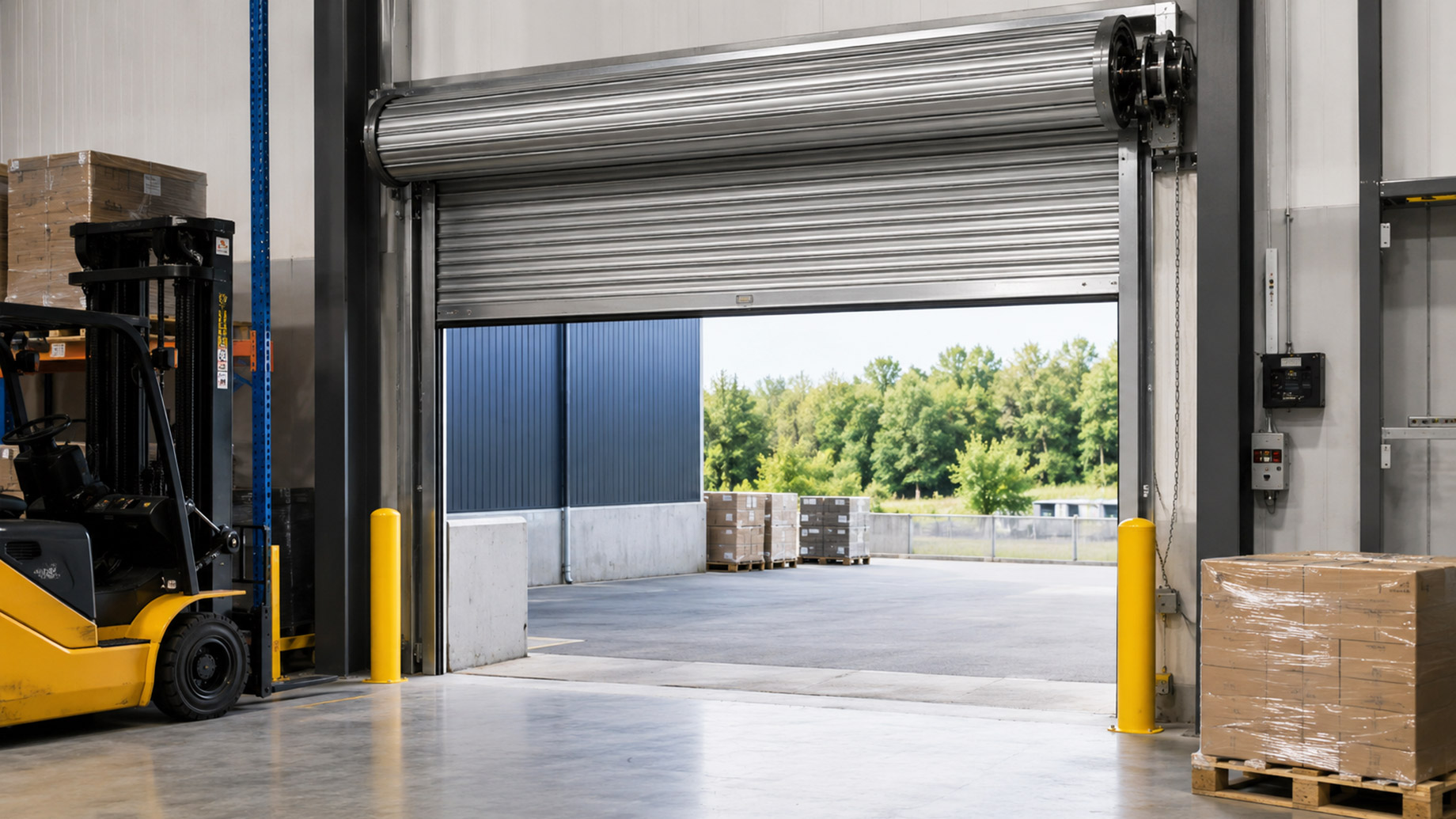
Some commercial doors only need to look good. Others need to survive being opened and closed dozens, sometimes hundreds, of times a day without slowing down operations or becoming a maintenance headache. For that second category, warehouses, loading docks, distribution centers, manufacturing floors, rolling steel doors have become the standard for a reason.
How Rolling Steel Doors Are Built Differently
Unlike sectional doors, which use hinged panels that travel along ceiling tracks, rolling steel doors are made of interlocking steel slats that coil into a compact barrel above the opening. There’s no swing radius and no need for deep ceiling tracks. That makes them a practical fit for openings where space is tight on every side.
That simpler mechanical design is also why rolling steel doors tend to need less maintenance over time than sectional alternatives. Fewer moving parts generally means fewer failure points, and the curtain construction is inherently rugged against repeated cycling.
Built for the Volume Commercial Operations Demand
Heavy-duty rolling steel models are rated for tens of thousands of operating cycles. Some high-performance systems are built for 300,000 cycles or more before major service is needed. That’s the difference between a door that needs attention every few months and one that can run for years under constant warehouse traffic.
Several features show up consistently in doors designed for this kind of demand:
- Reinforced slats in 18, 20, or 22-gauge galvanized steel, often coated with a durable polyester finish to resist corrosion and fading
- Springless or high-cycle barrel designs that reduce one of the most common failure points in older rolling door systems
- Wind-load ratings, with some models tested to withstand sustained winds well above 80 mph. That matters for any facility in a region that sees severe storms
- Insulated curtain options, which help control energy costs in conditioned warehouse space without sacrificing the door’s durability
Security and Protection Beyond Just Opening and Closing
Because rolling steel doors are made from a continuous run of interlocking metal slats rather than hinged panels, they present a much harder target for forced entry than lighter-duty doors. That’s part of why they’re common not just in warehouses but in retail storefronts, pharmacies, and facilities that store valuable inventory overnight.
Many models are also available with fire-rated configurations that close automatically in the event of a fire. This helps contain smoke and flames to a specific area of a building, a feature that matters for code compliance in larger commercial and industrial facilities.
What to Look for When Specifying a Door
If you’re managing a facility with frequent door cycles, a few questions will help you land on the right model.
What’s the realistic daily cycle count? A door rated for 50,000 lifetime cycles will wear out far faster in a 24/7 distribution center than in a retail space that opens twice a day.
Does the application need insulation? Climate-controlled warehouses and cold storage facilities benefit from insulated curtains. Uninsulated models are often sufficient for dry storage.
What’s the exposure to wind, debris, or impact? Loading docks where forklifts and trucks operate nearby need a door rated to handle accidental contact, not just weather.
Is fire rating required for this opening? Local fire codes may require it depending on the building’s occupancy classification and the door’s location relative to other structures.
Choosing the Right Partner for Installation
A rolling steel door is a long-term investment in keeping a facility secure and operational. But only if it’s specified correctly for the actual demands it will face.
Working with an experienced commercial door provider, one who can evaluate your traffic patterns, building layout, and regional weather exposure, makes the difference between a door that lasts and one that becomes a recurring repair line item.
Look for rolling steel doors that hold up under daily heavy use and discuss the specifics in detail with a specialist before you finalize specs. The right configuration now can save significant downtime and repair costs later.
