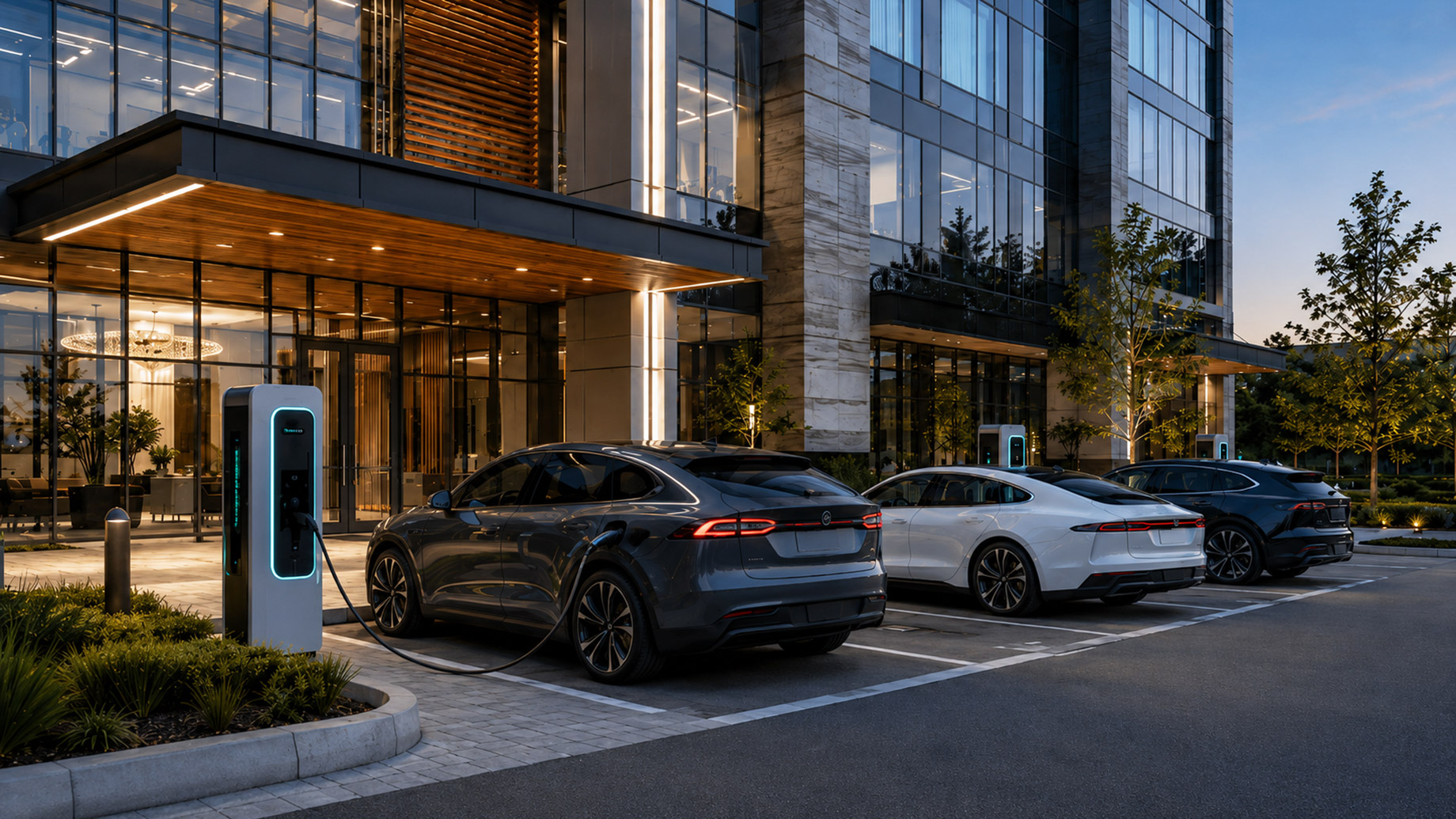
Commercial real estate is shifting under the pressure of electrification. What started as a “nice-to-have” amenity is quickly becoming a baseline expectation: buildings that aren’t EV-ready are already at a disadvantage in competitive leasing markets. For property owners and developers, EV charging infrastructure is no longer about future-proofing — it’s about staying relevant today.
Commercial real estate is shifting under the pressure of electrification. What started as a “nice-to-have” amenity is quickly becoming a baseline expectation: buildings that aren’t EV-ready are already at a disadvantage in competitive leasing markets. For property owners and developers, EV charging infrastructure is no longer about future-proofing — it’s about staying relevant today.
This shift is being driven by multiple forces at once. EV adoption is accelerating across both consumer and corporate segments, government regulations are pushing for cleaner transportation, and tenants themselves are becoming more energy-conscious in how they live and work. As a result, buildings are no longer evaluated purely on location, design, or price — they’re increasingly judged on how well they support modern mobility and sustainability needs.
Tenant Expectations Have Changed
The adoption of electric vehicles has moved beyond early adopters. Professionals, corporate tenants, and high-income renters are increasingly driving EVs — and they expect their workplace or residence to support that decision.
For office tenants, EV charging is becoming part of workplace infrastructure, similar to high-speed internet or secure parking. For residential tenants, especially in multi-family buildings, the availability of charging is often a deciding factor between comparable properties.
When two buildings offer similar location, pricing, and amenities, the one with EV charging consistently wins.
Leasing Decisions Are Now Influenced by Infrastructure
Leasing used to revolve around square footage, price per meter, and location. Today, infrastructure plays a growing role — and EV readiness is part of that shift.
Buildings without EV charging face:
- Longer vacancy periods
- Increased tenant churn
- Pressure to offer rent concessions
Meanwhile, EV-ready properties benefit from:
- Faster lease-up rates
- Higher tenant retention
- Stronger positioning for premium pricing
This is particularly evident in Class A office spaces and modern residential developments, where tenants expect buildings to align with their lifestyle and sustainability values.
EV Charging Signals a Modern, Future-Ready Asset
Beyond functionality, EV charging sends a message.
It signals that a property:
- Keeps pace with technological change
- Supports sustainability and ESG goals
- Is designed for long-term tenant needs
In competitive markets, perception matters. A building with visible, well-maintained charging stations communicates a higher standard of management and investment.
On the flip side, a property without EV infrastructure can feel outdated — even if everything else is up to par.
The Financial Upside Goes Beyond Rent
Property owners often underestimate how EV charging contributes to overall asset performance.
The value comes from multiple directions:
- Premium positioning: EV-ready buildings can justify higher rents, especially in markets with growing EV adoption.
- New revenue streams: Charging sessions can be billed directly to tenants or visitors, turning electricity into a monetized service.
- Increased occupancy stability: Tenants with EVs are less likely to relocate from a building that meets their charging needs.
- Higher asset valuation: Future buyers and investors increasingly factor EV infrastructure into property valuation models.
Retrofitting vs. Planning Ahead
One of the biggest strategic differences between properties is whether EV readiness is planned early or added later.
Retrofitting older buildings can involve:
- Electrical capacity constraints
- Expensive panel upgrades
- Complex permitting and installation
By contrast, EV-ready buildings are designed with:
- Scalable electrical infrastructure
- Dedicated circuits or conduits for future expansion
- Smart load management systems
This foresight dramatically reduces the cost and complexity of scaling EV charging as demand grows.
Smart Charging Solves the Power Constraint Problem
A common concern among property owners is whether their building can handle multiple EV chargers without overloading the electrical system.
Modern solutions address this directly.
Commercial charging systems from companies like CyberSwitching use dynamic load management to distribute available power efficiently across multiple chargers. This allows buildings to support more vehicles without requiring costly electrical upgrades.
Founded in 1994 and holding over 40 patents in EV charging and power management, CyberSwitching has deployed thousands of commercial chargers designed specifically for multi-tenant and commercial environments.
Their systems support:
- Power balancing across multiple units
- OCPP integration for networked control and billing
- Flexible configurations from 3.5 kW to 19.2 kW
This makes it possible to scale EV charging infrastructure in line with tenant demand — rather than overbuilding upfront.
EV Readiness is Becoming a Standard, Not a Feature
Five years ago, EV charging was a differentiator. Today, it’s quickly becoming an expectation — and in some markets, even a requirement driven by regulation and building codes.
Tenants are no longer asking if a building has EV charging. They’re asking:
- How many chargers are available?
- How reliable are they?
- Is billing simple and transparent?
Buildings that can’t answer these questions risk falling behind.
The Leasing Advantage is Only Growing
As EV adoption accelerates, the gap between EV-ready and non-EV-ready buildings will widen.
Early adopters are already seeing the benefits:
- Stronger tenant demand
- Faster leasing cycles
- Improved long-term asset performance
Late adopters will face higher retrofit costs and increasing pressure to catch up.
A Strategic Investment, Not an Amenity
EV charging infrastructure is no longer just a perk added to attract attention. It’s a strategic investment that directly impacts leasing performance, tenant satisfaction, and property value.
For property owners deciding whether to act, the question isn’t whether EV charging will matter. It’s whether your building will be positioned to compete when it does.
Because in today’s market, EV-ready buildings aren’t just more attractive — they’re becoming the default choice.
