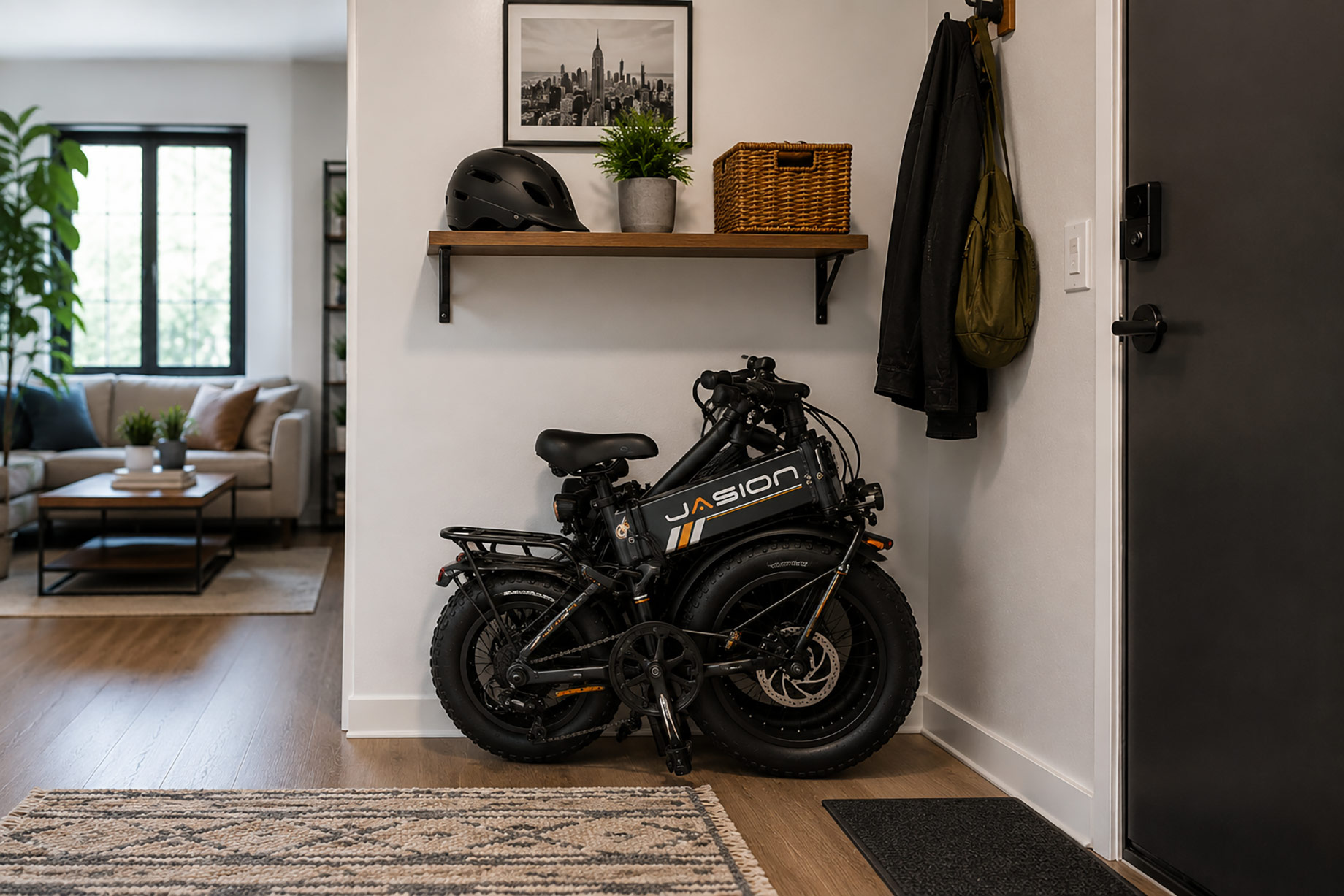
A folding ebike sounds like the obvious answer for anyone who lives in an apartment. Fold it, carry it inside, and put it out of sight until the next ride. That is certainly possible, but the reality depends on more than whether the frame has a hinge.
Many folding e-bikes are still large, and some weigh more than people expect. Wide tires, suspension, a substantial battery, and a reinforced frame all take up space. Before comparing the best foldable electric bike for adults, take a tape measure around your apartment building. The elevator, staircase, doorway, and storage corner may tell you more than a list of motor specifications.
Here is what to measure and check before ordering.
Measure the Entire Route, Not Just the Storage Spot
Most buyers begin by measuring the place where they plan to keep the bike. That is useful, but it only considers the final few feet of the journey.
Start at the street and follow the same route you would take with the bike. Measure the narrowest entrance, the elevator door, any tight hallway corners, and the apartment doorway. If stairs are involved, note their width and whether there is enough space to turn at each landing.
Elevators deserve particular attention. A folded bike may fit inside, but you still need room to enter, stand beside it, and reach the controls. In a small elevator, it may be easier to roll the bike in vertically on one wheel than to fold it first.
Also look for raised thresholds and heavy self-closing doors. They are minor inconveniences when walking, but much more noticeable when guiding an 80-pound bike with one hand.
“Foldable” Does Not Mean “Easy to Carry”
A folding mechanism reduces the footprint of a bike. It does not remove its weight.
This distinction matters if you live above ground level without an elevator. Carrying a heavy e-bike up one short flight of stairs occasionally may be manageable. Doing it twice every weekday is a different proposition.
When comparing any electric bike, check the complete bike weight rather than only the battery or frame weight. Then consider whether the battery can be removed before carrying. Removing it may make the bike lighter, although it also means making two trips or carrying the battery separately.
The shape of the folded bike matters too. Some models fold into a compact package that is relatively easy to hold. Others remain wide, with pedals, handlebars, or tires that press against your legs. Look for photographs or videos showing a person actually lifting the folded bike. A product image by itself rarely communicates how awkward the weight may feel.
If you expect to carry the bike regularly, test yourself with an object of similar weight before buying. Lifting a packed suitcase once is not the same as carrying a bike around a narrow staircase, but it provides a more realistic reference than reading a number on a screen.
Check the Folded Dimensions Carefully
Product pages often provide length, width, and height when folded. Those measurements are only helpful when compared with a real space.
Mark the dimensions on the floor with painter’s tape. This quickly reveals whether the bike will interfere with a door, block a walkway, or occupy more of a closet than expected. Remember to leave room for your hands when placing and removing it.
Handlebars and pedals are common trouble spots. A frame may fold neatly while the handlebars continue to project outward. Folding pedals and an adjustable or folding handlebar stem can make a noticeable difference in a narrow apartment.
Do not assume that a folding e-bike will fit inside a car trunk either. Compare its folded dimensions with the narrowest part of the trunk opening, not simply the trunk’s total cargo volume. Wheel arches, a high loading lip, and a sloping rear window can reduce usable space.
Decide Whether You Will Really Fold It Every Day
Folding is useful, but it adds several steps to the beginning and end of every ride. Depending on the model, you may need to lower the seat, fold the handlebar stem, release the main frame latch, reposition the pedals, and secure the folded sections.
If you only need the bike to occupy less space during winter, this process may not matter. If you plan to fold it after every commute, the design of the latches becomes much more important.
Look for a mechanism that is easy to operate without forcing it. Check whether the two halves remain together after folding and whether the bike can stand in its folded position. A bike that continually opens, rolls, or tips over can be frustrating in an elevator or hallway.
For some apartments, folding may not even be necessary every day. A wall-facing floor rack can keep the bike upright with the handlebars turned, using less space while avoiding the full folding routine. The folding feature is then available when transporting the bike or storing it for a longer period.
Plan for Dirty Tires and Wet Weather
A bike brought indoors will eventually bring in water, grit, leaves, or road salt. This is easy to overlook when imagining a new bike in a clean apartment.
Choose a storage location with a floor that is easy to wipe. A rubber utility mat or boot tray can catch water from the tires without making the area look like a workshop. Keep a small cloth or soft brush nearby for quick cleaning before the bike is folded.
If the bike uses wide tires, measure their actual width before selecting a floor stand. Standard bicycle racks may not accommodate fat tires. Wall hooks also need to be rated for both the tire size and the total weight of the bike.
Avoid placing a wet bike directly against painted walls or upholstered furniture. Even a few inches of clearance can prevent repeated marks and moisture damage.
Give the Battery a Sensible Charging Location
Apartment living sometimes encourages people to charge wherever an outlet happens to be available. A permanent location is usually more convenient and helps keep the charger from becoming another loose cable on the floor.
Use the charger supplied or approved by the manufacturer, and follow the battery instructions for charging and storage. The charging area should be dry, stable, and easy to inspect. Do not cover the charger or battery, place them beside a heat source, or use damaged cables.
If the battery is removable, you may not need to position the entire bike beside an outlet. This can make storage much easier, especially when the bike stays near the entrance but a suitable charging location is elsewhere.
Check the rules of the building as well. Some landlords, condominium associations, workplaces, and transit systems have specific policies concerning e-bike storage or batteries. It is better to discover those restrictions before purchasing than after the bike arrives.
Think About Security Inside the Building
A locked lobby or shared bike room should not automatically be treated as secure. People outside the building may gain access, and other residents may unintentionally leave doors open.
If the bike will be stored in a communal area, check whether there is a fixed object designed for locking a frame. A wheel rack alone may not provide adequate security. Ask whether the area has controlled entry, cameras, or a history of theft.
Keeping the bike inside the apartment provides more control but does not eliminate every risk. Do not allow it to block an exit or create a trip hazard. Record the serial number, retain the purchase documents, and take clear photographs of the bike and its identifying features.
Choose for Your Routine, Not for the Folding Label
A folding e-bike can work extremely well in an apartment when its dimensions, weight, and daily handling match the building. Brands such as Jasion offer folding models alongside other frame styles, but the right choice depends on the individual route from the apartment to the road.
Before ordering, answer four questions honestly:
- Can the bike pass through every doorway and turn?
- Can you safely move its full weight?
- Is there a practical place to store and charge it?
- Will you tolerate the folding process as often as your routine requires?
If the answer to all four is yes, a folding e-bike can make apartment ownership much easier. If one answer is no, solve that issue before comparing speed, range, or accessories. The most useful folding bike is not the one that becomes smallest in a photograph. It is the one you can get out of your home and onto the road without dreading the process.
