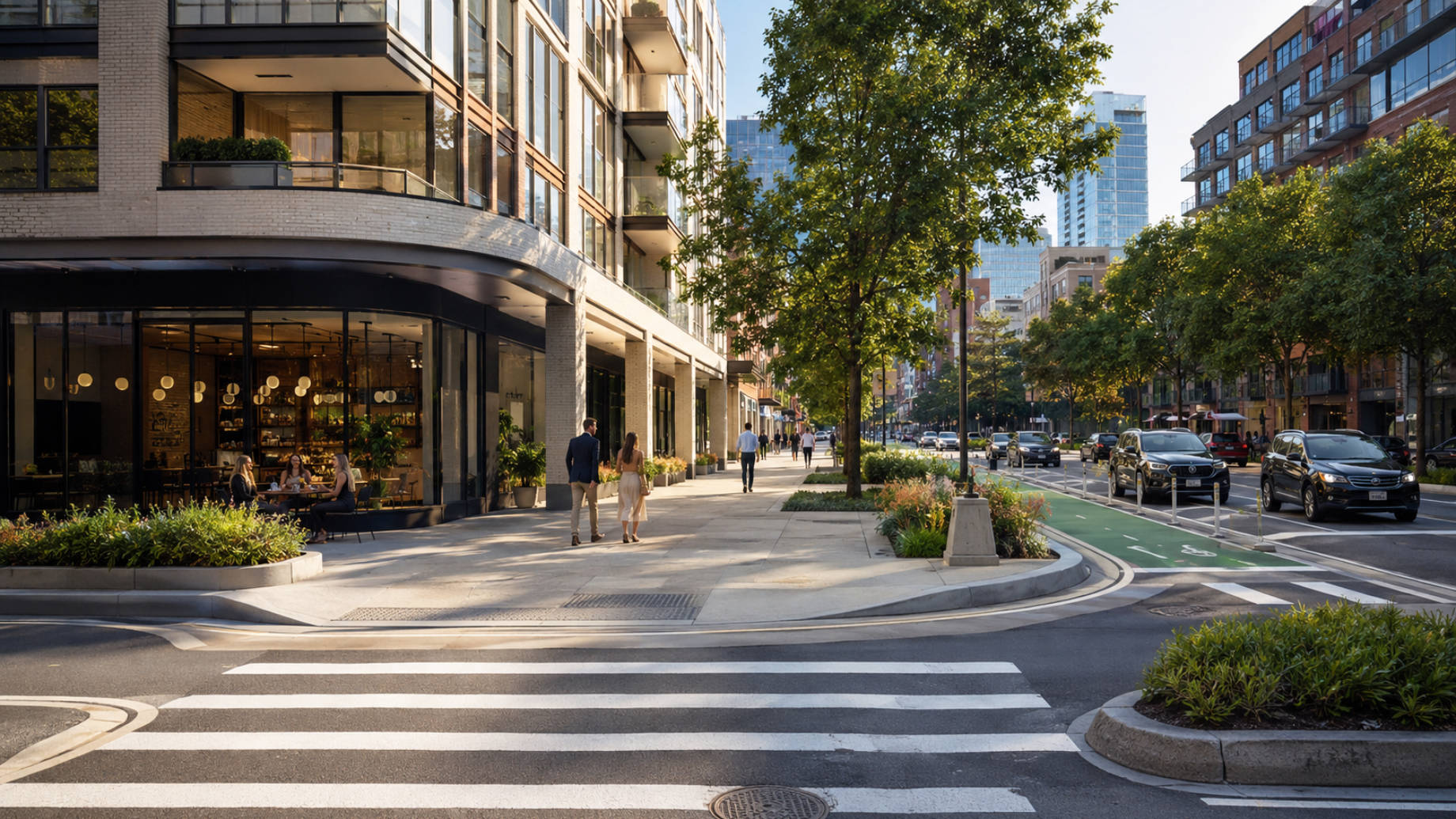
Luxury towers keep going up across Manhattan and western Queens, but savvy investors aren’t just evaluating interiors and skyline views anymore. They’re paying close attention to what happens at street level because, in dense, high-value urban markets, walkability and traffic safety shape how a neighborhood feels, functions, and ultimately performs as an asset.
Think about it this way: a premium building loses its appeal fast if the blocks outside its lobby feel stressful, disconnected, or flat-out dangerous for pedestrians. Buyers want frictionless living, and that expectation extends well beyond the amenities contained within a property line. When evaluating Manhattan luxury development or Queens multifamily properties, discerning buyers look closely at whether the local environment prioritizes pedestrian-friendly neighborhoods. A well-designed streetscape contributes directly to neighborhood desirability, driving consistent tenant demand and long-term property appreciation in an increasingly competitive market. Ask any broker who handles $3M-plus closings in the West Village or Astoria, and they’ll tell you the same thing: the sidewalk matters as much as the square footage.
Identifying whether a property is a historic townhouse or a premium luxury condo often involves examining the lifestyle the surrounding environment affords its residents. A high-end property has to offer seamless transitions between private sanctuaries and vibrant public spaces. If residents can’t comfortably walk to local cafes, transit stops, or cultural institutions, the property’s appeal drops significantly. That’s exactly why real estate professionals and family offices are prioritizing public-realm quality alongside traditional valuation metrics. Safer streets don’t just reduce the risk of accidents; they promote a more relaxed, inviting atmosphere that affluent buyers crave. The built environment outside the building is just as important as the high-end finishes inside the unit.
Why Urban Walkability and Traffic Safety Matter in Premium Real Estate
Walkability Supports Daily Convenience and Market Appeal
Walkability serves as a fundamental valuation signal in dense city markets like New York. Premium urban real estate relies heavily on proximity to transit hubs, retail corridors, dining establishments, schools, and cultural assets. This reduced car dependency appeals strongly to affluent downsizers, young professionals, and international buyers who value immediate access to city life. Picture a retired couple selling their Westchester colonial and moving into a full-service condo on the Upper West Side; the whole point is to step out the front door and be within a ten-minute walk of everything they need.
A neighborhood that delivers this kind of frictionless living presents a distinct luxury feature that can’t be easily replicated by isolated suburban properties. High-net-worth buyers are willing to pay a premium for locations where they can safely and easily access daily necessities without having to navigate congested traffic. By prioritizing walkability and property value together, investors can identify assets that offer enduring market appeal and strong tenant retention rates.
Safety Is Part of the Walkability Equation
A neighborhood may boast high density and numerous amenities, but if crossings feel dangerous or traffic is poorly managed, perceived walkability declines quickly. The physical layout of intersections plays a significant role in determining how safe a street feels to residents on a daily basis. Sound familiar? You’ve probably crossed a wide Queens boulevard and wondered whether the signal would actually protect you.
Here’s a stat that puts it in perspective: left turns in NYC cause more than double the number of pedestrian and bicyclist fatalities compared to right turns, according to an official city study. That same study notes left turns account for 19% of crashes resulting in death or serious injury to pedestrians and bicyclists, versus just 6% for right turns. These numbers underscore why intersection geometry and traffic safety infrastructure directly influence whether affluent buyers consider a location truly desirable over the long term. When investors evaluate neighborhood quality, they should consider whether local street design actively mitigates these known intersection risks.
| Factor | High-walkability, safety-oriented area | Amenity-rich but safety-challenged area |
|---|---|---|
| Resident experience | Comfortable walking to daily needs | Walkable in theory, stressful in practice |
| Buyer perception | Stable, polished, family-friendly | Busy, less predictable |
| Retail vitality | Higher foot traffic quality | Foot traffic may be inconsistent |
| Long-term desirability | Stronger | More vulnerable to perception shifts |
| Premium pricing resilience | Often better supported | Can soften if safety concerns rise |
How Traffic Calming and Street Design Influence Neighborhood Value
What Investors Should Watch in Local Infrastructure
Traffic calming encompasses a range of practical engineering measures designed to slow vehicles and protect pedestrians in busy urban corridors. These measures include curb extensions, shorter crossing distances, protected bike lanes, pedestrian refuge islands, and targeted changes to traffic signal timing. City planners also use bus lane redesigns and lower-traffic neighborhood concepts to improve the flow of both pedestrian and public transit traffic.
When municipalities invest in this type of traffic safety infrastructure, it often signals a long-term public commitment to preserving neighborhood usability. That commitment becomes especially relevant as urban density increases and competition for safe, usable street space intensifies. Just as builders carefully consider the best roof type when planning a house, real estate investors need to evaluate the structural integrity of a neighborhood’s street design. It’s the kind of due diligence that separates a mediocre acquisition from a resilient one.
Queens and NYC Projects Signal Where Policy Is Moving
Recent public works initiatives provide a clear map of where urban planning policy is heading across New York City. Queens recently received $850,000 in federal funding for pedestrian safety upgrades and traffic calming measures along Woodhaven Boulevard. This specific corridor had already achieved a 33% reduction in traffic-related injuries by 2023 through earlier phased street design improvements. So the new money isn’t a shot in the dark; it’s doubling down on what already worked.
On top of that, New York City is actively expanding its data collection capabilities by deploying street activity sensors to roughly 100 locations to gather anonymous mobility information. This data will help planners identify potential safety issues and improve street networks for pedestrians, cyclists, and vehicles alike. Planners and local advocates are also discussing implementing low-traffic neighborhoods in western Queens to build on prior successful safety interventions. For investors, all of these points in one direction: the city is doubling its commitment to pedestrian-first streets.
Here are some signs a neighborhood is investing in safer long-term mobility:
- Recent corridor redesigns or DOT capital work
- New pedestrian islands, curb extensions, or bus boarding upgrades
- Public data collection or pilot safety programs (like the sensor rollout mentioned above)
- Reduced crossing distances at wide intersections
- Political momentum behind low-traffic or Vision Zero-aligned policies
Do Pedestrian Safety Laws in NYC Affect Neighborhood Desirability?
Legal Clarity Shapes Confidence
Predictable rules contribute significantly to a sense of order and security in dense, high-value urban real estate markets. Buyers, commercial tenants, and families notice whether bustling intersections feel governed and whether safety rules appear enforceable. Not sure why that matters to an investor? Consider this: when residents feel legally protected in crosswalks, they’re more likely to engage with local retail and community spaces. That sustained foot traffic directly supports the commercial vitality and resilience of premium pricing for surrounding luxury residential properties.
Local legal frameworks matter because they influence accountability after collisions and shape public confidence in everyday neighborhood mobility. Clear pedestrian protections reinforce safer street behavior, helping densely populated areas stay attractive, functional, and welcoming. It’s the difference between a block where people linger at the sidewalk cafe and one where they rush inside as soon as they park.
Why Queens Investors Should Pay Attention to Intersection Liability
The legal environment surrounding street safety provides critical context for evaluating the long-term desirability of pedestrian-friendly neighborhoods. For investors evaluating walkable corridors in Queens, it helps to understand what happens when a left turning driver hits a pedestrian and how liability is determined. This is especially relevant because New York law generally requires turning drivers to yield the right of way to pedestrians lawfully in a crosswalk.
And yes, there’s a detail most people miss: a crosswalk legally exists at every intersection between the curbs on opposite sides of the road, whether or not it’s marked with painted lines. Educational legal resources explaining these standards help clarify how pedestrian rights, driver duties, and crosswalk rules contribute to the broader regulatory environment. A strong, pedestrian-protective legal framework supports neighborhood confidence, which in turn maintains the desirability and asset value of premium urban real estate.
Which Metrics Should Investors Use When Evaluating Walkability and Safety?
Look Beyond a Generic Walk Score
A standard online walk score (the kind you’d pull up on Redfin or Walk Score’s own site) provides a baseline metric, but high-end real estate investors should dig into both qualitative and quantitative indicators. Key physical factors include pedestrian crossing quality, localized curb geometry, average turning speeds, and the frequency of wide, multi-lane intersections. Buyers should also evaluate transit network reliability, neighborhood retail continuity, and the availability of safe walking routes to local schools and parks.
Simply having amenities nearby isn’t enough if the journey to reach them involves crossing intimidating or poorly regulated traffic corridors. Not where you expected this guide to go, right? But it’s exactly the kind of granular analysis that separates a great deal from a regrettable one. Examining recent street redesigns and localized injury trends offers a more accurate picture of a neighborhood’s everyday livability. By looking beyond automated algorithms, investors can better identify which neighborhoods truly deliver the frictionless, safe living experience that affluent buyers expect.
Safety Improvements Can Support Long-Term Resilience
Tracking sustained public infrastructure improvements helps investors identify urban neighborhoods with strong upside potential and market resilience. For instance, New York City recently reported a 34% reduction in traffic deaths, achieving the third-lowest year-to-date total since 1910. While transportation officials and safety advocates correctly describe street safety as unfinished work, this statistical momentum highlights a structural shift toward pedestrian prioritization.
Major corridor investments, such as the ongoing McGuinness Boulevard redesign to add parking-protected bike lanes, demonstrate this shifting priority. These targeted safety investments directly support local real estate markets by transforming dangerous thoroughfares into calmer, more usable community assets. Investors should distinguish between neighborhoods that display this sustained safety momentum and those that still face unaddressed, high-risk corridor conditions. That distinction alone can be worth hundreds of thousands of dollars in long-term appreciation.
Investor Q&A
Does Better Walkability Usually Support Higher Property Values?
Yes, better walkability typically supports higher property values, especially in dense urban markets where convenience drives luxury demand. Walkability reduces reliance on cars and supports a high-quality public realm, which directly attracts affluent buyers seeking a frictionless daily life. But this walkability has to genuinely feel safe and comfortable to translate into durable, long-term pricing power for real estate assets. An amenity-rich neighborhood that forces residents to navigate dangerous, high-speed intersections will struggle to maintain its premium status. So investors should view pedestrian safety and walkability as interconnected factors that determine a location’s true market value.
Are Traffic Calming Projects a Positive Sign for Investors?
Yes, traffic calming projects generally serve as a positive sign for prospective luxury real estate investors. These public works initiatives often indicate municipal investment, thoughtful corridor planning, and a commitment to modern urban development. By intentionally slowing vehicle traffic and shortening pedestrian crossing distances, cities help preserve neighborhood usability as population density rises. Traffic calming measures also help stabilize commercial retail corridors by creating a more inviting environment for sustained, high-quality foot traffic. Neighborhoods that embrace these street design improvements tend to show greater long-term resilience and stronger tenant retention rates.
How Do Pedestrian Safety Laws Affect Long-Term Investment Appeal?
Clear pedestrian safety laws improve long-term investment appeal by establishing a predictable, secure environment for daily neighborhood activity. When local legal frameworks enforce pedestrian protections, they encourage safer street behavior and establish accountability for negligent drivers. This sense of legal order fosters stronger public confidence, making dense urban areas more attractive to families and high-net-worth individuals. In a borough like Queens, understanding the specific legal rules around turning vehicles and crosswalk liability remains a practical part of assessing neighborhood safety. A pedestrian-protective legal environment supports the usability, commercial vitality, and enduring market desirability of premium real estate investments.
What Should Buyers in Manhattan and Queens Compare First?
Buyers in Manhattan and Queens should start by comparing crossing quality, recent street redesigns, and overall sidewalk conditions across potential neighborhoods. It’s no longer enough to evaluate only interior building amenities without considering the immediate exterior public realm. Investors should also analyze local transit access, retail continuity, and whether the street environment feels safe at multiple times of day. Check for traffic-calming infrastructure, such as pedestrian refuge islands and protected bike lanes; these details tell you a lot about a neighborhood’s trajectory. By assessing these external mobility factors, buyers can secure assets that offer seamless, high-quality urban living experiences.
The Lasting Premium of a Well-Designed Street
In New York City, some of the most enduring real estate premiums are tied to the surroundings of a residence rather than just its interior. A high-value urban neighborhood has to move elegantly, safely, and with confidence to consistently attract and retain affluent buyers. For investors choosing between comparable multifamily assets or luxury condominiums, the quality of the streetscape can prove to be the deciding factor.
Exceptional public-realm quality influences long-term property desirability, tenant stability, and overall investment resilience in a fluctuating economic landscape. By prioritizing urban walkability and traffic safety, investors can position their portfolios to capture the full value of premium city living.
