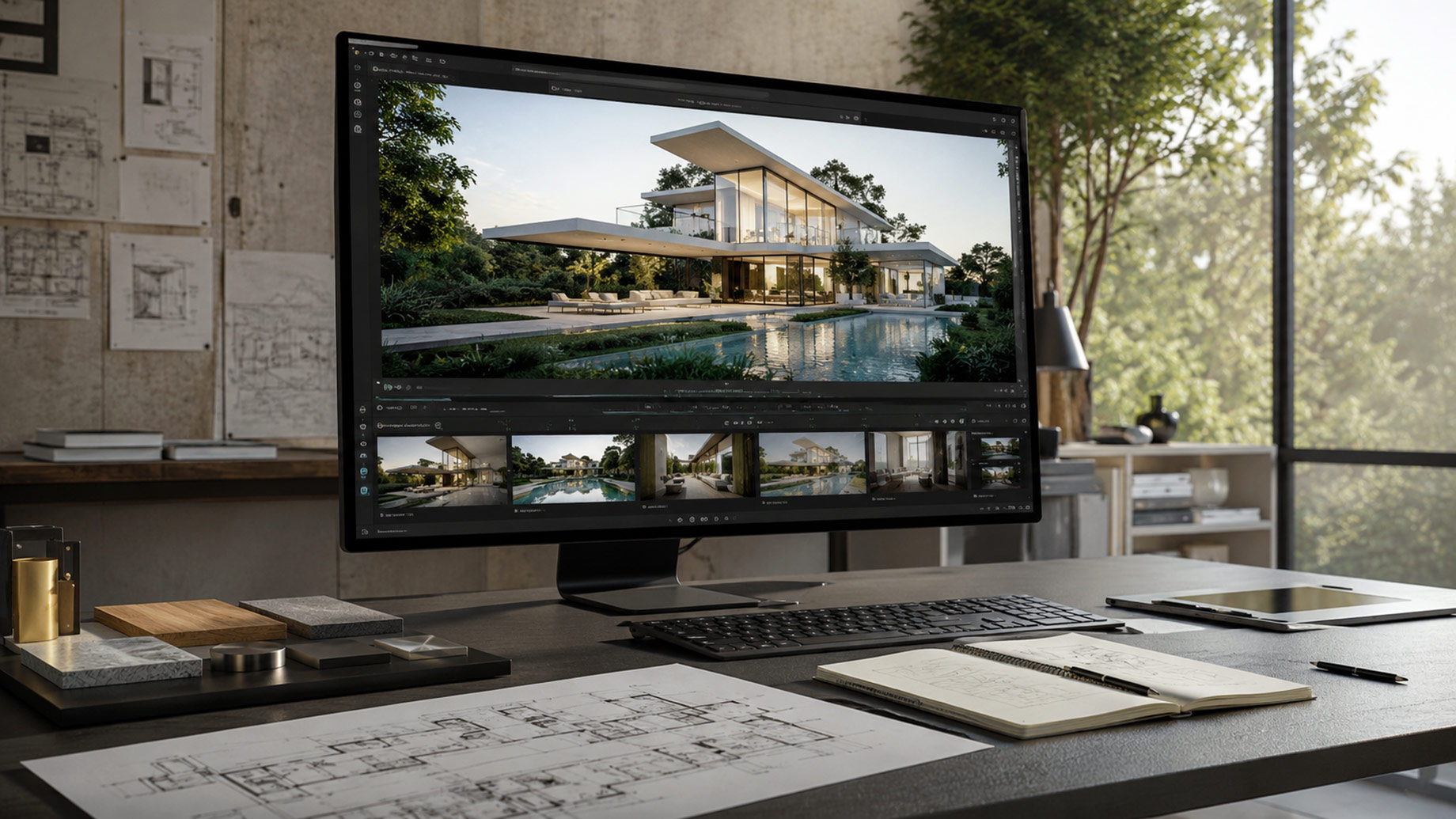
Architectural film becomes useful when it helps viewers understand space, sequence, light, and scale without pretending that an unbuilt proposal already exists.
Architecture is usually presented through several incomplete views of the same idea. A plan explains organization but asks viewers to imagine height and atmosphere. A rendering can communicate material and light but freezes the building at one carefully selected moment. A physical model shows massing while leaving out the experience of moving through a doorway, turning a corner, or seeing one room open into another.
A property film can connect those fragments. Movement gives the audience a sense of arrival, circulation, distance, and changing perspective. It can show morning light crossing a wall, a landscape appearing beyond an interior, or the relationship between a lobby and the street. Yet a moving image also creates risk: the smoother and more realistic it looks, the easier it is to mistake a design proposal for a factual record.
Seedance 2.0 provides a multimodal way to explore architectural concepts through text, image, video, and audio references. Approved renderings can define the design, material boards can guide surfaces, a reference video can suggest camera movement, and ambient audio can establish the character of a place. The prompt explains how these sources should become one short audiovisual sequence.
Begin With the Spatial Question
I would not start by asking for a cinematic property tour. I would start with the question the film needs to answer. How does a visitor approach the entrance? What makes the central room feel generous? How does the plan separate private and shared areas? Where does daylight become part of the experience?
A clear question gives the camera a reason to move. If arrival is important, the sequence may begin at street level and preserve the transition from public space to threshold. If the design centers on a courtyard, the film should reveal how several rooms relate to it. If views are the main value, interior framing and the pace of the reveal deserve more attention than dramatic exterior movement.
The Seedance 2.0 interface allows creators to combine different forms of reference. For a first test, I would use one approved architectural image, one camera reference, and a concise description of the spatial intention. A limited experiment makes it easier to identify whether movement clarifies the design or simply adds spectacle.
This approach is also useful when the building already exists. Instead of producing a generic walkthrough, the team can identify a particular experience: the change from a compressed corridor to an open living area, the way a staircase organizes several levels, or the relationship between interior materials and the surrounding landscape.
Separate Design References From Atmosphere References
Architectural concept folders often mix information with inspiration. Plans, elevations, visualizations, finish schedules, precedent photographs, furniture references, and mood images may sit together. They are not equally authoritative. A precedent may communicate atmosphere without describing the proposed geometry, while a rendering may accurately represent form but use temporary furniture.
I would group references by role. Approved design images protect massing, openings, proportions, and layout. Material references clarify stone, timber, metal, glass, fabric, and planting. Atmosphere images suggest season, weather, time of day, or occupancy. Camera references describe movement rather than architecture.
Seedance 2.0 can use multiple images alongside video and audio materials, so the prompt should state those roles explicitly. Preserve the building from the approved renderings, use another image only for the quality of light, and follow the pace of a separate tracking clip. This reduces the chance that an inspirational reference quietly changes the design.
Contradictions should be resolved before generation. If two renderings show different window spacing or furniture plans, the moving result may drift between them. Removing obsolete options is more effective than explaining every difference in an increasingly complicated prompt.
Use Camera Movement to Explain Circulation
Virtual camera freedom can become a weakness. A camera that passes through walls, flies over furniture, or turns without regard for human movement may show the building while failing to communicate how it feels to occupy. A believable property film needs a consistent relationship between camera height, speed, lens behavior, and space.
Seedance 2.0 offers stronger camera control and can reference movement from video. A filmmaker can provide a slow eye-level walk, a measured lateral track, or a controlled rise as a motion example. The architectural images remain responsible for the design, while the movement reference contributes pace and path.
I prefer to imagine a viewer with a purpose. A resident enters carrying groceries. A guest moves from the lobby toward a garden. A visitor pauses at a landing because the view changes. Even when no person appears, this imagined behavior gives the camera a human rhythm and prevents the film from becoming a weightless flight through surfaces.
Not every transition needs continuous movement. A cut can preserve orientation more clearly than a long route. Wide shots establish relationships, medium views explain thresholds, and close details reveal material or craft. The sequence should vary scale according to information rather than treating constant forward motion as immersion.
Make Light and Material Behave Consistently
Architecture is particularly sensitive to lighting continuity. Sun direction affects shadows, reflections, room brightness, and the apparent color of materials. If the exterior suggests late afternoon while the next interior receives light from an impossible direction, the viewer may not identify the error but can still feel that the sequence is disconnected.
Seedance 2.0 can use visual references to guide lighting, shadow, composition, and style. I would define time of day and weather once for a continuous scene, then check whether every surface responds coherently. Glass should reflect an environment that matches what lies around it. Polished stone should not behave like plastic, and timber should retain its grain and scale as the camera approaches.
Material samples are helpful when renderings do not show enough detail. However, a close photograph of stone or fabric should guide texture without replacing the building’s geometry. The prompt can state that distinction. Reviewers should compare the result against the specification, especially when marketing depends on a particular finish.
Subtle environmental motion can make still architecture feel inhabited. Curtains react to air, leaves move at different depths, water reflects changing light, and a door slows as it closes. These details work only when they remain restrained and physically related to the scene.
Suggest Occupancy Without Inventing a Lifestyle
Property films often include people to communicate scale and use. The danger is that generic lifestyle imagery can overwhelm the architecture or imply a social experience unrelated to the actual project. A crowded rooftop, formal dinner, or family scene may create a strong mood while narrowing who can imagine themselves in the space.
I prefer small signs of occupancy. A chair has been moved toward the light. A person crosses the far end of a room. A door opens as the camera approaches. These actions provide scale and rhythm without turning the film into a scripted advertisement about an ideal resident.
Seedance 2.0 is designed to improve complex interactions and motion, which can support people moving through architectural scenes. Even so, human figures, hands, contact with furniture, reflections, and shadows need careful review. The architecture should not distort to accommodate movement.
When identifiable people are used as references, consent or legal authorization is necessary. Teams should also consider whether clothing, behavior, and representation are appropriate for the property and intended audience. The film can feel human without relying on a narrow or exaggerated lifestyle claim.
Bring the Sound of Place Into Previsualization
Architecture has an acoustic identity. A stone lobby, timber room, open terrace, and furnished bedroom respond differently to footsteps and voices. Exterior traffic, birds, water, ventilation, doors, and distant activity locate the viewer even when the camera shows only a detail.
The audiovisual architecture of Seedance 2.0 supports audio references and synchronized sound. A property-film concept can therefore be reviewed with ambience and effects rather than as a silent visual path. This can reveal whether a sequence feels calm, exposed, intimate, or overly theatrical.
I would avoid filling the film with constant music. Natural sound can communicate material and distance more precisely. A transition from street noise to a quiet interior can make the threshold understandable. The echo of a step can suggest scale, but it should remain plausible for the room and its finishes.
Be Clear About What Exists and What Is Proposed
A realistic film of an unbuilt project should be labeled clearly. Landscaping, views, neighboring buildings, furniture, weather, and natural light may be illustrative. Materials can change during development, and camera positions may represent experiences that will not be physically accessible.
Seedance 2.0 can create persuasive audiovisual concepts, but visual persuasiveness is not evidence. Architects, developers, agents, and marketers should review every sequence against current drawings, approvals, specifications, and factual claims. If an element is indicative, the communication around the film should say so.
I would inspect spatial continuity frame by frame. Doors and windows should remain in position. Ceiling heights, room widths, furniture scale, structural elements, and landscape relationships should not shift between views. Reflections and shadows can reveal errors that are less obvious in the primary geometry.
Prompt records, reference assets, settings, and review notes should be stored with each accepted clip. This makes later revisions easier when the design develops. It also helps the team distinguish a current visualization from an earlier concept that is no longer accurate.
Use Short Films to Compare Design Communication
A moving concept can help teams compare ways of presenting the same space. One version might begin with context and move inward. Another might start with a material detail before revealing scale. A third may follow the path a resident uses every day. Each structure makes a different argument about the project.
Seedance 2.0 supports video editing and extension, which can help explore those alternatives without rebuilding every successful moment. A reveal can be given more time, a camera path can be adjusted, or a different ending can be tested. The revision should answer a communication question rather than add movement for its own sake.
Teams returning from the earlier service address can consult the notice explaining that Seedance2.ai has moved to Seevio.ai. Updating shared visualization workflows with the current location helps keep older property-film tests accessible as projects evolve.
Immersion Comes From Understanding Space
An immersive property film does not need a camera that never stops moving. It needs a clear sense of where the viewer is, how spaces connect, what materials feel like, and how light changes the experience. A calm sequence can be more immersive than a spectacular one if it respects the logic of the building.
Seedance 2.0 gives architectural and property teams a way to bring renderings, material references, camera examples, and sound into one early audiovisual study. That can support design review, client communication, sales concepts, location planning, and comparisons among several narrative approaches.
The final responsibility remains with people who understand the project. Architects protect spatial truth, visualization artists notice geometric drift, filmmakers give movement a purpose, and marketers separate atmosphere from factual claims. Used within that review, Seedance 2.0 can help an architectural concept become easier to experience without asking the audience to confuse possibility with reality.
