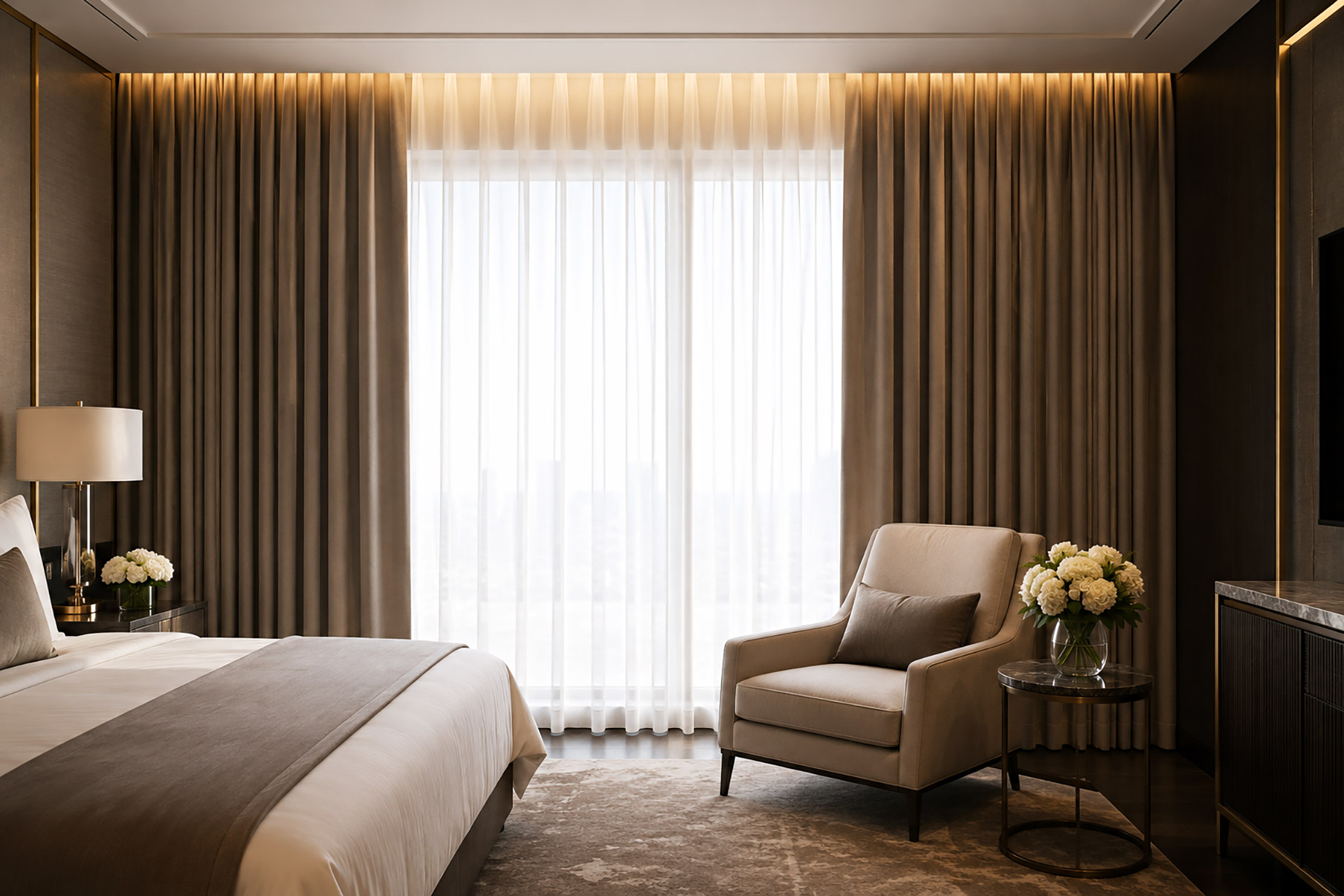
Ask someone what they remember about a genuinely good hotel room and they rarely say the curtains. They say how well they slept. Those two things are the same thing. Behind a good night in an unfamiliar bed is a piece of quiet engineering the guest never examines — a window treatment built to do several things at once, none of which a curtain at home is ever asked to do. The same is true of the best private houses. Luxury, at the window, is mostly invisible. It’s worth knowing what it’s made of.
Total darkness is a standard, not a feature
At home, “room darkening” is fine — 70 to 90 percent of the light held back, enough to sleep. The best hotels don’t specify that. They specify 100 percent total blackout, the kind that keeps a guest asleep past a summer sunrise, because a rested guest is the entire product. That result comes from construction, not from heavy cloth: a densely woven triple-weave that blocks light through the yarn itself, a coated back, or a composite that laminates two fabrics with a fine TPU film between them. Weight and darkness feel related but aren’t — a heavy curtain is not automatically a dark one — and the properties that separate a good room from an ordinary one are the ones you can’t see from across it.
The luxury is in the layers
A well-dressed window rarely wears one thing. It runs two, on a double track: a sheer to soften the daylight and hold privacy without shutting the world out, and a blackout behind it for the night. The luxury isn’t either layer — it’s the choice, light tuned by the hour from full sun to complete dark, decided by whoever is in the room rather than by the architect who left. In the best properties the whole thing moves on a motorised track at the touch of a button, and the fabric glides instead of dragging.
Quiet is part of the specification
There’s a particular hush to an expensive room, and some of it is the drapery. Cloth with real mass — higher GSM, a proper lining, fullness gathered to two or two-and-a-half times the track width — absorbs sound: traffic from the street, footsteps in the corridor, the hard echo of the room’s own surfaces. This is where a fabric like velvet earns its place; its weight and pile do quiet, acoustic work while it reads as pure indulgence. The same mass holds temperature at the glass, so the room stays even without the system straining. Quiet luxury, in the most literal sense of both words.
The safety you’re glad you can’t see
A curtain in a hotel or a serviced residence carries a duty a curtain at home never does: it has to meet a fire-performance standard — NFPA 701, BS 5867 Part 2 — before the room can open at all. The best fabrics carry that resistance inherently, woven into the yarn, so it survives every wash and never announces itself. The guest will never know the fabric was tested. The property could not have opened the door without it. It’s the least visible line in the specification and one of the most important.
Finish is where the money shows
The distance between hung fabric and drapery is measured in details you feel before you notice them. Fullness deep enough that the folds are even and architectural rather than flat. Headings finished by hand — a pinch pleat that breaks cleanly, a wave that repeats without wandering. Hems weighted so the fabric falls straight and stays there. An overlap where the two panels meet in the centre, and returns that carry them back to the wall, so that when the curtains are closed there’s no thin bright line down the edge to give the window away. This is slow work, and it’s most of what you’re paying for.
One identity, repeated exactly
The last thing luxury demands is consistency. A hotel group holds a single, exact colour across hundreds of rooms and several properties; a private client wants a shade matched to something they already own. That means custom dyeing to a specific Pantone, private-labelled, and — the hard part — reproduced batch after batch, three hundred to five hundred metres at a time, without drift. Anyone can buy a beautiful curtain once. Making the four-hundredth one identical to the first is a manufacturing discipline, and it’s the part of the trade that never shows up in the photographs.
Luxury tends to be the sum of things a guest can’t quite name — the reason a room feels calm, dark, and quiet without any single object announcing why. The curtain is one of the largest of those things and one of the easiest to get wrong. Done properly — which, for hotel curtains, means all of those details holding together at once — it does its work and disappears, which is exactly what it was hired to do.
