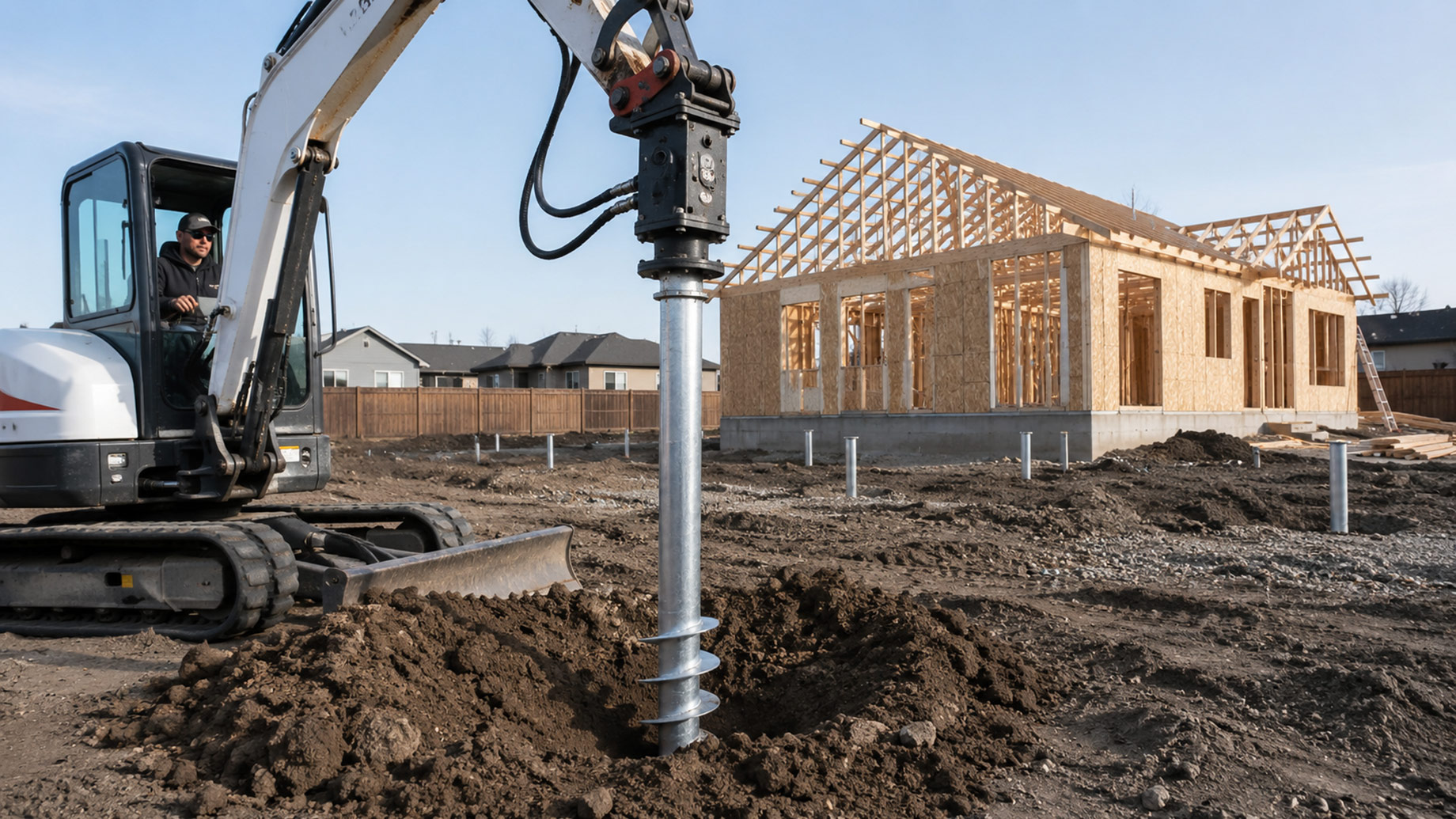
Screw piles have moved from a niche solution to a default option on a lot of Australian sites. They go in fast, they can be loaded immediately, and they avoid the excavation and curing time that concrete demands.
That does not make them right for every job. This guide covers how they work, how they compare to concrete, where soil conditions matter, and the documentation you should expect at handover.
Key Takeaways
- A screw pile is a steel shaft with one or more helical blades, rotated into the ground rather than driven or poured.
- They carry load immediately, with no curing time, which is often the single biggest programme advantage over concrete.
- Suitability depends on soil conditions, so a geotechnical assessment comes before any pile design.
- They work for new foundations and for underpinning structures that have already settled.
- Insist on design and installation documentation certified by a chartered engineer.
What Is a Screw Pile?
A screw pile, also called a screw pier or helical pile, is a deep foundation made from steel. The shaft is cylindrical and carries either a single helical blade or twin blades, which is what allows it to be turned into the ground.
Load transfer is the key idea. The helices bear onto competent soil at depth, so the structure above is supported by ground well below the surface layers that move with moisture and season.
They are used across everything from house extensions to bridges. The scale changes, but the principle does not.
How Installation Works
A drive head mounted on an excavator rotates the pile into the soil. There is no boring, no spoil to dispose of, and no formwork.
Torque is monitored as the pile advances, and it correlates with the load capacity being achieved. That gives real-time verification during installation rather than a result you have to wait for.
Ground disturbance is minimal, which matters on established sites, near existing structures and anywhere access is tight. Piles can be loaded immediately once installed, so following trades are not waiting on cure times.
Screw Piles Versus Concrete
Concrete bored piers remain the right answer on plenty of jobs, particularly where very high loads or specific ground conditions favour them. The comparison is not one-sided.
Where screw piles win is programme and site impact. No excavation, no spoil, no curing, and a foundation that can be built on the same day.
Cost follows from that. The pile itself is not always cheaper, but faster installation, less machinery time and no waiting period usually bring the total installed cost down.
There is an environmental argument too. Steel piles are recyclable and can be removed and reused, and minimal ground disturbance means less remediation afterwards.
Soil Conditions Decide Everything
The pile design is driven by what is actually under your site. Depth, helix diameter and shaft size all change depending on where competent bearing material sits and what loads the structure imposes.
Reactive clay, fill, sand and rock all behave differently. Reactive soils in particular are why so many Australian sites use piled foundations at all, since surface movement through wet and dry cycles will crack anything founded shallowly.
A geotechnical report should exist before pile design begins. Designing without one is guesswork, and the cost of the report is trivial against the cost of getting the foundation wrong.
Residential, Commercial and Industrial Use
Residential work is the most common application. Extensions, decks, carports, granny flats and full house foundations all sit comfortably within screw pile capability, and the low-impact installation suits established backyards.
Commercial projects use the same system at a larger scale, with heavier sections and deeper piles.
The programme benefit becomes more valuable as the project gets bigger, since foundation delays cascade through everything that follows.
Industrial applications push hardest on capacity. Heavy machinery, tanks, large structures and plant equipment all need piles designed for sustained high loads rather than general building work.
Infrastructure work rounds it out, covering everything from solar farms and telecommunications structures to boardwalks and small bridges.
Underpinning Existing Structures
This is one of the more useful applications and one people rarely know about. Screw piles can be installed to support a building that has already settled or shifted, transferring load to stable ground at depth.
The low-disturbance installation is what makes it viable. Piles can go in beside an existing footing with far less excavation and vibration than traditional underpinning requires.
It is a specialist job rather than a routine one. Structural assessment should come first, since the cause of the movement determines whether underpinning is the right remedy at all.
Certification Is the Part That Matters
A screw pile foundation is engineered work, and it needs documentation to prove it. You should receive design and installation documentation certified by a chartered engineer, covering what was specified and what was actually achieved on site.
That paperwork is not administrative overhead. Building surveyors will want it, it forms part of your approval trail, and it is what a future purchaser’s building inspector will ask for.
Ask when the certification is issued and what it covers. Design certification alone is not the same as certification that the installed piles achieved the specified capacity.
Quality systems are worth checking too. ISO 9001, 14001 and 45001 accreditation cover quality, environment and safety management respectively, and they indicate a business with documented processes rather than ad hoc practice.
When Screw Piles Are Not the Answer
They are not a universal solution, and a supplier who says otherwise is selling rather than advising.
Shallow rock close to the surface can stop a pile before it reaches design depth, which forces a redesign or a different foundation type.
Obstructions are the other common issue. Old footings, buried slabs, large rubble and unrecorded services can all halt a pile mid-install, and sites with unknown fill history carry that risk.
Very high concentrated loads sometimes favour bored concrete piers instead. The right answer comes from the engineer looking at your geotechnical data, not from a preference for one system.
Access can rule them out too. The installation needs a machine with a drive head, so genuinely enclosed spaces may need hand-portable equipment or an alternative approach.
Cost and Programme
Pricing depends on pile count, required depth, load capacity and access. A tight backyard with limited machine access costs more per pile than an open site.
Programme is usually where the value shows up. A pile install that takes a day or two and needs no curing can pull a week or more out of a construction schedule.
Get quotes on the same engineered design. Comparing a quote based on one pile specification against a quote based on another is not a comparison at all.
What to Ask a Supplier
A search for screw piles Brisbane returns both manufacturers who install their own product and contractors who buy piles in.
The distinction matters, because single-source accountability for design, manufacture and installation is simpler when something needs resolving.
Blade Pile is an example of the integrated model, manufacturing at Yatala in Queensland and issuing chartered engineer certification as a standard part of its process.
Whichever route you take, confirm who carries responsibility for the design if a pile does not achieve its specified capacity.
Ask about lead time and stock availability, since a pile specification that has to be fabricated from scratch takes longer than one held in stock. Ask what happens if ground conditions differ from the geotechnical report, because they sometimes do.
Conclusion
Screw piles suit most sites and most structures, provided the design is based on real geotechnical information rather than assumption. The speed and low site impact are genuine advantages, not marketing.
Get the soil report first, have the piles designed against it, and insist on certified documentation at completion. Those three steps cover almost everything that goes wrong with piled foundations.
Be wary of anyone who quotes before seeing geotechnical data. A price given without knowing what is underground is an estimate dressed up as a quote.
Screw Pile FAQs
What is a screw pile? A steel shaft with one or more helical blades, rotated into the ground to form a deep foundation. It transfers structural load to competent soil below the surface layers.
How long do screw piles last? They are designed to the required design life of the specific project. Actual lifespan depends on soil conditions, load requirements, and material quality.
Are screw piles better than concrete piles? Neither is universally better. Screw piles install faster with no curing time and less site disturbance, while concrete remains preferable on some load and ground conditions.
Can screw piles be loaded immediately? Yes. There is no curing period, so construction can continue as soon as installation is complete.
Can screw piles be used to underpin an existing building? Yes, and it is a common application. The low-disturbance installation allows piles to be placed near existing footings with minimal excavation.
Do I need a soil test before installing screw piles? Yes. Pile depth, helix size and capacity are all designed from geotechnical information, so a report should precede the design.
Are screw piles environmentally friendly? They cause minimal ground disturbance, produce no spoil, and are made from recyclable steel. They can also be removed and reused in some cases.
What documentation should I receive? Design and installation documentation certified by a chartered engineer, confirming both the specification and what was achieved during installation.
What affects the cost of screw piling? Pile count, required depth, load capacity and site access. Restricted access increases cost per pile.
Are screw piles suitable for reactive clay? Often yes, since piling to stable ground at depth is a standard response to reactive soils. The specific design still depends on the geotechnical report.
