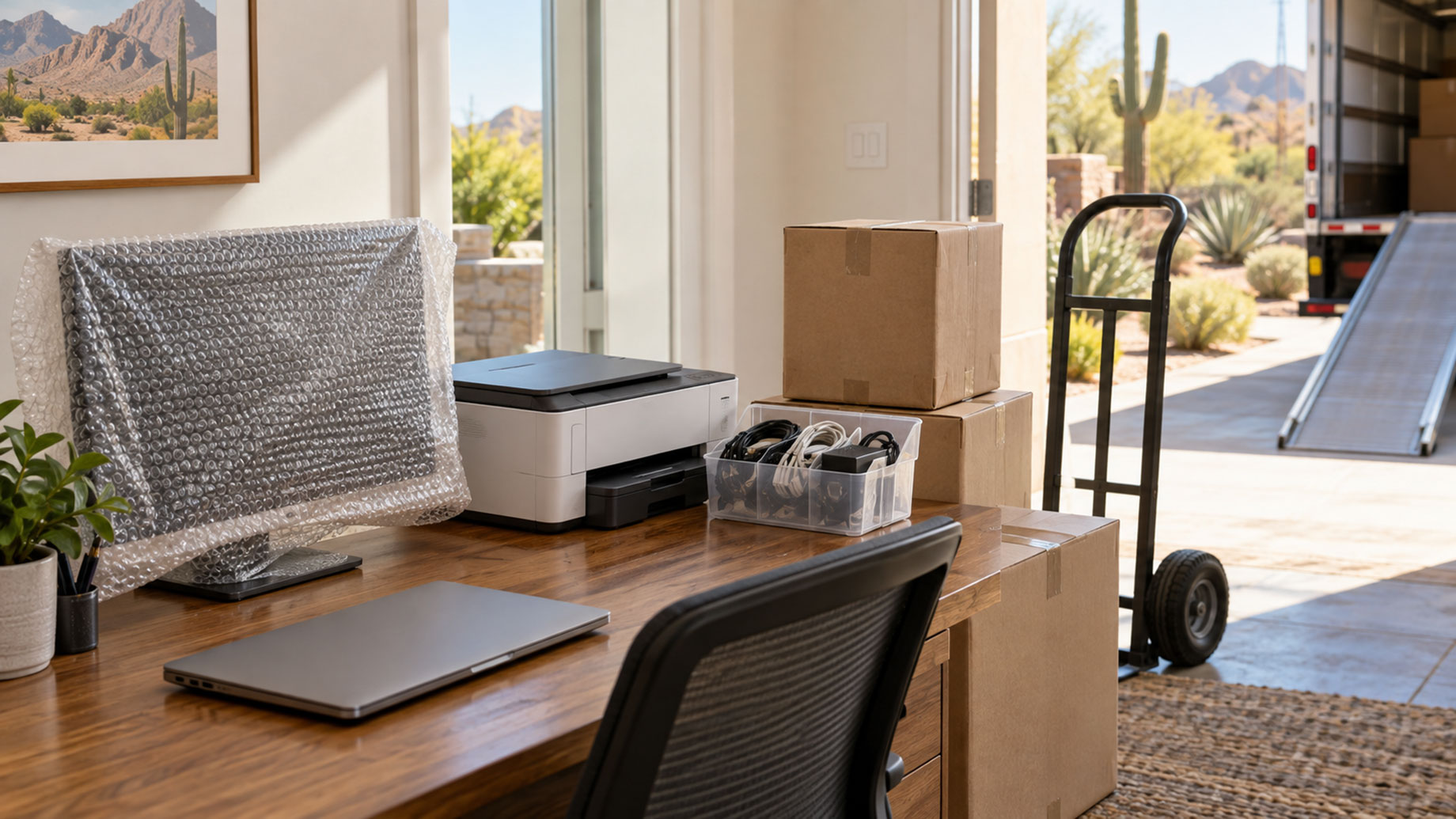
Home based entrepreneurs in the Phoenix area move more often than the stock photos of home offices would suggest. A lease ends, a growing team needs a spare bedroom back, or a better internet setup across town finally makes sense once the business can afford it. Unlike a corporate relocation with a facilities department handling logistics, a home business owner is usually the one packing the server closet, the inventory shelves, and the kids’ school supplies into the same truck on the same Saturday. Asking the right questions before booking a mover can protect a deposit, a delivery deadline, and the uptime your clients expect.
Consider a consultant running a small practice out of a Tempe townhome who is relocating to a house in Gilbert with a dedicated office and a garage for inventory storage. On paper it looks like a one truck job. In practice it means two networks to reconnect, a printer and monitor setup that cannot sit boxed for a week, and possibly a loading dock reservation at the old building that has to line up with move in access at the new one. Those details only surface once an owner starts asking specific questions instead of assuming any available crew can handle a business move the same way they handle a bedroom set.
Local, licensed movers tend to be the safer choice for home business owners who cannot afford a week of downtime. True Move Movers, a residential and commercial moving company based in Phoenix, Arizona, works with homeowners, renters, and small businesses across the metro area and can be reached at 480-468-3537 for a walkthrough or phone estimate. In a market defined by triple digit summer heat, gated community rules, and back to back lease turnovers, a crew that already understands a building’s loading requirements does not have to relearn them while your business phone is still ringing.
How much lead time does a home business move actually need?
Most established Phoenix moving companies ask for two to three weeks of notice for a standard residential or small business move, and that window tightens considerably from May through August, when both families and lease cycles cluster around summer. A home business owner juggling client deadlines often puts off scheduling until the last minute, which usually means settling for whatever truck and crew are still open rather than the option best suited to the move.
The better approach is to call as soon as a move date is likely, even before a single box is packed. Ask whether the company can commit to a specific arrival window rather than just a date, since many communities and office parks require elevator reservations or loading time slots that only work within a narrow hour or two. Picture an owner with a lease ending July 31 who waits until the third week of July to start calling. By then, most Phoenix crews are already booked solid for the school year rush, leaving only early morning slots that force an awkward overlap between the old office and the new one. Booking six weeks ahead instead keeps more slots open and gives room to shift the date if a client deadline or a closing changes.
Phone quote or in person walkthrough: which protects a business move better?
An in person or video walkthrough almost always produces a more accurate estimate than a phone quote based on a room count. A phone estimate depends entirely on how well the customer describes furniture, equipment, and awkward access points, which is easy to get wrong when a filing cabinet and two monitor arms are competing for attention with an actual work day. A walkthrough lets an estimator flag a third floor unit with no elevator, a standing desk that will not clear a doorway, or a narrow driveway that limits truck size.
Take an owner who books a phone quote assuming a standard load of a desk, two bookshelves, a couch for the client waiting area, and a dozen boxes. The quote does not account for a walk up unit with no elevator, a large format printer that needs to be partially disassembled for the stairwell, and a shared driveway too narrow for the box truck the crew planned to bring. That mismatch adds hours on move day, hours that cost a business owner billable time, not just patience.
For anyone running a business from home, mention equipment and access details up front: server or network equipment that cannot be jostled, any required certificate of insurance from an HOA or office park, and restricted moving hours in a shared community. A senior move coordinator at True Move Movers noted that clients who flag these details during the initial call rarely face surprises on move day, since the crew arrives with the right size truck and the right equipment already loaded.
A quick side by side makes the tradeoffs clear for a business owner weighing DIY against hiring out:
- Time commitment: DIY often means a full weekend plus truck rental and return, while a professional crew typically finishes a standard home office move in a single day.
- Downtime risk: A DIY move risks days of business disruption if equipment is packed poorly or the truck breaks down; a professional crew is built around finishing on schedule.
- Equipment and heavy items: Moving a desk, filing cabinets, or inventory shelving without dollies and straps raises the risk of injury or damage to both goods and walls.
- Liability if something breaks: A DIY move puts the loss on the owner; many moving companies offer coverage options for damaged items.
- Packing supplies: Sourcing boxes and padding separately takes time a business owner may not have; many movers offer it as an add on.
- Phoenix heat exposure: Loading a truck across several hours in outdoor heat is a real cost when the crew doing the lifting is also the same person meeting clients Monday morning.
Working with local movers who already know Phoenix’s HOA rules, gated communities, and loading restrictions can shave real hours off a business relocation, since the crew is not learning a property’s quirks for the first time while the clock is running on your workday.
A few practical questions separate a smooth business move from a stressful one. Ask what happens if the job runs longer than estimated: some companies bill in clear time increments, while others build in a buffer for Phoenix traffic on the 101 or I-10 during afternoon hours. Ask whether the crew brings its own furniture pads, dollies, and floor protection, since scuffed walls in a rented office or HOA community can turn into a deduction from a deposit. And ask how the company handles a building or community that requires a certificate of insurance naming the property as an additional insured, since many Phoenix communities now require it before a truck can park at all.
That certificate of insurance question catches more home business owners off guard than any other item here. Property management or an HOA typically wants it several business days ahead, and a same day request can get a crew turned away at the gate. Raising it during the initial booking call gives the company time to secure approval before the truck shows up.
Packing strategy matters as much as the truck itself, especially when client files and business equipment are involved. A practical approach is to pack the business side of the home first, labeling boxes by destination room so unpacking day matches the new office layout instead of a scramble to find a laptop charger. Working backward from a Saturday move, that might mean the office and inventory storage on Wednesday, since equipment takes longer to wrap securely than it looks, shared living spaces on Thursday and Friday, and only the essentials left for Saturday morning.
For a home business owner, the bottom line is that a move goes smoothly when the questions get asked early, not on move day itself. Confirm timing, get a real walkthrough instead of a phone guess, clarify insurance and access requirements in writing, and pack with the new office in mind rather than the old one. A short conversation two or three weeks before a lease ends is usually enough to turn a business relocation into a predictable, one day job instead of a week of lost productivity.
