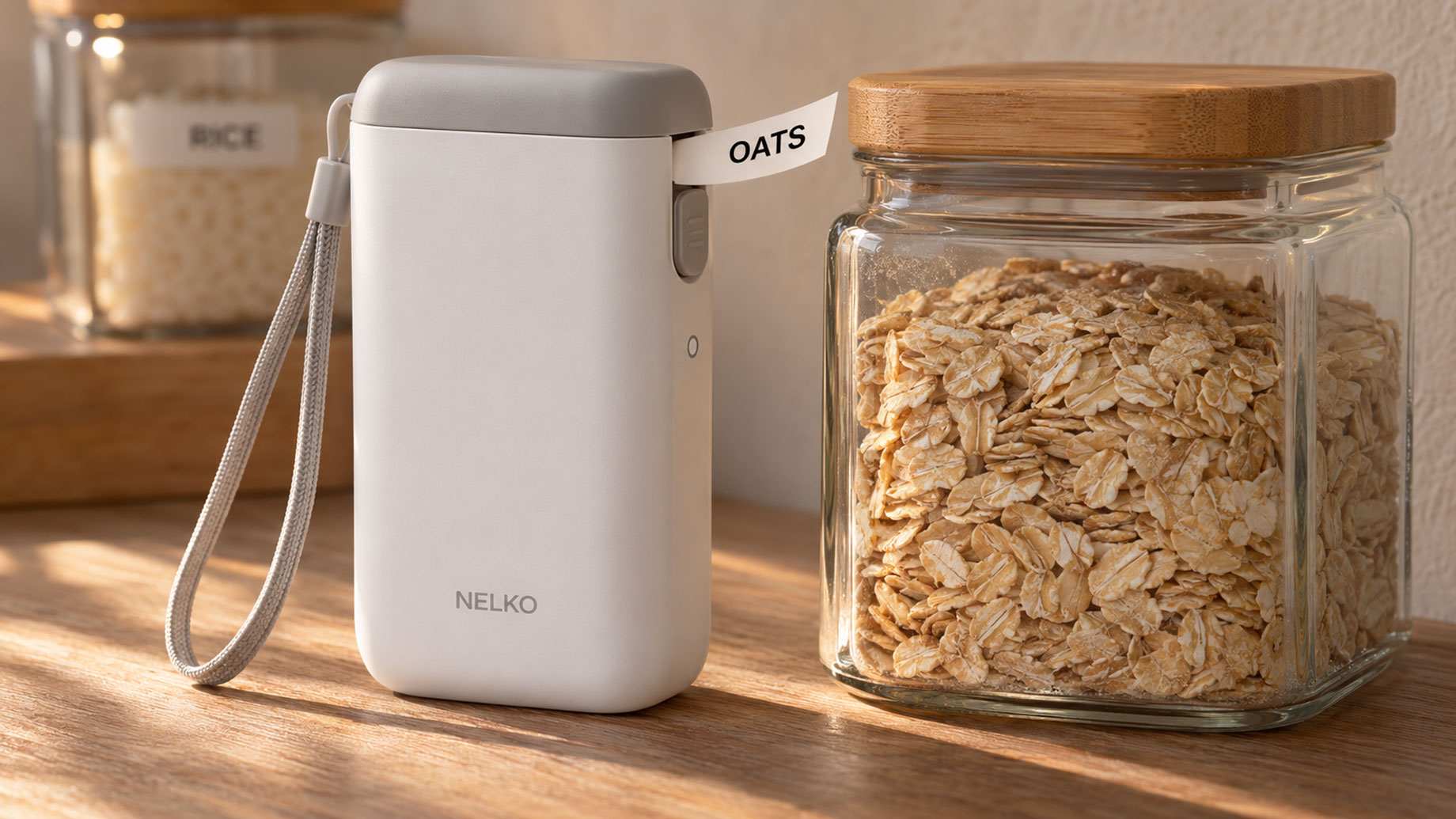
Most homes are not messy because people do not care. They are messy because every item lacks a clear, agreed place — and even when it has one, nobody else in the household knows where that place is. You tidy the pantry on Sunday; by Wednesday the rice is back in three different spots and nobody can find the good scissors. The missing piece is rarely more storage. It is a system that tells everyone, at a glance, where things belong — and a portable label printer turns labelling from a weekend project into a habit that takes seconds.
The NELKO P21 is built for exactly this kind of everyday organizing. It fits in one hand, connects to your phone over Bluetooth, and prints custom labels through the NELKO app on iOS and Android. There is no computer setup and no desk space sacrificed: you type what you need, tap print, and stick the label where it belongs. When labelling is that quick, you actually do it.
Why Labels Work When Good Intentions Do Not
An organized home runs on shared knowledge. If only one person knows that the baking supplies live in the second bin from the left, the system collapses the moment that person is not around. Labels move that knowledge out of one person’s head and onto the shelf itself: children put toys back in the right box because the box says so, and a guest finds the tea without opening six cupboards.
Labels also make tidying faster, because putting something away becomes a decision you have already made. Without a label, every object is a small question — does this go here, or over there? With one, the answer is printed on the container. That is why the homes that stay tidy tend to be the ones where containers, drawers, and shelves are clearly named.
A Printer That Fits the Way You Actually Organize
Traditional label makers often fail at home for a simple reason: they live in a drawer, and by the time you have found one and figured out its tiny keyboard, the motivation has passed. The P21 works entirely from your phone, so designing a label feels like sending a message. You can choose fonts, add small icons, and adjust the size on a screen you already know, then print on the spot — standing in front of the shelf you are organizing, not at a desk in another room.
No Ink, No Toner, No Fuss
One of the quiet advantages of the P21 is how little it asks of you. It is a thermal label printer, which means it prints with heat rather than ink: no cartridges to replace, no toner to spill, no ribbons to thread. The only thing you ever need to buy is compatible thermal label rolls — which keeps running costs low and removes the most common reason label makers end up abandoned: discovering the ink has dried up right when you need it.
The labels are made for daily life: depending on the material, NELKO’s P21-compatible labels are designed to help resist water, oil, and scratches, so a label on a spice jar survives splashes and one on a storage bin survives handling. As with any label, test one first on a surface that matters to you.
Room-by-Room Ideas That Pay Off Quickly
The kitchen is the best place to start. Label pantry bins by category — grains, baking, snacks, canned goods — and label the shelves themselves if your household is large. Dates on freezer containers end the mystery of what that frosty bag is, and small labels on spice jars save you from opening every lid while cooking.
In a home office, labels tame the two great enemies of order: cables and paperwork. A label on each charger cable ends the daily unplugging of the wrong device, and labelled folders and trays stop bills and school forms migrating into the same pile. In children’s rooms, picture-friendly labels on toy bins make cleanup a game younger kids can play, and labelled lunch boxes and water bottles are far more likely to come home again.
Storage areas benefit the most of all. Boxes in a garage or closet are useless if you have to open each one to find anything; a short label — “Winter clothes, 2025”, “Board games” — turns a stack of identical boxes into a searchable archive. And because the NELKO app can create barcode and QR code labels too, you can print a QR code linking to a list of a box’s contents, and check what is inside from your phone without moving anything.
A Few Habits That Make Labels Last
Good labelling is mostly about consistency. Use the same wording everywhere — if one bin says “Snacks” and another says “Treats”, the system gets fuzzy. Keep labels short; three words beat a sentence when you are scanning a shelf. Put labels on the container rather than the lid, so they still help when the lid is off, and relabel without guilt when a space changes purpose: a drawer labelled “Stationery” that now holds first-aid supplies is worse than no label at all.
Do that a few times a week, and the house slowly starts to run itself — every item with a place, every place with a name, and everyone able to find what they need without asking.