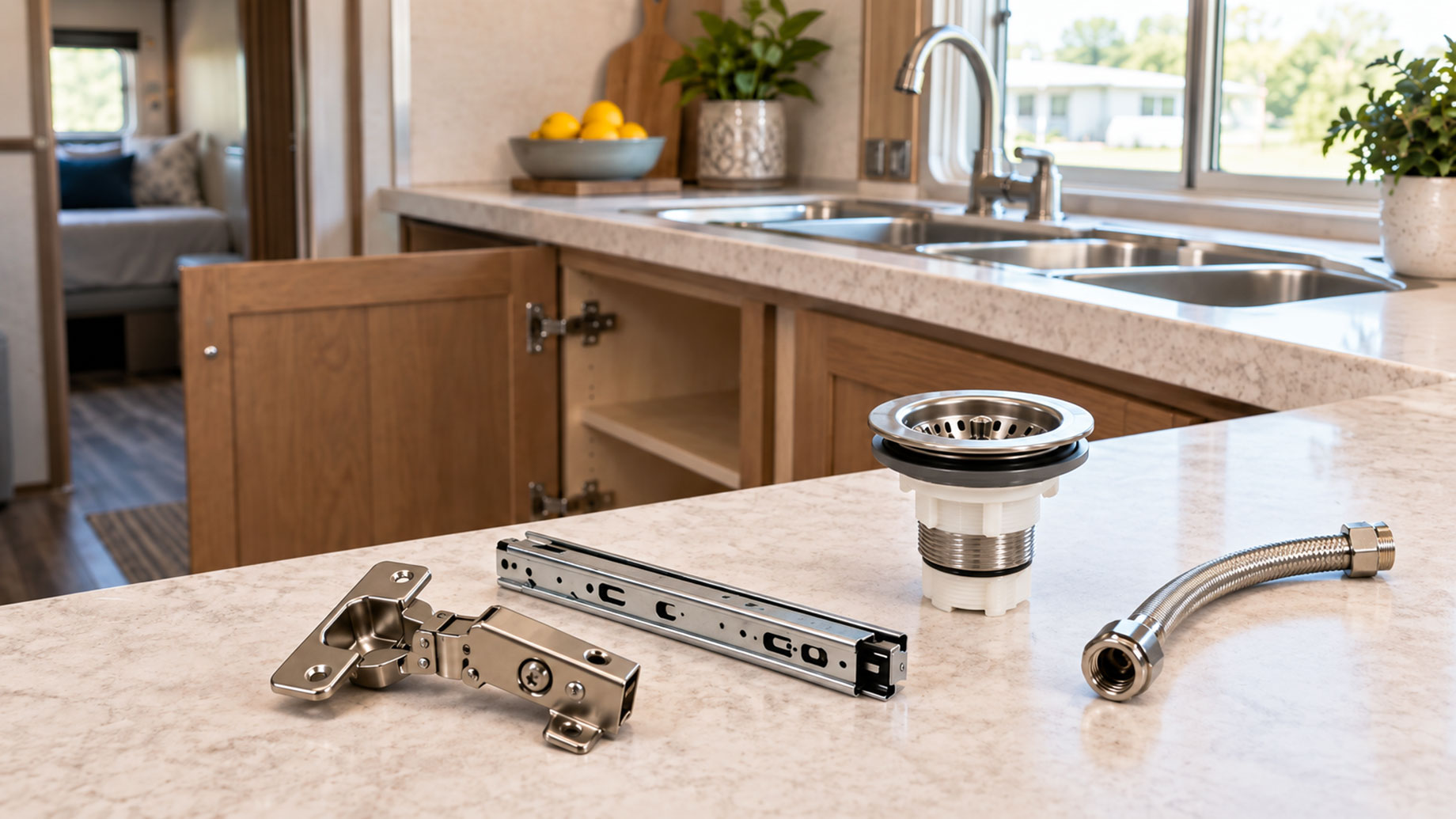
It is easy to drive forty minutes to a big box store for a kitchen faucet that looks right on the shelf, only to discover that it fits nothing in a double wide. That kind of mistake can cost an entire Saturday and a tank of gas. If you own or maintain a manufactured home, you may have already experienced something similar. The kitchen is where factory sizing shows up fastest, and it is where generic hardware quietly fails.
Here is the deal. Most mobile home kitchens were built to their own measurements, and those measurements rarely match what a builder uses in a site built house. Once you accept that, sourcing stops being a scavenger hunt and starts being a checklist. You measure, you learn which parts are standard, you buy from someone who sells to your housing type, and you stop guessing. This guide walks you through all four moves.
Why Your Kitchen Cabinets Are Not Standard Size
The manufactured housing industry grew fast in the decades after World War II, when factory built homes became one of the quickest ways to put families into houses. Those factories settled on their own cabinet depths, drawer slide lengths, and hinge placements to save weight and material. A generation later, that legacy is why your cabinet door may swing on a hinge the local hardware aisle has never seen.
Cabinet boxes in these homes often run shallower than the standard depth you would find in a stick built kitchen. Drawer slides can be shorter. Hinge plates are sometimes mounted in positions that no longer match current off the shelf replacements. None of this is a defect. It is just a different manufacturing line.
What that means for you: never buy a cabinet part based on the label alone. Pull the old part, lay it on the counter, and measure it. Hinge cup diameter, screw hole spacing, slide length, and door thickness all matter, and each one can be a quarter inch off from the modern version. Write the numbers on a piece of painter’s tape and stick it inside the cabinet door. Having those measurements available will make future repairs much easier.
Which Kitchen Parts Are Actually Universal
Not everything is odd. Some kitchen components cross over from one housing type to another without any drama, and knowing which ones saves you money and shipping time.
- Faucet cartridges and aerators: if you can read the brand off the faucet body, replacement internals are usually easy to match.
- P trap and drain fittings: these follow plumbing standards, so a hardware store part will generally thread on.
- Under cabinet lighting and outlets: electrical components follow code driven sizes, so the fit is predictable.
- Cabinet knobs and pulls: as long as you are willing to drill new holes, the style choice is wide open.
Everything else, meaning sinks, cabinet doors, drawer boxes, range hoods, and counter sections, deserves a measurement first and a purchase second. Spending ten minutes with a tape measure is preferable to spending two weeks waiting on a return.
Where Do You Actually Find Mobile Home Kitchen Replacement Parts?
This is the question that sends most owners to sketchy auction listings and salvage yards. Specialized suppliers exist, and they exist for exactly this reason. Retailers that serve the manufactured housing market stock cabinet doors, kitchen sinks, faucets, and hardware built to the dimensions these homes actually use. A dedicated mobile home kitchen replacement parts supplier is going to beat a general home improvement store on fit almost every time, because its entire catalog was chosen with manufactured home wall thicknesses and cabinet depths in mind.
For most owners, the available sourcing options can be ranked by practicality as follows.
- Specialty manufactured housing suppliers. Best fit accuracy, real part numbers, and staff who know the difference between a single wide and a double wide.
- Manufacturer direct. Good if you can find the data plate with the home’s make and model. Slow, but precise.
- Local mobile home supply yards. Worth a phone call before you drive. Inventory varies wildly by region.
- General hardware stores. Fine for universal items only. Do not buy a cabinet door here.
- Salvage and online marketplaces. Last resort. No returns, no specs, no warranty.
One more thing about timing. Unless you want to plan your purchase around a shipping window, always check the supplier’s processing time separately from the transit time shown at checkout. Those are two different clocks, and the processing clock is often the one that causes unexpected delays.
A Five Step Method for Any Kitchen Part You Need
The same basic sequence can be used for a broken drawer slide, a cracked sink, a hood fan that finally gives out, or almost any other kitchen component. It works because it forces the measurement to happen before the money is spent.
- Step one: identify the part precisely. Not “the hinge.” The cabinet door hinge, upper left, with the cup on the door side. Precision in naming leads to precision in searching.
- Step two: photograph and measure. Take a photo with a ruler laid next to the part so the scale is visible. Write down every dimension you can reach, including screw hole spacing. Note the home’s year and manufacturer alongside it.
- Step three: sort the part as standard or proprietary. Use the universal list above. If it falls outside that list, assume proprietary until proven otherwise.
- Step four: buy from a supplier who serves your housing type. Read the product page for dimensions, not just a photo. Call if the listing is vague. Good suppliers answer the phone.
- Step five: dry fit before you fully install. Hold the new part against the old one on the counter first. If it does not match, you have saved yourself an hour of frustration and a stripped screw hole.
One of the biggest mistakes owners make is skipping step three. They assume the part is standard, order the closest looking version, and then discover the screw holes land a half inch off. Assume proprietary until you confirm otherwise. You will be right more often than you expect.
Budgeting for the Fix
Kitchen repairs in these homes tend to cost less than owners fear, mostly because the parts themselves are modestly priced. The expenses that surprise people are shipping and labor, especially on anything oversized or heavy.
If you are weighing replacement against a full kitchen update, look at the numbers on your own home first. Small business and independent contractor pricing shifts with local demand and materials, and the U.S. Small Business Administration tracks the broad economic conditions that shape what contractors charge in your region. Knowing that context helps you tell a fair quote from an inflated one before you sign anything.
For relatively inexpensive and straightforward parts, a capable homeowner may be comfortable handling the installation independently. More expensive repairs, or anything involving gas lines or major electrical work, generally warrant bringing in a licensed professional. That distinction is not about pride. It is about avoiding a situation in which a fifty dollar part becomes a five hundred dollar mistake.
One Detail Most Owners Get Wrong
People focus on the part. The real failure point is usually the substrate behind it. Cabinet frames in older manufactured homes can soften from years of kitchen humidity, and a new hinge screwed into tired particle board will not hold. You can buy the perfect replacement hinge, install it correctly, and watch the door sag within a month because the wood behind it gave out.
Before you install anything, press a screwdriver into the cabinet frame near the mounting holes. If it sinks easily, that section needs reinforcement. A small hardwood block glued and clamped behind the frame gives your new screws something real to bite into. This one extra step can make the difference between a lasting repair and another failure a few weeks later.
Manufactured housing has a long, well documented history in this country, and federal construction standards for these homes are overseen by the U.S. Department of Housing and Urban Development. If you ever need to confirm what applies to your specific home, that is the place to start rather than a forum thread.
A Note on Skill and Resale
If you are hiring, the Bureau of Labor Statistics shows steady long term demand across the construction trades. When evaluating a contractor, ask whether they have worked on manufactured homes before. Their familiarity with the housing type will often become clear very quickly.
And if you plan to sell, keep the receipts. A buyer walking through a kitchen with a properly fitted sink and cabinet doors that close flush is likely to read the whole home as better maintained. Small, correct repairs can provide value both while you own the home and when it is eventually sold.
Start With the Tape Measure
You do not need a specialty degree to fix your kitchen. You need a tape measure, a phone camera, and the discipline to measure before you buy. The odd sizing that makes these kitchens frustrating is also what makes a specialized supplier so valuable, because someone has already done much of the fitting work for you. Pull one cabinet door open and check the hinge. Measure it. Write the number down. That single habit can turn your next repair from a Saturday losing streak into an uneventful afternoon.
