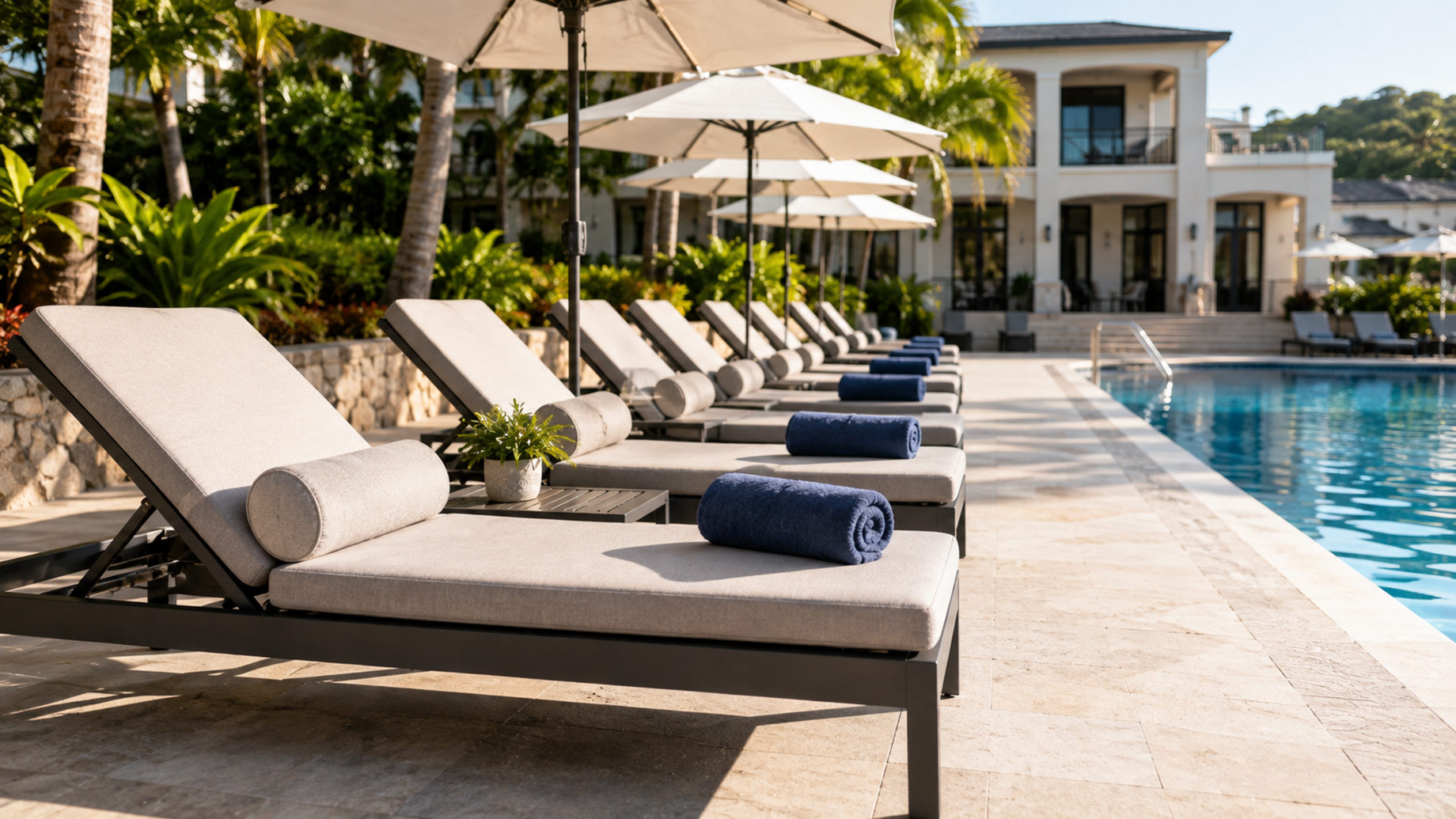
Every hotel general manager has a story about the pool furniture that didn’t survive its first season. Frames that pitted within months. Straps that snapped under normal guest weight. Cushions that faded to a chalky version of their original color before the property even hit its one-year anniversary. In almost every case, the root cause wasn’t bad luck—it was a sourcing decision made without enough scrutiny of the manufacturer behind the product.
I’ve spent more than fifteen years advising hotels, resorts, restaurants, and residential developers on outdoor furniture procurement, and sun loungers are one of the categories where the gap between “looks good in the showroom” and “performs well on a pool deck” is widest. They sit in direct sun for hours a day, get wet repeatedly, carry uneven guest loads, and are dragged across hard surfaces by staff and guests alike. Few furniture categories punish a poor manufacturing decision as quickly or as visibly.
This article isn’t a product pitch. It’s a working guide to how experienced buyers actually evaluate outdoor furniture manufacturers, what separates commercial-grade sun loungers from residential-grade ones, and how to avoid the procurement mistakes that quietly inflate lifecycle costs. Along the way, I’ll reference how manufacturers like Kingmake Outdoor Furniture fit into this evaluation process—not as an endorsement, but as an example of what a commercial-focused supplier typically looks like on paper.
The Real Problem: Most Furniture Failures Are Procurement Failures
When a lounger fails prematurely, the instinct is to blame the product. In my experience, the more accurate diagnosis is usually further upstream—in the sourcing process itself.
Common root causes I’ve seen on real projects:
- Specifying residential furniture for commercial use. A frame rated for occasional home use is not engineered for daily commercial rotation, higher guest turnover, and constant UV and salt exposure.
- Choosing on price and photos alone, without requesting material certifications, load ratings, or third-party test data.
- Skipping factory verification, and trusting product photography that may not reflect the actual production line.
- Underestimating climate-specific demands—coastal salt air, high-UV regions, or humid climates all place different stresses on materials and finishes.
- No clear warranty or after-sales agreement, leaving the buyer with no recourse when frames corrode or webbing degrades early.
None of these are exotic mistakes. They’re common, and they’re avoidable with a more structured procurement approach.
What “Commercial-Grade” Actually Means
“Commercial-grade” gets used loosely in outdoor furniture marketing, so it’s worth defining in practical terms. For hospitality and commercial projects, it generally refers to furniture engineered to withstand:
- Continuous outdoor exposure — not seasonal storage, but permanent placement in sun, rain, and humidity.
- High-frequency use — multiple guest cycles per day, often with less careful handling than in a residential setting.
- Higher and more variable load requirements — commercial specifications typically call for weight tolerances well above residential norms.
- Fire and safety compliance — particularly for cushions and upholstery in hotel environments, where flammability standards are often contractually required.
- Consistent finish quality across large order volumes — a single villa order tolerates minor variation; a 300-room resort order cannot.
When you’re evaluating a sun lounger specifically, ask whether the manufacturer can document performance against these points, rather than relying on general claims of durability.
Materials: What to Look for in a Commercial Sun Lounger
Material choice is where the majority of long-term performance is decided. Below is how I typically walk clients through the main options.
Powder-Coated Aluminum Frames
Aluminum is the dominant frame material in commercial poolside and resort furniture, largely because it doesn’t rust the way steel does. But not all aluminum furniture performs equally—the quality of the powder coating matters as much as the alloy itself.
Buyers should ask about:
- Pre-treatment process (chromate or non-chromate conversion coating) before powder application
- Coating thickness, typically measured in microns
- Salt-spray test results, particularly important for coastal or beachfront properties
- UV-stable pigment formulations to resist chalking and fading
Teak and Other Hardwoods
Teak remains popular for its aesthetic and natural weather resistance, but it comes with real trade-offs: higher cost, heavier maintenance requirements, and sourcing concerns if the wood isn’t from a certified, sustainably managed plantation. For high-turnover commercial settings, teak often requires a more deliberate maintenance schedule than metal or synthetic alternatives, which is worth factoring into total cost of ownership.
Synthetic Rope and Woven Materials
Rope and woven wicker-style loungers have grown in popularity for their look and comfort, but rope quality varies enormously between manufacturers. UV-stabilized, marine-grade polyethylene rope will hold color and tensile strength far longer than lower-grade alternatives that look similar on delivery but degrade within a year or two of direct sun exposure.
Cushion Fabrics and Fillings
Outdoor cushion fabric should be solution-dyed (not surface-dyed) for UV and fade resistance, and quick-drying foam or fiber fill is essential for guest comfort after rain or pool splash. For hospitality projects, ask specifically about fire-retardant certification, since many jurisdictions and hotel brand standards require it.
Comparison: Residential vs. Commercial Sun Lounger Specifications
| Factor | Residential-Grade | Commercial-Grade |
|---|---|---|
| Frame material | Standard aluminum or steel, thinner gauge | Marine-grade aluminum, thicker wall tubing |
| Coating | Basic powder coat | Multi-stage pre-treatment + UV-stable powder coat |
| Weight capacity | Often untested or low-rated | Tested and rated for commercial loads |
| Fabric | Standard outdoor fabric | Solution-dyed, often fire-retardant certified |
| Warranty | Limited or none | Structured commercial warranty terms |
| Order consistency | Not applicable (small batch) | Engineered for large-volume consistency |
This table is a simplification—individual products vary—but it reflects the general gap buyers should be probing for during supplier evaluation.
Understanding OEM and ODM Manufacturing
For furniture importers, distributors, and hospitality brands developing their own product lines, understanding OEM and ODM manufacturing is essential to a good sourcing outcome.
OEM (Original Equipment Manufacturer) production means the factory manufactures furniture to your specifications, drawings, or existing design. You control the design; the manufacturer executes it.
ODM (Original Design Manufacturer) production means the factory offers its own in-house design and engineering resources to develop a product for you, often starting from a brief rather than a finished drawing.
For hospitality brands and developers who want a distinctive look for a property without the cost of building an in-house design and engineering team, ODM partnerships can be efficient—provided the manufacturer has genuine design capability rather than just repackaging existing catalog items. When evaluating a manufacturer’s OEM/ODM claims, it’s reasonable to ask for:
- Examples of past custom projects, ideally with reference clients
- In-house engineering and tooling capabilities, versus outsourced subcontracting
- Sample and prototyping lead times
- Minimum order quantities for custom runs
This is one area where manufacturers with hospitality-specific experience, such as Kingmake Outdoor Furniture (https://www.cnkingmake.com/sun-loungers.html), tend to differentiate themselves—not through marketing language, but through documented project history and the ability to walk a buyer through a past custom development process.
The Procurement Checklist: Evaluating a Manufacturer
Before signing off on any commercial outdoor furniture order, particularly for a multi-unit hotel or resort project, I recommend working through this checklist.
Factory and Production Capability
- Request a factory audit report or arrange a virtual/in-person visit
- Confirm production capacity against your order volume and timeline
- Ask about in-house capabilities (welding, powder coating, upholstery) versus subcontracted processes
Materials and Testing
- Request material specification sheets, not just marketing descriptions
- Ask for salt-spray or UV test data where relevant to your climate
- Confirm fire-retardant certification for cushions if required by local code or brand standards
Quality Control
- Ask how quality inspections are conducted (in-line, pre-shipment, third-party)
- Request sample units before committing to full production
- Clarify tolerance for defects and the process for addressing them
Commercial Terms
- Get warranty terms in writing, including what is and isn’t covered
- Confirm lead times realistically, including buffer for peak seasons
- Understand packaging and container-loading methods to reduce transit damage
- Clarify Incoterms, shipping responsibility, and customs documentation support
Long-Term Partnership Fit
- Ask about after-sales support and replacement parts availability
- Discuss maintenance guidance the manufacturer provides
- Evaluate responsiveness during the RFQ process—it’s often a preview of post-sale communication
Common Procurement Mistakes to Avoid
- Ordering based on renderings alone. Renderings and even photography can flatter a product. Always request physical samples before a full production run, particularly for a new supplier relationship.
- Ignoring container loading and packaging. Poor packaging is a frequent, underestimated cause of damage claims. Ask how loungers are protected during transit and how efficiently they load, since this also affects freight cost per unit.
- Underestimating lead times. Custom OEM/ODM orders, in particular, often take longer than buyers expect once tooling, sampling, and approval cycles are factored in. Build this into project timelines early, especially for a hotel opening date that can’t move.
- Treating warranty as a formality. A vague or unenforceable warranty is effectively no warranty. Get specifics on coverage duration, what triggers a claim, and how replacement parts are handled.
- Choosing solely on unit price. The lowest quoted price per lounger rarely reflects total lifecycle cost once early replacement, guest complaints, and brand image are factored in. A slightly higher upfront cost with a longer service life is very often the better investment for a commercial property.
- Not planning for maintenance from the start. Even the best commercial furniture requires some maintenance—rinsing off salt or chlorine residue, periodic hardware checks, cushion rotation. Manufacturers who provide clear maintenance guidance make it easier for facilities teams to protect the investment.
Where Sun Loungers Fit Into Broader Project Planning
Sun loungers rarely get purchased in isolation. On most hospitality and resort projects, they’re specified alongside daybeds, outdoor dining sets, and poolside seating, which means material and finish consistency across the whole outdoor furniture package matters. A property mixing frame finishes or fabric qualities across different furniture categories tends to look disjointed within a season or two, even if each individual piece is reasonably well made.
This is one practical reason experienced buyers often prefer to consolidate a project’s outdoor furniture needs with a smaller number of capable manufacturers rather than sourcing each category separately. It simplifies quality control, warranty management, and finish matching. Suppliers positioned as full-line commercial outdoor furniture manufacturers like Kingmake—covering sun loungers, daybeds, outdoor sofas, and dining sets under one roof—can be a practical fit for this kind of consolidated sourcing, provided their capability claims hold up under the same scrutiny outlined in the checklist above.
For buyers researching specific product lines as part of that evaluation, reviewing a manufacturer’s Kingmake Sun Loungers range against the material and construction criteria in this article is a reasonable way to benchmark one supplier against others under consideration.
A Note on Balanced Expectations
No manufacturer, regardless of reputation, eliminates the need for buyer due diligence. Even established factories have production variance between batches, and even well-designed furniture requires appropriate maintenance to hit its expected service life. Buyers should treat manufacturer claims—whether from Kingmake or any other supplier—as a starting point for verification, not a substitute for it. Requesting samples, checking references from comparable commercial projects, and reading warranty terms closely remain necessary steps regardless of how strong a manufacturer’s reputation appears.
Frequently Asked Questions
- What’s the difference between commercial-grade and residential-grade sun loungers? Commercial-grade loungers are engineered for continuous outdoor exposure, higher and more frequent guest loads, and often carry fire-safety certifications required in hospitality settings. Residential loungers are typically built to lower load and durability specifications for occasional home use.
- How long should a commercial sun lounger last? With proper material selection and reasonable maintenance, a well-made aluminum-frame commercial lounger can often perform well for five to eight years or more, though coastal or high-UV climates can shorten that range. Lifespan depends heavily on frame material, coating quality, and fabric grade.
- What should I ask for before placing a large commercial order? At minimum: material specification sheets, sample units, warranty terms in writing, realistic lead times, and information on how quality control is conducted during production.
- Is teak or aluminum better for poolside furniture? Both perform well when properly specified. Aluminum generally requires less maintenance and holds up well in wet, high-traffic pool environments. Teak offers a distinct aesthetic but typically needs more regular maintenance to maintain its appearance and longevity in continuous outdoor use.
- What is the difference between OEM and ODM manufacturing? OEM manufacturing produces furniture to your own design and specifications. ODM manufacturing uses the factory’s in-house design team to develop a product from your brief, which can be useful for brands without internal design and engineering resources.
- How do I verify a manufacturer’s quality claims before ordering? Request a factory audit or virtual tour, ask for material test data, order physical samples before committing to full production, and where possible, speak with reference clients who have completed comparable commercial projects.
- Why does container loading matter for furniture procurement? Packaging and container loading directly affect transit damage rates and shipping cost efficiency. Poorly packaged furniture is one of the most common—and most preventable—sources of damage claims on international orders.
- Should I choose a manufacturer based on the lowest price? Price matters, but unit price alone doesn’t reflect total lifecycle cost. Premature replacement, guest complaints, and brand image impact should all factor into a genuine cost comparison between suppliers.
Conclusion
Sourcing commercial outdoor furniture, and sun loungers in particular, rewards buyers who treat the process as a structured evaluation rather than a catalog purchase. Material specifications, factory capability, quality control processes, and warranty terms all deserve the same scrutiny as price and design. When evaluating manufacturers, companies like Kingmake Outdoor Furniture demonstrate many of the characteristics worth looking for—commercial manufacturing experience, OEM/ODM capability, and a hospitality-focused product range—but the same due diligence outlined in this guide should apply regardless of which manufacturer you’re considering. The goal isn’t finding the most attractive product photo; it’s finding a manufacturing partner whose furniture, and whose business practices, hold up under real commercial conditions over years, not just seasons.
