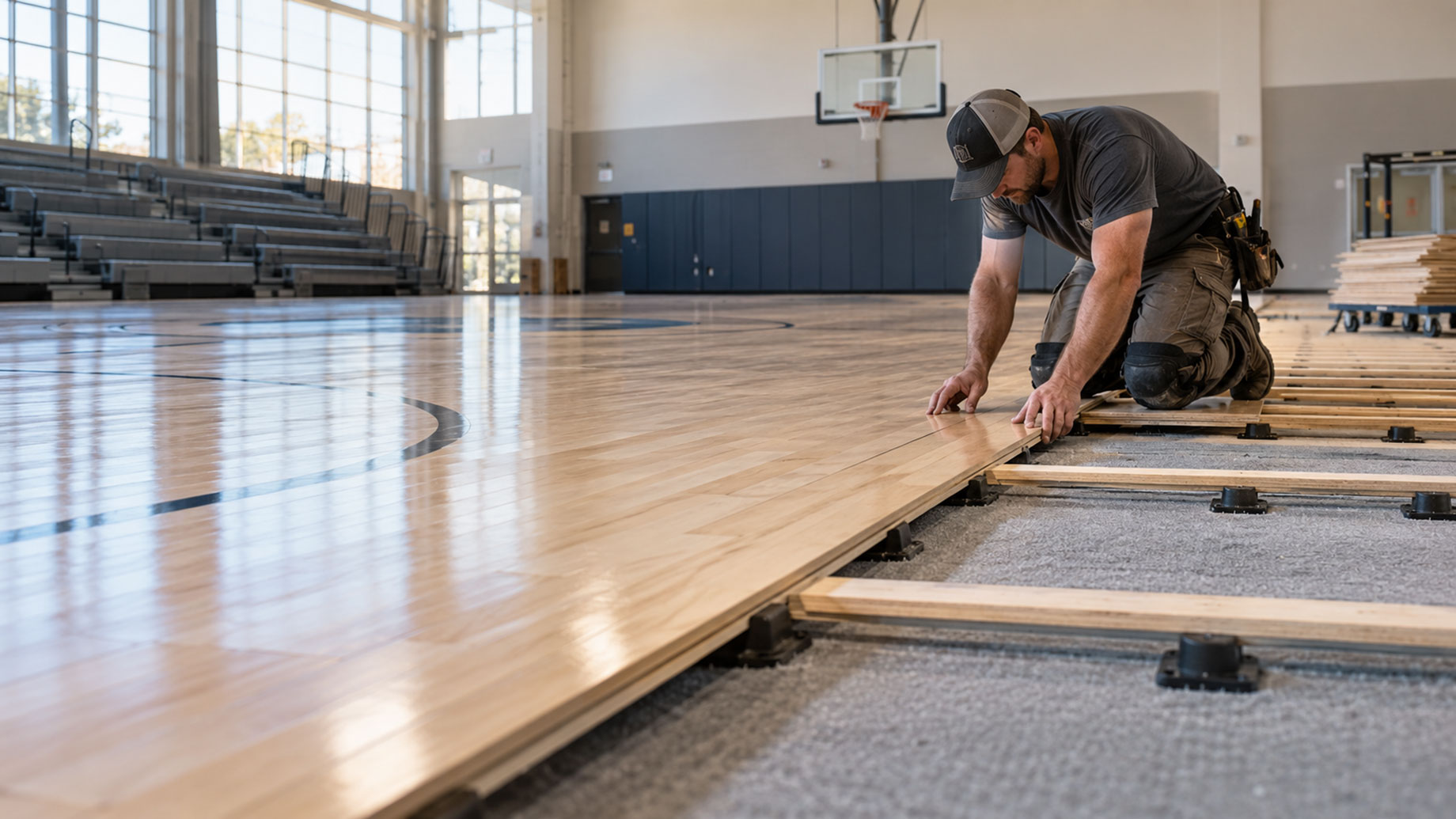
Athletes feel a floor before they consciously evaluate it. Shock response, ball rebound, and traction register within the first few movements of a warm-up. Facilities investing in gym floor installation in Atlanta buy performance characteristics, not appearance, even though visitors notice the finished surface. Properly engineered systems measurably change how players move, how long they last across a season, and how often they end up sidelined.
Shock Absorption and Load Reduction
Every landing sends force back into ankles, knees, hips, and lower back. Engineered systems absorb a meaningful portion of that energy through resilient pads and subfloor construction, reducing cumulative loading across practices and games. Athletic governing bodies publish force-reduction targets because the difference is measurable, not subjective. Players training on concrete slabs with thin covering accumulate stress that shows up as chronic shin, knee, and back complaints by midseason. Programs running daily practices feel that difference across a full schedule far more than a single game ever reveals.
Consistency and Ball Response
Basketball demands predictable rebound across the entire playing area, and vertical deflection standards ensure it. A floor with dead spots forces constant unconscious adjustment, which erodes shooting rhythm and ball-handling confidence. Flatness tolerances during installation determine whether that consistency is achieved, since even minor subfloor variation transfers directly to the playing surface. Precise leveling work is invisible in photographs and obvious during play. Volleyball, badminton, and racquet sports demand similar uniformity, which is why multipurpose facilities cannot afford variation either.
Traction Balanced Against Slide
Surface friction has to sit within a narrow range. Too little grip causes slipping on hard cuts, while too much prevents the controlled slide that lets a foot release safely during rotation, a leading contributor to knee injuries. Finish selection and application thickness directly govern that balance. Maintenance protocols keep it stable, since residue from improper cleaning products can alter friction across an entire floor within weeks. Dust, court shoe rubber, and improperly diluted cleaners all shift that balance in ways players notice long before facility staff does.
Subfloor Systems Carry the Performance
The visible surface receives the attention while the structure beneath it does the work. Sleeper systems, floating panels, and anchored assemblies each deliver different resilience profiles suited to different competition levels and event schedules. A multipurpose room hosting assemblies and banquets needs different construction than a court dedicated to competitive play. Matching that assembly to the facility calendar prevents both underperformance and unnecessary expense. Portable staging, chair loading, and equipment traffic all factor into which system a room can realistically support.
Indoor Systems Compared With Outdoor Play
Outdoor construction answers to different priorities, where thermal movement, ultraviolet exposure, and drainage govern the design. Athletes moving between an indoor floor and a sports court in Atlanta notice the change in energy return immediately, because rigid outdoor bases return force rather than absorbing it. Understanding that contrast helps facilities plan training loads intelligently across both environments. Neither surface is deficient; they are engineered for different conditions.
Moisture Control and Long-Term Stability
Concrete slabs release moisture for far longer than most schedules anticipate, and wood systems respond by cupping, buckling, or separating. Testing before installation determines whether a vapor barrier is required and whether the slab is ready to receive a floor. Acclimation periods and correctly sized expansion voids allow seasonal movement without damage. Performance characteristics hold only as long as the floor remains dimensionally stable.
Conclusion
Force reduction, consistent rebound, balanced traction, and a subfloor matched to real use combine into a surface athletes can trust without thinking about it. Those characteristics come from engineering decisions and disciplined installation practice, not the finish coat. Facilities that treat the floor as performance equipment rather than a finish material see returns in fewer injuries and better play. The right system, installed correctly, quietly supports everything that happens above it.
