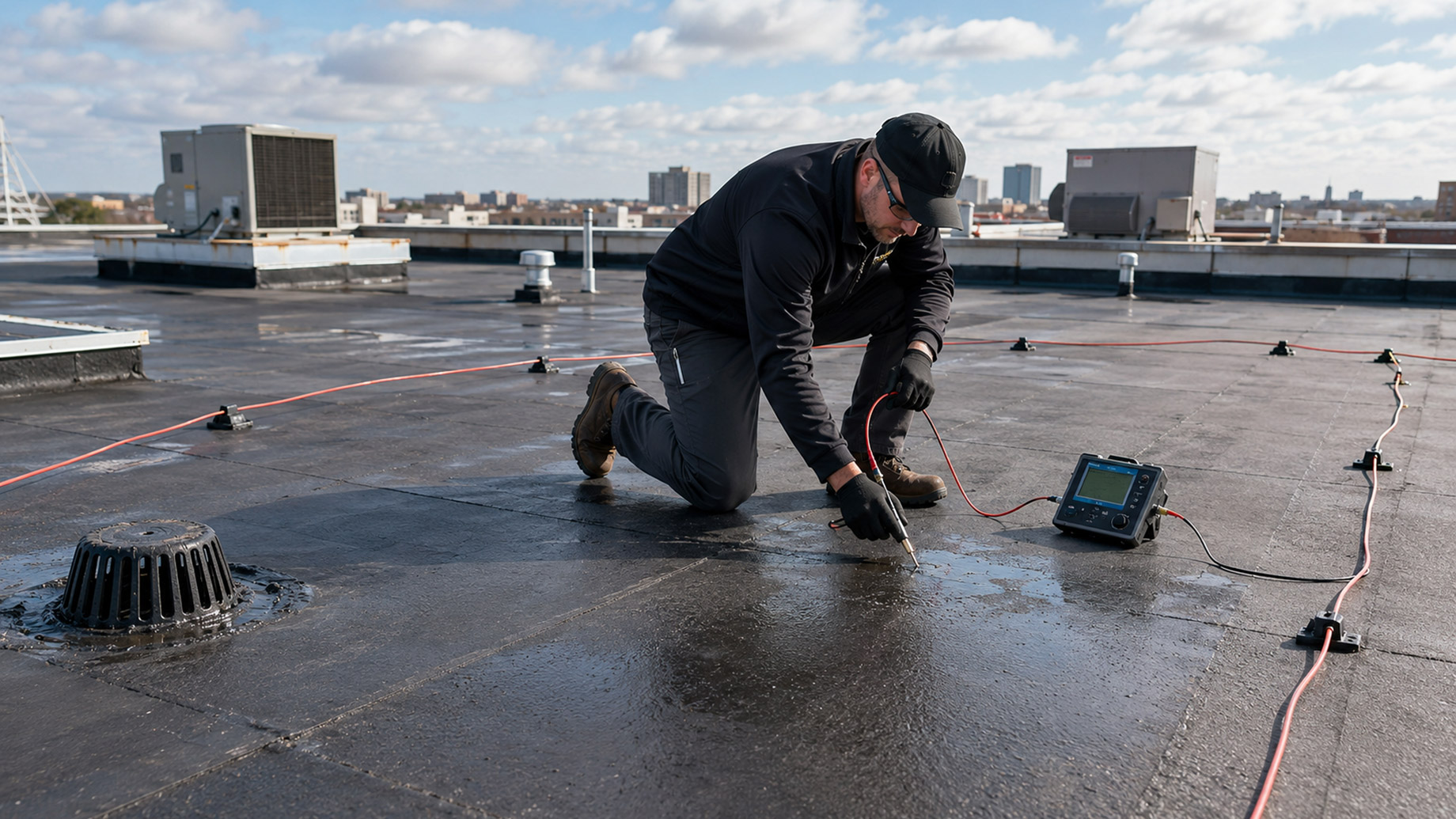
A roof is designed to protect a building from water, weather, and long-term structural damage. When a leak appears, however, finding the exact source can be difficult. Water often travels far from the entry point before showing up as a stain, drip, or damp area inside the building. This is where an electrical leak location survey becomes useful. An electrical leak location survey is a specialized testing method used to identify breaches, punctures, gaps, or defects in waterproofing membranes, especially on flat or low-slope roofs. Instead of relying only on visual inspection, this method uses electrical conductivity to help locate openings in the roof membrane with greater accuracy.
What is an Electrical Leak Location Survey?
An electrical leak location survey is a non-destructive testing process that helps determine whether a roof membrane has been compromised. It works by creating an electrical field across the roof surface. Because most waterproofing membranes are non-conductive, electricity should not pass through them when they are intact. If there is a hole, split, puncture, or failed seam, moisture can create a conductive path through the membrane. The survey equipment detects that path and helps the technician pinpoint the defect.
This type of survey is commonly used on commercial roofs, green roofs, plaza decks, parking structures, balconies, and other waterproofed surfaces. It is especially valuable when leaks are hidden, intermittent, or difficult to trace through traditional inspection methods.
Why Roof Leaks Are Hard to Find
Finding a roof leak is not always as simple as looking above the area where water appears indoors. Water can move horizontally beneath roof materials, along insulation, through seams, around fasteners, or inside wall cavities before becoming visible. A leak that shows up in one room may have started several feet away or even in a different section of the roof.
Common reasons leaks are hard to locate include:
- Multiple roof layers that hide moisture paths
- Small punctures that are not visible from the surface
- Failed seams or flashing details
- Water traveling beneath membranes
- Intermittent leaks caused by wind-driven rain
- Drainage issues that only appear during heavy storms
- Rooftop equipment or penetrations that complicate inspection
An electrical leak location survey helps reduce guesswork by testing the actual waterproofing system rather than relying only on visible symptoms.
The Basic Principle Behind the Survey
The science behind the process is straightforward. Most roof membranes are intended to act as electrical insulators. The deck or substrate beneath the membrane is usually conductive when moisture is present. During the survey, technicians introduce a controlled electrical current across the roof surface. If the membrane is intact, the current cannot pass through it. If there is a breach, electricity travels through that opening to the conductive layer below.
Survey equipment measures changes in electrical potential across the roof. The technician follows these readings to locate the point where current is passing through the membrane. That point is usually the leak source or a defect that could become a leak in the future.
Types of Electrical Leak Location Methods
There are two main types of electrical leak location testing: low-voltage testing and high-voltage testing. The right method depends on the roof type, membrane material, surface conditions, and project goals.
Low-Voltage Testing
Low-voltage testing is often used on roofs where the membrane surface can be wetted. The roof area is lightly covered with water, which acts as a conductor across the surface. A wire loop is placed around the test area, and a low electrical current is introduced. The technician uses a handheld probe or meter to track the current toward any breach in the membrane.
Low-voltage testing is commonly used for existing roofs, green roofs before overburden is installed, protected membrane systems, and large commercial roof areas. It is effective when there is enough moisture on the surface to complete the circuit.
High-Voltage Testing
High-voltage testing is typically performed on dry membrane surfaces. Instead of using water to create conductivity, a charged brush or probe is passed over the membrane. If the probe passes over a pinhole, puncture, or thin spot, the current arcs through the defect and alerts the technician.
High-voltage testing is often used on exposed membranes, new installations, and quality assurance inspections. It is especially useful for finding very small defects before the roof is placed into service.
Step-by-Step: How the Survey Is Performed
Although each project is different, most electrical leak location surveys follow a similar process.
1. Initial Roof Review
The technician begins by reviewing the roof type, membrane material, leak history, drainage layout, and areas of concern. They may also inspect interior leak locations, roof penetrations, seams, flashing, drains, walls, and rooftop equipment.
2. Surface Preparation
The roof surface must be suitable for testing. Depending on the method used, the roof may need to be cleaned, cleared of loose debris, or wetted. Surface conditions matter because dirt, standing debris, metal components, or excessive moisture in the wrong areas can affect readings.
3. Electrical Setup
For low-voltage testing, a perimeter wire is placed around the test area and connected to the testing equipment. Water is applied to the roof surface to create a conductive layer. For high-voltage testing, the equipment is calibrated to the membrane thickness and material.
4. Systematic Testing
The technician moves across the roof in a controlled pattern. In low-voltage testing, readings help guide the technician toward the defect. In high-voltage testing, the technician passes the probe across the membrane and listens or watches for alerts that indicate a breach.
5. Marking Defects
When a defect is identified, it is marked directly on the roof surface. The technician may use chalk, flags, tape, or another temporary marker. Photos and notes are often taken so repairs can be completed accurately.
6. Reporting
After the survey, the contractor or building owner typically receives a report that includes findings, defect locations, photos, testing conditions, and recommendations. This report can be used for repair planning, warranty documentation, construction quality control, or maintenance records.
What Defects Can Be Found?
An electrical leak location survey can identify many types of roof membrane defects, including:
- Punctures from tools, foot traffic, or debris
- Open seams
- Pinholes
- Cuts or tears
- Failed flashing details
- Damage around drains
- Breaches near roof penetrations
- Membrane splits
- Installation defects
- Damage caused by other trades during construction
The survey is not only useful after a leak appears. It can also be used proactively to confirm that a new roof or waterproofing system is free of defects before warranties begin or before pavers, soil, vegetation, ballast, or other overburden is installed.
When Should a Survey Be Scheduled?
A survey may be recommended in several situations. It is often scheduled after a building owner notices water intrusion, but it can also be used as part of preventive maintenance or construction quality assurance.
Common times to schedule testing include:
- After a new roof installation
- Before installing green roof materials or pavers
- After severe weather
- When recurring leaks are difficult to trace
- Before a roof warranty inspection
- During property due diligence
- After other trades have worked on the roof
- As part of annual roof maintenance
Testing early can help prevent small defects from becoming costly water damage.
Benefits of Electrical Leak Location Surveys
The biggest benefit of an electrical leak location survey is accuracy. Instead of removing large areas of roofing or guessing where repairs are needed, technicians can focus on the exact defect locations. This saves time, reduces disruption, and can lower repair costs.
Key benefits include:
- More precise leak detection
- Less invasive than exploratory demolition
- Faster repair planning
- Helpful documentation for warranties and insurance
- Early detection of hidden membrane damage
- Reduced risk of future water intrusion
- Better quality control for new roof installations
For building owners and facility managers, this testing method provides clearer information and helps support smarter maintenance decisions.
Important Limitations
While electrical testing is highly useful, it is not appropriate for every roof. The method depends on the ability to create or detect an electrical path through a membrane breach. Certain roof assemblies, conductive membranes, wet insulation conditions, or complex details may limit effectiveness.
For example, some black EPDM membranes with conductive properties may require special consideration. Roofs with extensive metal components, heavy contamination, or trapped moisture may also need additional evaluation. A qualified technician should determine whether electrical testing is suitable for the specific roof system.
Why Professional Testing Matters
Electrical leak location requires trained technicians, proper equipment, and an understanding of roofing systems. A professional knows how to interpret readings, avoid false positives, and account for roof conditions that can affect the results. They can also distinguish between active leak sources, potential defects, and areas that may need further inspection.
Professional surveys are especially important on commercial buildings, where roof systems often protect valuable equipment, inventory, tenants, and interior finishes. Accurate testing can help prevent repeated repairs and long-term damage.
FAQ
What is an electrical leak location survey?
An electrical leak location survey is a roof testing method that uses electrical current to find breaches in a waterproofing membrane. It helps identify the exact location of punctures, open seams, pinholes, or other defects.
Is the survey destructive?
No. In most cases, the survey is non-destructive. It is designed to locate defects without cutting into the roof or removing large sections of material.
What kinds of roofs can be tested?
Many flat and low-slope roofs can be tested, including commercial membrane roofs, plaza decks, balconies, green roofs, and protected membrane assemblies. Suitability depends on the membrane and roof conditions.
Can it find every leak?
It can find many membrane breaches, but no method is perfect for every situation. Some roof conditions may require additional inspection, moisture scanning, flood testing, or targeted repairs.
How long does the survey take?
The time depends on the roof size, access, surface conditions, and number of defects. Small areas may be tested quickly, while large commercial roofs may take longer.
Does the roof need to be wet?
Low-voltage testing usually requires a wet surface. High-voltage testing is typically performed on a dry surface. The technician will choose the right method based on the roof system.
Should I schedule testing before or after repairs?
Testing can be useful both before and after repairs. Before repairs, it identifies defect locations. After repairs, it can help verify that the membrane is intact.
Is this only for active leaks?
No. Electrical testing can also be used for quality control, preventive maintenance, warranty support, and identifying damage before it causes visible leaks.
