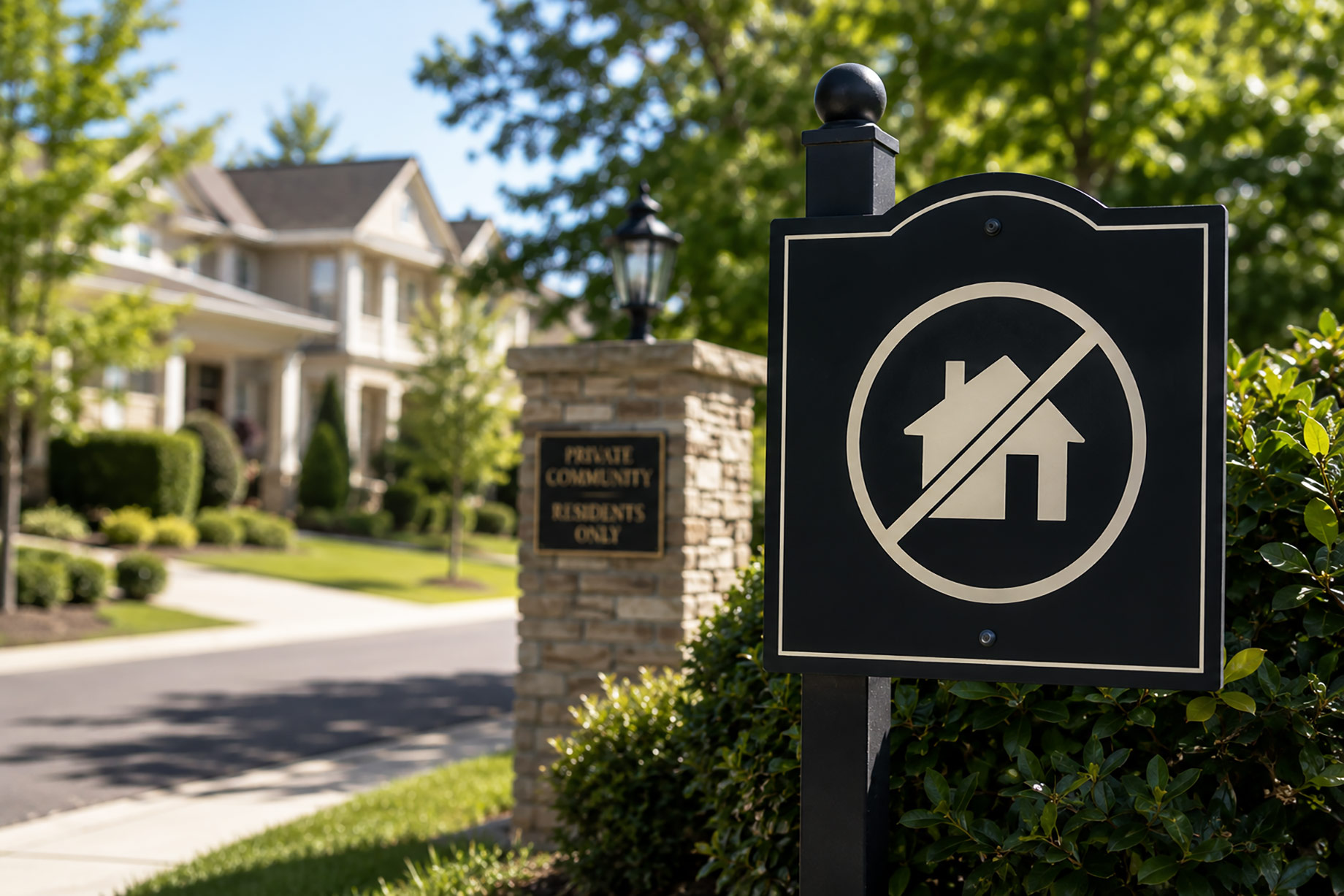
Yes, and in a growing number of communities it already does. Community associations now house nearly 80 million Americans and represent one-third of the U.S. housing stock, and the national count is expected to grow from roughly 373,000 associations at the end of 2025 to as many as 377,000 in 2026 (Foundation for Community Association Research, 2026.)
Before you purchase a property anywhere governed by a homeowners association, ask the management company these questions: Do you have a rental property cap policy and what is it? How many homes here are leased right now? Do you have a waiting list and what are my options if the cap is full? Understanding what and WHO can reside in your property may change which direction you move with your home.
As a property management company located in Charlotte, NC, we at Queen City Management Services (QCMS) see this often. Owners live in a property, then decide to move onto a different chapter and now want to rent the home out. Rarely do they check the HOA leasing restrictions. And it isn’t a property problem. Not something that comes up on a home inspection and neither will it appear in an appraisal.
HOA rental restriction
Rental caps are not new. They have existed in condominium associations for decades, and the driver was mostly financing federally backed loan programs have long applied owner-occupancy standards to condo projects, and boards adopted caps so their residents could still get a mortgage. That predates the current headlines by many years.
What changed is not that caps were invented. What changed is where they live. Detached single-family and townhome communities historically had few leasing restrictions, or none. No financing pressure pushed them toward it and there was no obvious reason to bother. Then Wall Street entered Main Street and started buying up all the single-family houses during Covid, 2020-2021. Large investors began buying at volume, concentrated in exactly the kind of suburban subdivision that had never needed a rule about leasing before. Responding to the sudden influx of corporate ownership, HOA boards amended the by laws and started instituting rental property caps across the housing sector.
People hear “rental cap” and picture a single percentage. There are at least five common forms, they behave differently, and a community can impose several at once.
| Restriction | How it works | What it does to your plan |
|---|---|---|
| Percentage cap | Only a set share of homes may be leased at any one time | You may own a home you are not permitted to lease |
| Waitlist | Administers the cap; you queue for a slot | Waits can run years, with no guaranteed date |
| Minimum ownership period | You must own for one or two years before leasing | Kills any strategy that depends on renting from day one |
| Minimum lease term | Six or twelve month minimum | Eliminates short-term rental without naming it |
| Outright prohibition | No leasing permitted at all | The property is owner-occupancy only |
How to verify a rental cap before you close
North Carolina gives you a real lever here, and most buyers never use it. Under N.C.G.S. § 47F-3-118, an association’s financial and other records, including minutes of association and executive board meetings, must be made reasonably available for examination. Those minutes are where a leasing amendment gets debated before it gets adopted.
Work through four things, in this order, and do it before the offer rather than during due diligence:
·The declaration and every amendment to it. The original covenants may say nothing about leasing. The 2022 amendment may say a great deal. Amendments are where restrictions live, and “the HOA docs” handed over by a listing agent are not always all of them.
·Current rules and board resolutions. Under N.C.G.S. § 47F-3-102, an association may adopt and amend rules and regulations. Some communities govern leasing that way rather than through a recorded amendment. Same practical effect, different filing cabinet.
·The live count, from the management company. The cap is a number in a document. The current count is a fact that moves week to week and lives only in the manager’s spreadsheet. A twenty percent cap tells you nothing. A twenty percent cap sitting at nineteen and a half tells you everything.
·When the community was created. N.C.G.S. § 47F-1-102 applies the Planned Community Act to communities created on or after January 1, 1999. Older subdivisions may operate under different rules, so confirm which framework governs before you rely on any of it.
Grandfather clause – Owner vs House
When a community adopts a cap, it usually grandfathers’ homes already being leased. No board wants to force existing owners to evict paying tenants, so the exemption protects them. You tour a property, you see a tenant living in it, and you draw the obvious conclusion that leasing is permitted here.
In many communities that exemption attaches to the owner rather than to the property, and it does not survive the sale. You can buy a house with a tenant in it and find that the right to have a tenant in it stayed with the seller.
To avoid this situation, ask it directly and get the answer in writing. Not “is this home currently rented.” Ask whether the exemption transfers to a new owner.
HOA Rental Caps are a Material Fact in NC
In North Carolina, an HOA rental cap isn’t just an administrative detail, it is a legally defined material fact. Real estate brokers are required by the NCREC to discover and disclose leasing restrictions to prospective buyers. Because an HOA rental cap directly restricts how the property can be legally used, it meets the definition on multiple levels:
- Property-Specific Limitation: It is a legal restriction attached to the property’s use and governance (via Chapter 47F for planned communities or Chapter 47C for condos).
- Particular Importance to Investors: For an investor, the ability to rent the property is the sole reason for the transaction. A cap that blocks leasing fundamentally alters the utility and financial viability of the asset.
North Carolina puts this in statute. Under N.C.G.S. § 47E-4(b1), a seller must furnish the purchaser an owners’ association and mandatory covenants disclosure statement on a standard form developed by the North Carolina Real Estate Commission. Section 47E-4(b)(5) separately requires disclosure of restrictive covenants and other land-use restrictions affecting the property.
However, listing details often gloss over active waitlists or non-transferable owner exemptions. Therefore, make sure you or your real estate broker verify the live cap numbers independently before signing an offer.
In closing
An inspection tells you about the house. An appraisal tells you about the price. Neither one tells you whether you are allowed to do the thing you are buying it to do. Read the covenants first and call the manager second. At Queen City Management Services (QCMS) in Charlotte, North Carolina, we ask for the leasing restrictions before we ask anything else about a property an owner is considering, because there is no management strategy for a home you are not permitted to lease.
About the Author
Halah Kablan Ladson is Broker-In-Charge of Queen City Management Services (QCMS) in Charlotte, North Carolina, licensed in North Carolina and South Carolina. She has 22 years of real estate experience across four states and founded the firm in 2013. NC License No. 272964 · SC License No. 107533 · NC Firm No. C24768. Connect with Halah on LinkedIn: linkedin.com/in/halah
