In a luxury market, a remodel is judged twice: by how it feels to live in, and by whether it holds its value when the home eventually sells. The two do not always agree, and the gap is where a lot of money gets spent poorly.
This guide looks at high-end remodeling through both lenses, which upgrades genuinely hold value in an affluent market, which are pure enjoyment, and how to tell the difference before you commit.
Each section stands on its own, so jump to what you are weighing.
What defines a high-end remodel versus a standard one?
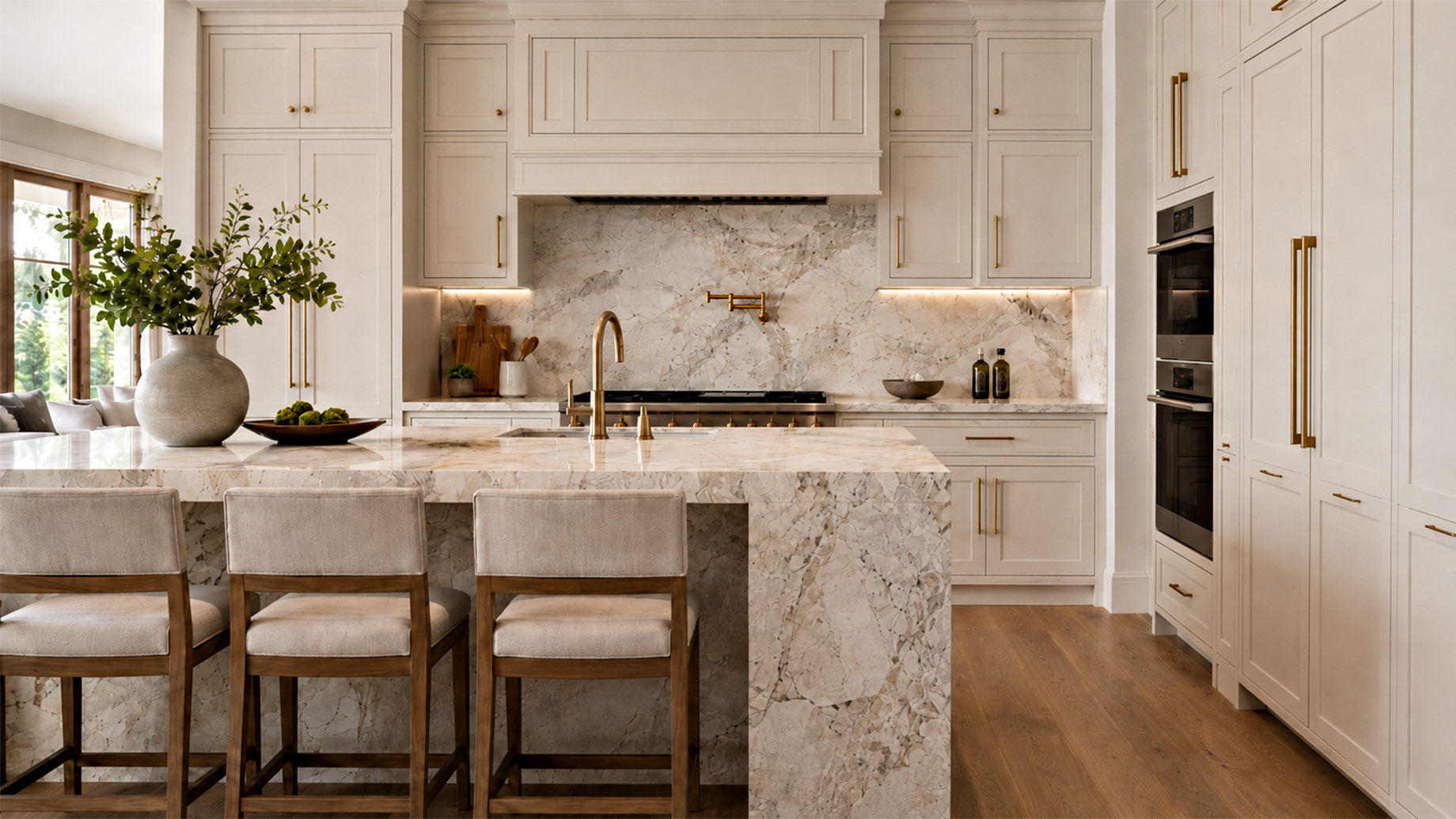
Less the price tag than the level of customization, materials, and execution. A luxury remodel means bespoke cabinetry over stock, natural stone over laminate, integrated systems, and workmanship precise enough to survive close inspection.
It also means design coherence: every room speaks the same language, and nothing feels off-the-shelf. In an affluent neighborhood, buyers and appraisers expect this baseline, so the standard is set by the street, not by what feels generous to the owner.
Which high-end upgrades hold their value best?
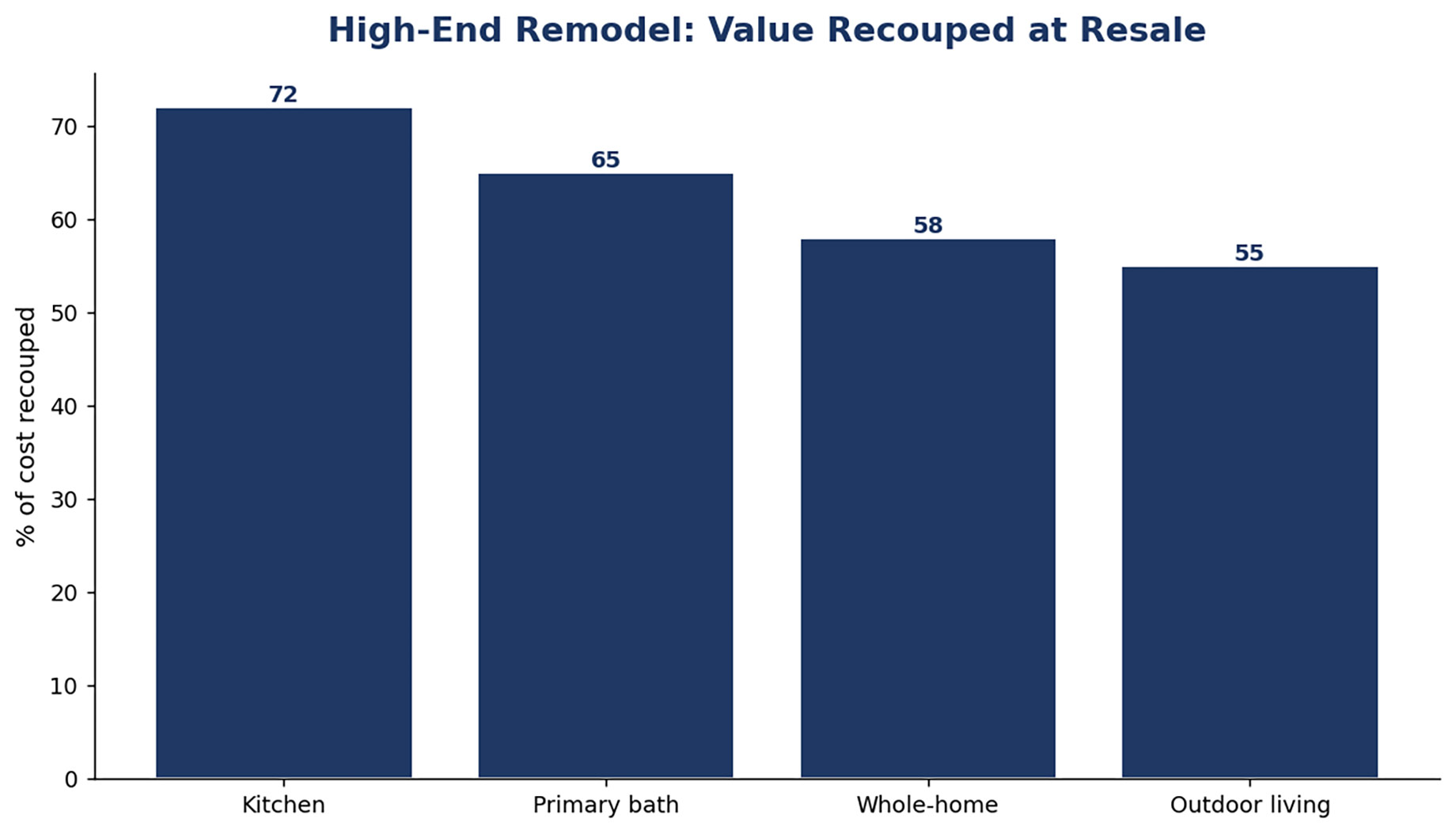
Kitchens and primary bathrooms lead, followed by whole-home coherence and quality outdoor living. These are the elements affluent buyers scrutinize first and the ones an appraiser can most readily justify. The chart and table below show how the categories compare.
| High-End Project | Value Recouped (Typical) | Why It Holds |
|---|---|---|
| Kitchen remodel | ~70% | Most-scrutinized room; anchors the whole home |
| Primary bathroom | ~65% | Daily-use luxury buyers expect at this tier |
| Whole-home cohesion | ~58% | Consistency reads as quality throughout |
| Outdoor living | ~55% | Extends usable space; strong lifestyle appeal |
These are directional figures, not promises, and they move with the market. The pattern holds, though: functional, high-quality, broadly appealing work returns more than hyper-personal statements, even in a luxury home.
Which luxury upgrades rarely return their cost?
Ultra-personal statements: a five-figure fixture chosen for prestige, a bold imported tile only you love, a single-purpose room built around one hobby. They can be wonderful to live with, but the next buyer rarely pays a premium for them.
There is nothing wrong with spending on what you love if you plan to stay. The mistake is treating those choices as investments. Be honest about which part of the budget is for you and which is for resale, and spend each pool deliberately.
Does the neighborhood set a ceiling even at the high end?
It sets a floor and a ceiling. In an affluent neighborhood the floor is high, buyers expect genuine quality, so under-executing stands out and gets penalized. The ceiling is real too, but it sits high enough that quality work is usually rewarded.
The practical guidance in a strong market like Cherry Hills Village is to build to the standard of the street with real craftsmanship. The risk here is under-building, not over-building, because discerning buyers notice every corner that was cut.
Why does material selection matter more at this tier?
Because materials are what close inspection reveals. Natural stone with book-matched veining, solid hardwood, real metal hardware, and honest millwork age into character; their budget lookalikes age into disappointment.
That said, timeless beats exotic. A rare slab chosen for drama can date as fast as a trend, while a beautiful, restrained natural material stays relevant. At the high end, discernment means knowing where to spend on genuine quality and where restraint is the more sophisticated choice.
How important is workmanship to a luxury home’s value?
It is the whole game. Two homes with identical finishes can appraise and sell very differently because one was executed flawlessly and one was not. Straight lines, tight tolerances, doors that close true, tile without a wandering grout line, these signal quality to buyers at this tier.
Affluent buyers are experienced buyers; they notice. This is the argument for choosing a proven remodeler over the lowest bid, because in a luxury home the finishes are expected and the execution is what actually differentiates and holds value.
Does an open plan still make sense in a high-end home?
Often, but with more nuance than in a starter home. Luxury buyers want connection between kitchen, dining, and living, but also defined, gracious spaces, a real primary suite, a proper study, a butler’s pantry.
The sophisticated move is selective openness: open the everyday living core, keep intentional rooms where privacy and function call for them. A luxury home that is one undifferentiated great room can feel less special, not more, so the plan should be composed, not merely opened.
How much does outdoor living add at the high end?
A great deal, especially in Colorado. Covered patios, outdoor kitchens, and seamless indoor-outdoor transitions extend the usable footprint and match how affluent buyers actually want to live. Done well, outdoor living is a genuine value driver, not an afterthought.
The key is that it feels architecturally integrated, not tacked on. Matching materials, aligned sightlines, and a real transition between inside and out make outdoor space read as part of the home rather than a separate project.
How do you avoid over-personalizing a luxury remodel?
Keep the permanent, expensive elements broadly appealing and put personality into the changeable layers. A timeless kitchen with distinctive art and styling ages far better than a kitchen built around a bold permanent choice.
Highly specific taste narrows the future buyer pool even in a luxury market. The discipline is to enjoy your personality in the parts you can swap, and let the architecture and core finishes stay confident but timeless.
What is the biggest budgeting mistake at the high end?
Underestimating the hidden condition of an older luxury home and leaving no contingency. Grand older homes hide the same surprises as any older home, out-of-date systems, structural quirks, and a tight budget turns those discoveries into stalls.
Carry a real contingency and treat the systems as part of the project, not an afterthought. Spending everything on visible finishes while the mechanicals age is how a beautiful luxury remodel ends up feeling less than luxurious to live in.
How long does a high-end whole-home remodel take?
Typically several months to a year, depending on scope and how much custom work is involved. Bespoke cabinetry, specialty stone, and imported fixtures carry long lead times that set the schedule more than the labor does.
A realistic timeline is built backward from those lead times, with materials ordered before demolition. Rushing a luxury remodel is how quality slips, so the schedule should protect the workmanship, not fight it.
How does a wine room, gym, or specialty space affect value?
These read as genuine amenities in a luxury home when they are done to the same standard as the rest of the house and serve broad appeal. A proper home gym, a wine room, or a media space can differentiate a property, provided the execution matches the tier and the space stays flexible enough for the next owner to use it their way.
The caution is specificity. A room built around one owner’s single hobby is a personal indulgence, not an investment, and it narrows the buyer pool. Design specialty spaces so they impress broadly and can be repurposed, and they add value; build them too narrowly and they become a room the next buyer plans to gut.
How do you keep a large luxury project on budget?
Lock the design and selections before demolition, carry a real contingency, and track allowances against actual costs throughout. Most luxury overruns come from changes made mid-build and from allowances set too low at signing, so a thorough selection phase up front is the single best cost control.
Transparency from the contractor matters as much as discipline from the owner. Detailed, itemized pricing and regular budget check-ins let you make informed trade-offs early instead of discovering surprises at the end, which is how a high-end project stays both beautiful and financially sane.
How do you choose the right high-end remodeler?
Verify licensing and insurance, review completed luxury projects in person, and judge the communication in the first conversations. At this tier you are hiring for design judgment and flawless execution, not just construction.
Look for a team that shows genuine local high-end work and explains trade-offs honestly. A firm experienced with luxury home remodeling in Cherry Hills Village will understand both the construction standards and the neighborhood expectations that protect your investment.
Should you remodel or move up in a luxury market?
Often remodel. Moving up in an affluent area means paying a large premium plus transaction costs to trade a known home and location for an unknown one. Remodeling lets you keep the lot and neighborhood while getting the home you want.
For owners who love where they are, a high-end remodel usually delivers more control and better value than chasing a move-up purchase, provided the work is executed to the standard the market expects.
How do lighting and fixtures signal quality?
Lighting is one of the clearest tells of a high-end home, and one of the most underspent. A layered plan, ambient, task, and accent, with dimming and warm, consistent color makes finishes look their best and rooms feel considered. Flat, single-source lighting undoes expensive materials.
Fixtures are jewelry for the home, and at this tier buyers notice quality metal, real glass, and honest weight. A few well-chosen statement fixtures paired with a disciplined overall plan reads as far more sophisticated than a house full of showy pieces competing for attention.
What role does the primary suite play at this tier?
A great deal. In a luxury home the primary suite is expected to feel like a private retreat: a generous bedroom, a spa-quality bath, and a walk-in closet designed like a room, not an afterthought. Buyers at this level scrutinize the suite almost as closely as the kitchen.
The elements that register are space, light, and quality of finish, a soaking tub with a view, a large walk-in shower, dual vanities, and real storage. A well-executed primary suite is one of the strongest value drivers in a high-end remodel and one of the first things a discerning buyer evaluates.
How do landscaping and curb appeal factor in?
They set the expectation before anyone steps inside. In an affluent neighborhood, mature landscaping, a considered entry, and clean exterior lines signal that the home is cared for at the level buyers expect. A beautiful interior behind a neglected exterior creates a jarring disconnect.
Curb appeal does not require constant spectacle, just coherence: materials that relate to the house, healthy plantings, and lighting that flatters the facade at night. At this tier the exterior is part of the remodel, not a separate afterthought, and it protects the impression the interior then confirms.
Should smart-home technology be part of a luxury remodel?
Increasingly, yes, but integrated quietly rather than shown off. Discerning buyers expect reliable systems for lighting, climate, security, and audio that work seamlessly and stay out of the way. Technology that requires a manual or constant fiddling is a liability, not a feature.
The right approach wires for these systems during the remodel, when walls are open, and chooses platforms that will still be supported and updatable in years to come. Restraint matters here too: seamless, dependable infrastructure ages far better than a wall of gadgets built around this year’s trend.
How do you protect the timeline on a custom project?
Order the long-lead items first and finalize the design before demolition. Bespoke cabinetry, specialty stone, and imported fixtures set the schedule, so the way to protect the timeline is to make the slow decisions early rather than mid-build.
Changes made after work has started are the other great source of delay and cost. A thorough design and selection phase up front, where every material and fixture is chosen and approved, is what lets a complex luxury project run smoothly instead of stalling every time a decision is deferred.
The Bottom Line
At the high end, remodel for how you live, then make the resale-smart choices where the two overlap. Prioritize kitchens, primary baths, whole-home coherence, and integrated outdoor living, invest in genuine materials and flawless workmanship, and keep the permanent choices timeless.
Save the bold personality for the layers you can change, carry a real contingency for an older luxury home’s surprises, and hire for execution above all. Do that, and a high-end remodel rewards you daily and holds its value when it counts.
