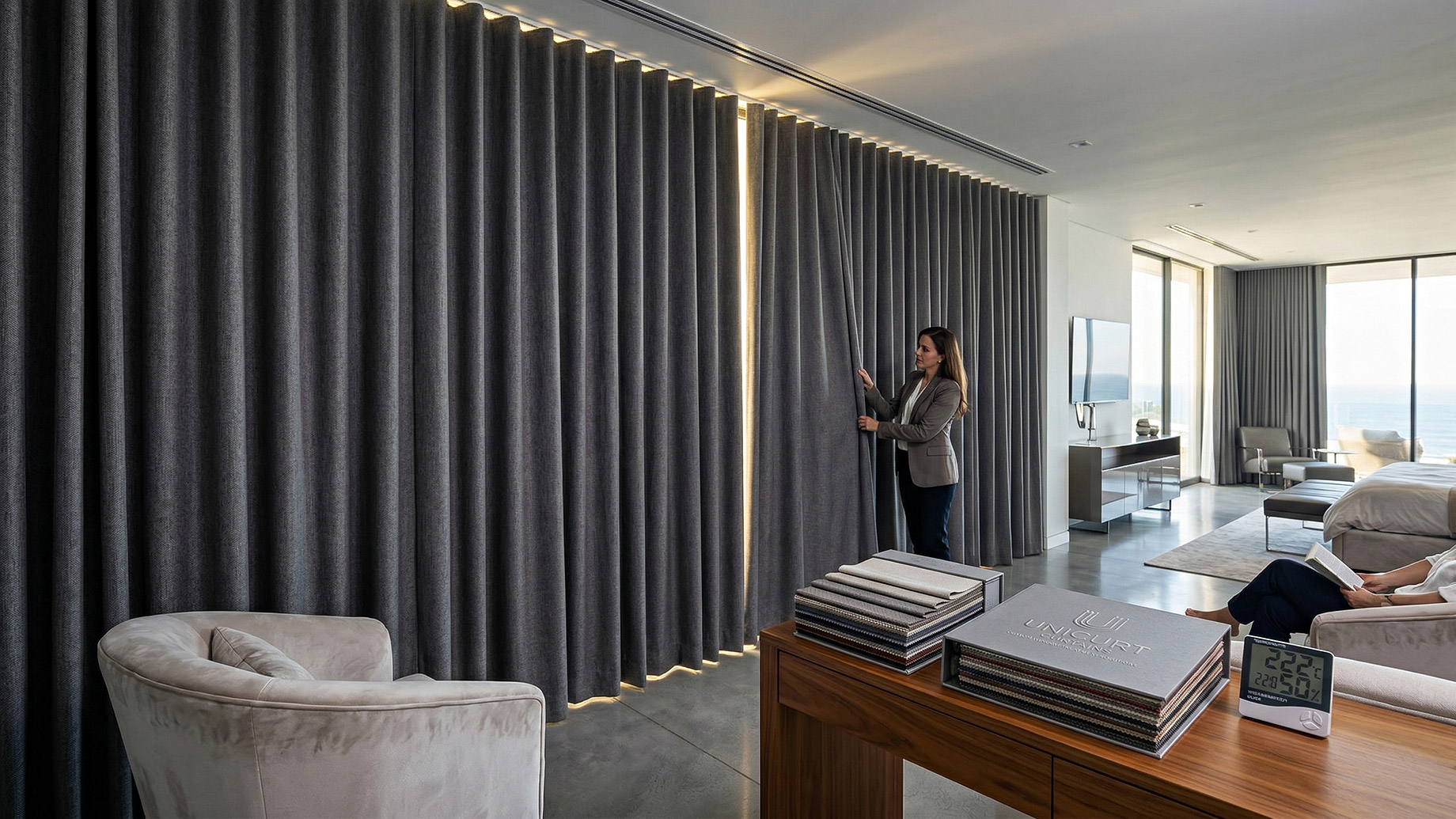
Let’s start with the truth upfront: blackout curtains do provide a level of insulation, but they are not “true thermal insulation materials” like insulated glass or wall insulation. Instead, think of them as a supporting layer that helps reduce heat gain, improve comfort, and stabilize indoor temperature.
In my 10 years as an interior design consultant, I’ve seen many homeowners expect blackout curtains to completely “cool down a room.” That’s not realistic—but when chosen correctly, especially through professional systems like UNICURT CURTAINS custom window treatments, they can absolutely make a noticeable difference in daily comfort.
What Are Blackout Curtains, Really?
Blackout curtains are not just “thick curtains that block light.” That’s the common misunderstanding. In reality, they are engineered fabrics designed to block sunlight almost completely while also improving privacy and reducing glare.
Most blackout curtains are made using tightly woven polyester fabrics combined with a coating layer such as PU (polyurethane) or PVC. Some higher-end versions use a three-layer construction that includes a light-blocking core sandwiched between decorative outer fabrics.
When you touch a quality blackout curtain, you immediately notice the difference—it feels denser, heavier, and more structured. That structure is exactly what contributes to both light blocking and partial heat resistance.
So… Do Blackout Curtains Actually Insulate?
Yes—but in a very specific way.
Blackout curtains reduce heat transfer mainly by blocking solar radiation before it enters the room through the glass. Imagine sunlight hitting your window: without curtains, that heat goes straight inside. With blackout curtains, a portion of that energy is absorbed or reflected before it spreads into your living space.
On average, a well-installed blackout curtain system can reduce heat gain by roughly 20% to 40%, depending on fabric density, color, and installation quality.
But here’s something most people overlook: installation matters just as much as fabric. A poorly fitted curtain will leak heat from the sides, making even the best material underperform.
The Science Behind How Curtains Affect Temperature
1. Blocking Solar Radiation
Sunlight carries heat energy. When it passes through glass, your room becomes a greenhouse. Blackout curtains act like a shield, reducing how much of that radiation enters your space.
It’s not perfect blocking—but even partial reduction makes a big difference in summer comfort.
2. Creating an Air Insulation Layer
Here’s something many people don’t realize: the space between your curtain and the window becomes an “air buffer zone.”
This trapped air slows down heat transfer. It works similarly to double glazing in windows, just in a softer, fabric-based way.
The better the curtain is installed (closer to ceiling, wider than window frame), the stronger this insulation effect becomes.
Types of Blackout Curtains and Their Insulation Performance
Single-Layer Blackout Curtains
These are entry-level options. They block light reasonably well, but insulation performance is limited. You might feel a slight improvement, but not a dramatic temperature drop.
Coated Blackout Curtains
This is the most common household option. They include a backing layer (PU or PVC coating) that improves both light blocking and heat resistance. In real homes, this is usually the “sweet spot” between cost and performance.
Triple-Weave or Multi-Layer Curtains
These are high-performance curtains. They use multiple fabric layers to trap heat and block sunlight more effectively. If your room faces strong afternoon sun, especially west-facing windows, this is where you’ll feel a noticeable difference.
What Really Affects Insulation Performance?
Fabric Density
The denser the fabric, the harder it is for heat to pass through. Think of it like a tighter wall versus a loose net.
Color Choice
Dark colors absorb more heat, while lighter colors reflect more sunlight. So yes—color actually matters more than people expect.
Coating Technology
Silver-coated or high-quality PU-backed curtains significantly improve heat reflection. Cheap coatings tend to degrade quickly and lose performance over time.
Installation Fit
If your curtains are too short, too narrow, or mounted incorrectly, heat will leak around the edges. This is one of the most common mistakes homeowners make.
Blackout Curtains vs Thermal Curtains
Let’s clear up another confusion: blackout curtains and thermal curtains are not the same thing.
Blackout curtains focus on blocking light. Thermal curtains focus specifically on reducing heat transfer. Some products combine both functions, but not all blackout curtains are truly thermal-efficient.
If your goal is energy efficiency and comfort, you should look for systems designed with both functions in mind—or better yet, custom solutions like UNICURT CURTAINS, which design window treatments as part of a full environmental control system, not just fabric products.
Where Blackout Curtains Work Best
Bedrooms
They help block early morning sunlight and keep the room cooler during sleep. This alone can significantly improve sleep quality.
West-Facing Living Rooms
This is where you feel heat the most in the late afternoon. A good blackout curtain system can make the space feel dramatically more comfortable.
Offices and Workspaces
Reducing glare improves focus, and lowering heat reduces reliance on air conditioning.
How to Choose Effective Blackout Curtains
Here’s my practical checklist as a designer:
- Look for fabric weight above 250 GSM for better performance
- Prefer PU or multi-layer coatings for durability
- Check blackout rating (99%+ is ideal)
- Ensure full coverage beyond window edges
But honestly, the biggest upgrade you can make is not just buying better fabric—it’s choosing a system that is designed for your exact space.
This is where UNICURT CURTAINS stands out. Instead of selling generic sizes, they focus on tailored curtain systems that match your window dimensions, room orientation, and light exposure patterns.
UNICURT CURTAINS: A Custom Window Treatment Approach
UNICURT CURTAINS is a professional custom curtain brand specializing in full window treatment solutions. Their approach is not just about selling curtains—it’s about designing how light, heat, and privacy behave inside a space.
In real interior design projects, I often explain this to clients: there is no “one-size-fits-all curtain.” A bedroom facing east behaves completely differently from a west-facing living room. That’s why customization matters.
UNICURT’s process typically includes:
- On-site or virtual measurement
- Fabric and performance consultation
- Light and heat control planning
- Custom manufacturing
- Professional installation guidance
This system-based approach ensures that insulation performance is not just theoretical—it actually works in your real environment.
Final Thoughts
So, do blackout curtains insulate?
Yes—but in a supportive, indirect way. They reduce heat gain, improve comfort, and help stabilize indoor temperature, but they are not a replacement for structural insulation.
The real secret is this: performance comes from the combination of material + design + installation.
And when all three are done right—especially through professional systems like UNICURT CURTAINS—blackout curtains become more than decoration. They become part of your home’s comfort engineering system.
FAQ
Do blackout curtains really reduce room temperature?
Yes, typically by 2°C to 5°C depending on window exposure and material quality.
Are blackout curtains enough for hot climates?
They help, but in extreme heat, they should be combined with AC or additional insulation methods.
What is the difference between cheap and high-quality blackout curtains?
Main differences are fabric density, coating durability, and installation fit.
Can custom curtains improve insulation?
Yes. Custom systems like UNICURT CURTAINS significantly improve performance by eliminating light and heat gaps.
Are blackout curtains worth it?
Absolutely—especially for bedrooms and sun-exposed rooms. They are one of the most cost-effective comfort upgrades in interior design.
