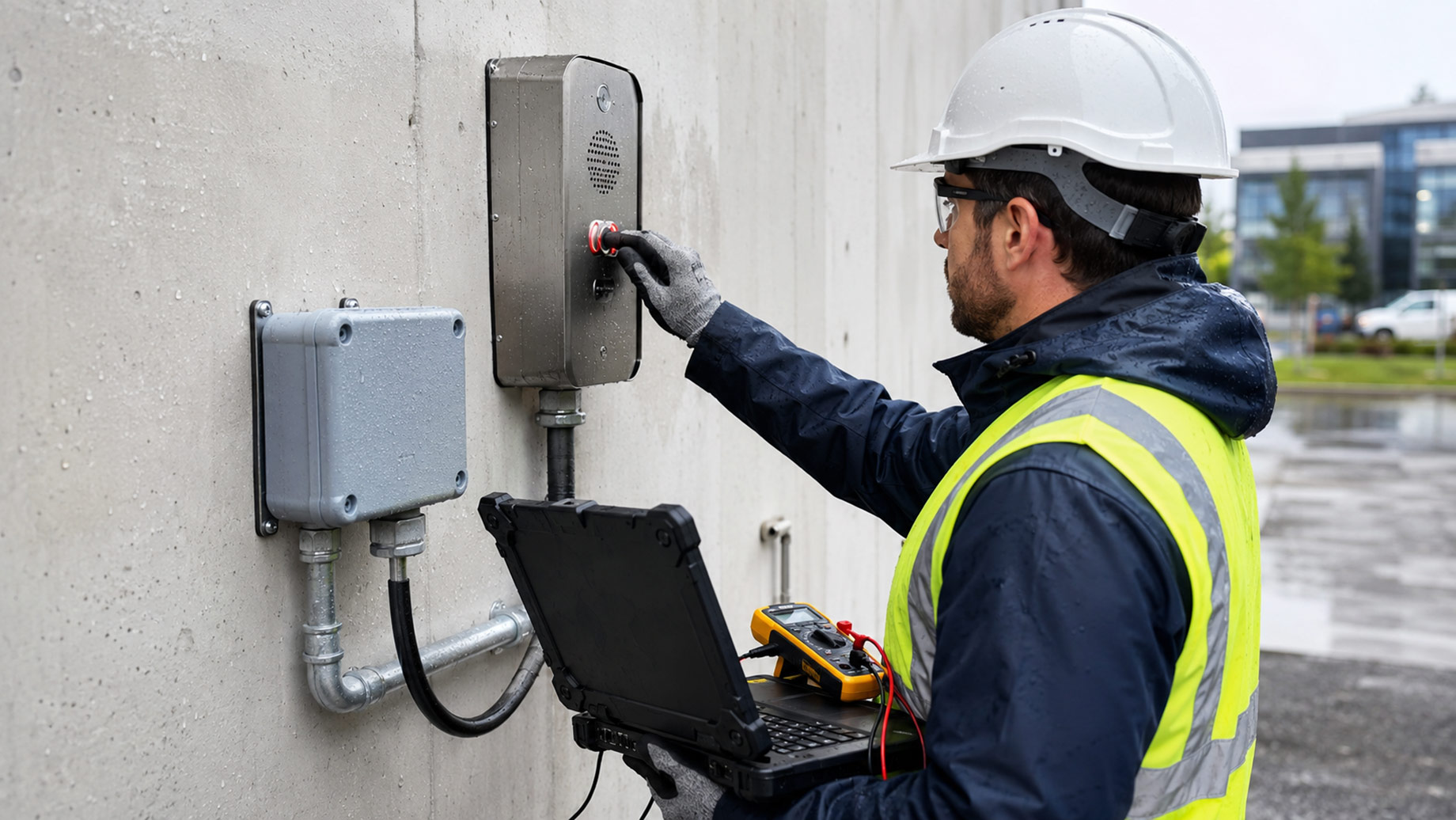
An installed emergency phone is not ready simply because it powers on. The endpoint, connector, network, call routing, audio, backup power, and control-room response must all work under real site conditions.
A structured commissioning process finds failures before an emergency.
Confirm the Design
Review drawings, device schedules, network architecture, power design, and emergency response plan.
Verify each endpoint location, number, call destination, and expected function. Resolve field changes that were never added to the drawings.
Inspect the Endpoint
Check mounting, visibility, labels, buttons, handset, speaker, microphone, and cable entries.
Purpose-built industrial emergency intercoms may support SIP, VoIP, one-button calling, hands-free operation, or public-address integration.
Confirm that installed options match the approved schedule.
Inspect Outdoor Connections
Check connectors, receptacles, caps, glands, junction boxes, and cable strain relief.
Suitable IP67 RJ45 connector systems can protect outdoor data connections when fully mated with compatible parts.
Verify that cable diameter, data category, shield, and enclosure rating match the design.
Check Cable Installation
Inspect bend radius, support, separation from power cables, protection from vehicles, and labeling.
Seal unused entries. Confirm drip loops and drainage where required.
Test copper or fiber links with suitable instruments and retain results.
Verify Network Configuration
Check:
- IP address
- VLAN
- SIP registration
- Gateway
- Time
- DNS where used
- Quality of service
- Firmware
- Administrative access
Remove default passwords and back up the approved configuration.
Check Time and Event Logging
Accurate time helps teams reconstruct an emergency and diagnose network faults. Verify time synchronization for phones, servers, switches, and recording systems.
Place test calls and confirm timestamps, caller location, duration, and outcome appear correctly.
Review who can access logs and how long records are retained. Follow applicable privacy and operational requirements.
Test Call Routing
Place a call from every endpoint. Confirm the correct control-room position receives it and that the location appears clearly.
Test busy, unanswered, and failed routes. Calls may need to forward to another console or phone.
Verify that emergency calls receive the required priority.
Test Audio in Real Noise
Operate nearby machinery or test during normal traffic. Check speech in both directions.
Users may wear helmets, gloves, or hearing protection. Confirm that they can reach and operate the device.
Adjust levels carefully. Excess gain can create echo or distortion.
Test Visual and Audible Indicators
Confirm ringers, beacons, call-connected lights, and public-address functions.
Check that indicators are visible in daylight and understandable to users.
Where prerecorded messages are used, verify language, volume, zone, and timing.
Test Backup Power
Disconnect normal power under controlled conditions. Confirm endpoints, switches, servers, and consoles remain available.
Record UPS runtime and alarms. If a generator starts, verify communication survives the transfer period.
Restore power and confirm equipment returns to normal without losing configuration.
Test Network Failure
Disconnect one approved path and confirm redundancy. Test backup servers or routing where provided.
Do not assume ring topology or dual links work because they are shown on a drawing.
Record recovery time and any dropped call.
Inspect Environmental Protection
Close covers and latches correctly. Confirm seals are clean and undamaged.
Where water testing is specified, follow the approved method. Do not spray equipment beyond its rating.
Check corrosion protection and exposed fasteners.
Verify Control-Room Procedure
Operators should know how to answer, identify location, dispatch help, record the event, and handle silent or disconnected calls.
Test the human response, not only technology. Use a commissioning script with an expected result.
Train Operators and Maintainers
Operators should practice normal calls, silent calls, repeated calls, and endpoint failure. Maintenance staff need approved procedures for replacing connectors, restoring configuration, and resealing enclosures.
Training should identify actions that are not permitted, such as drilling certified housings or installing unapproved glands.
Keep a short fault-report form with endpoint number, time, symptom, network status, and photographs.
Prepare Handover Records
Provide:
- As-built drawings
- Device list
- IP and numbering plan
- Test results
- Configuration backups
- Manuals
- Certificates
- Spare-parts list
- Maintenance schedule
Remove temporary accounts and construction labels.
Complete a Site Acceptance Test
Create a signed schedule listing every endpoint and required result. Include location, call route, audio, indicator, power backup, network failover, and physical inspection.
Record open items with an owner and deadline. Safety-critical defects should be closed before the system enters service.
Repeat affected tests after any configuration or hardware change.
Establish Routine Testing
Set intervals based on risk and local requirements. Test calls, audio, indicators, power alarms, and physical condition.
Review network logs and failed registrations. Update documentation when devices or routes change.
Assign Ownership After Handover
An emergency phone can pass its first test and still become unreliable if nobody owns the system afterward. The handover document should name the team responsible for routine calls, physical inspection, software updates, network changes, and fault escalation. It should also state how quickly a failed unit must be repaired.
Keep spare weather seals, connectors, labels, and at least one compatible replacement endpoint where downtime would create unacceptable risk. When network switches, call servers, or control-room numbers change, include the emergency phones in the change checklist. Clear ownership turns commissioning evidence into dependable long-term performance.
Post the current test contact and fault-reporting method where technicians can find them. This avoids delay when a problem is discovered during an inspection.
Conclusion
Commissioning an IP emergency phone system means testing the complete path from outdoor endpoint to response team.
Inspect physical protection, verify network settings, test noise and power loss, and confirm control-room action. Thorough commissioning turns installed equipment into a dependable emergency system.
