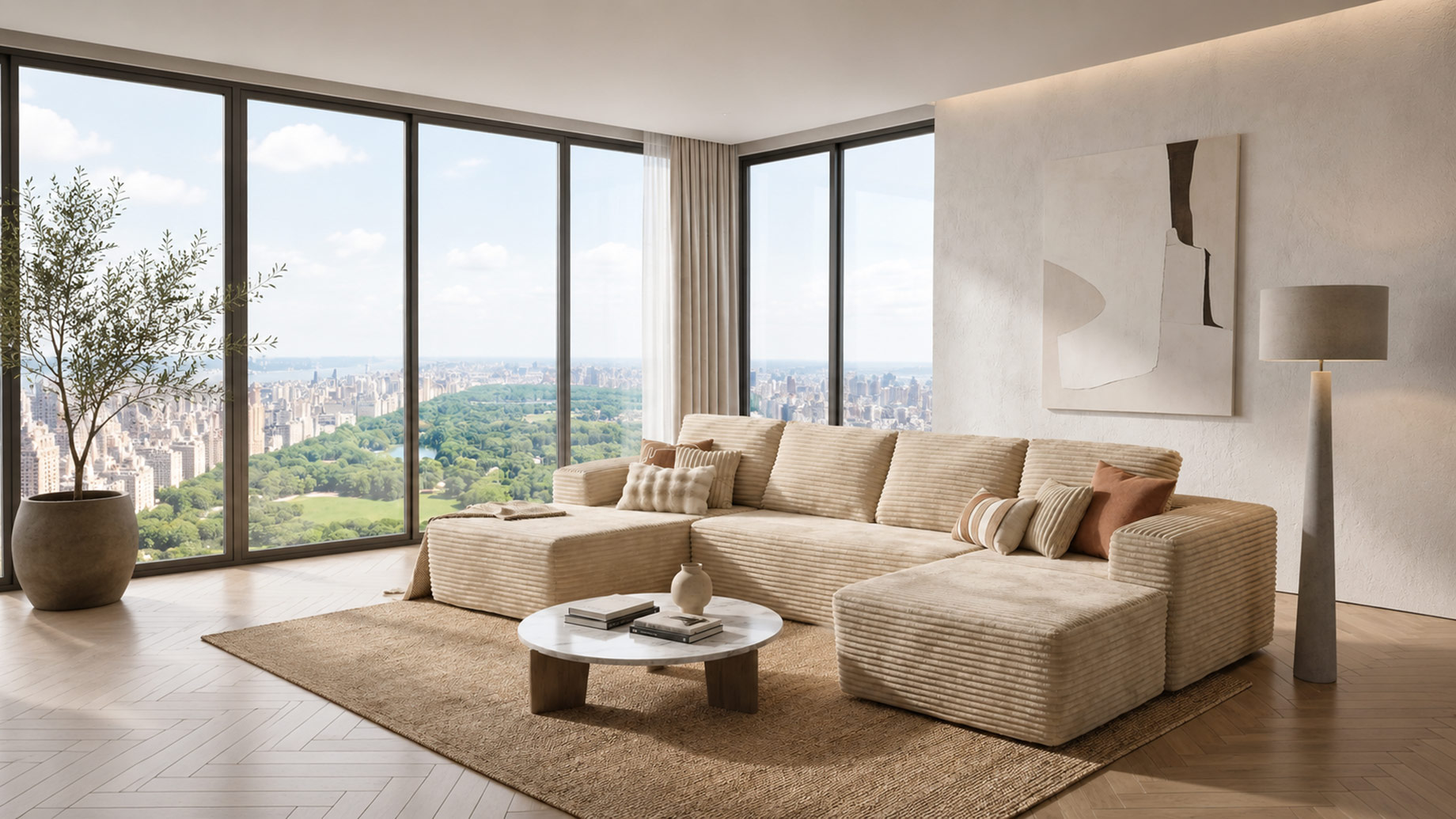
For decades, the construction of a sofa followed one unquestioned rule: there must be a frame. Wood or steel, hidden beneath the upholstery, was what gave a sofa its shape, its posture, and its permanence. The idea that a couch could exist without one seemed like a contradiction.
Yet in the past few years, a new category of furniture has been quietly rewriting that rule. The boneless couch, built entirely from high-density foam with no internal frame at all, has moved from a curiosity into a genuine design movement. And it is finding an unexpected home in some of the most considered interiors being built across the country today.
What a Boneless Couch Actually Is
The name is literal. A boneless couch contains no skeleton. Where a traditional sofa relies on a rigid internal structure with springs, webbing, and padding layered on top, a boneless piece is sculpted entirely from dense, high-resilience foam. The foam is the structure.
The result is a fundamentally different object. Without a frame, there are no hard edges beneath the surface, no pressure points where padding thins over a rail, and no fixed posture the sofa forces on the sitter. The entire piece gives slightly and evenly, contouring to the body rather than resisting it.
The engineering behind this is more considered than it might first appear. The foam used in well-made boneless pieces is not the soft, collapsing material found in a bean bag. It is high-density, high-resilience foam of the kind used in performance seating, engineered to compress under weight and recover its shape completely, thousands of times over. Some pieces layer different foam densities, firmer material at the base for structure, softer material at the surface for comfort, achieving through material science what traditional sofas achieve through springs and padding.
This construction is also what allows these pieces to ship vacuum-compressed, arriving in a fraction of their full size and expanding over a day or two once unboxed. What began as a logistics innovation has become part of the category’s identity.
Why the Timing Makes Sense
The rise of the boneless couch tracks closely with a broader shift in how American interiors are conceived. The prevailing direction in residential design has moved away from formality and toward what might be called engineered ease: rooms that look composed but live comfortably.
Deep seats, low profiles, rounded silhouettes, and heavily textured fabrics have defined the most influential living rooms of recent years. The cloud sofa aesthetic, with its sink-in cushions and relaxed geometry, became one of the most requested looks in American residential design. Boneless construction takes that aesthetic to its logical conclusion. If the goal is softness, why keep the skeleton?
There is a generational dimension to this shift as well. The homeowners furnishing their first serious homes today grew up with a different relationship to formality than the generations before them. The formal living room, preserved for guests who rarely came, has given way to the great room as the most-used space in the house, a place for working, hosting, streaming, and stretching out, often all in the same day. Furniture that photographs beautifully but punishes long sitting no longer fits the brief. The demand is for pieces that hold their looks while genuinely inviting use.
There is also a spatial argument, and it is a particularly American one. The open-concept great room, now standard in new construction from Texas to the Carolinas, tends to swallow conventional furniture. Rooms that run twenty feet or more in a single sightline make a standard eighty-four-inch sofa look stranded. A boneless sectional, particularly in an oversized U-shape or a long, low modular arrangement measuring well past a hundred inches, can anchor that kind of space with real visual weight while remaining physically light and adaptable. The furniture holds the room without hardening it.
The Materials Conversation
Much of what makes this category interesting to design-minded homeowners happens at the surface. Because the form underneath is soft and rounded, fabric choice carries more of the aesthetic load than it does on a conventionally tailored sofa.
Boucle has become the signature texture of the category, its looped, nubby surface complementing the organic shapes that frame-free construction produces. Channel-tufted corduroy and chenille appear throughout the category as well, each bringing a different balance of warmth, light play, and durability. On curved silhouettes in particular, where the front of the sofa sweeps in an arc rather than meeting at corners, these textured fabrics emphasize the sculptural quality of the form.
Color has followed a similar trajectory. The category leans heavily into the palette of contemporary calm: warm greys, oatmeal, cream, sage, and deep charcoal, tones that let texture do the visual work rather than pattern. It is a palette that suits the way these pieces are used in real rooms, as grounding elements rather than statements, letting art, architecture, and light carry the drama.
The better makers in the category treat fabric as seriously as any upholstery house would, with removable, washable covers as a common feature, a practical acknowledgment that a sofa designed to be lived in will actually be lived on. For American households, where roughly two-thirds keep pets and family rooms double as playrooms, this is not a minor point. A cover that can be unzipped and run through a washing machine changes the calculus of choosing a light-colored sofa entirely.
Configuration as a Design Tool
Perhaps the most compelling argument for the category in larger homes is modularity. Many modular boneless couche designs are built in independent sections that can be arranged as an L-shape, opened into a U-shape, split into separate seating zones, or reconfigured entirely as a room’s purpose changes.
For homeowners who entertain, this flexibility has obvious appeal: a formal arrangement one evening, an open lounge configuration the next. For those furnishing lake houses, mountain properties, or coastal second homes, it means one purchase can serve several layouts over the life of the home rather than being locked to a single floor plan.
The modularity also solves a quieter problem that anyone who has lived with a large sectional will recognize: rooms change. A media room becomes a nursery. A formal sitting area becomes a home office. Children arrive, and eventually leave for college. Traditional sectionals, purchased to fit one floor plan precisely, tend to fit only that floor plan. Modular boneless pieces move with the life of the house instead of anchoring it to a single moment.
This adaptability extends to the practical realities of American housing itself. Brownstones in Brooklyn, walk-ups in Boston’s Back Bay, Chicago three-flats, and San Francisco Victorians have complicated furniture delivery for as long as large sofas have existed. Anyone who has watched a delivery crew measure a stairwell, shake their heads, and start discussing window hoisting knows the problem intimately. A sectional that arrives compressed in boxes and expands in place sidesteps it entirely, no freight crews, no hoisting, no doorway measurements determining what a room can hold. For the roughly thirty-five percent of American households that rent, and move far more often than they buy, that portability carries real weight.
What to Look For
As with any young category, quality varies, and a few markers separate well-made boneless pieces from the rest. Foam density is the first: high-resilience foam holds its shape for years, while cheaper open-cell foam flattens within months. Weight ratings are a useful proxy, well-engineered pieces publish load capacities that match or exceed framed furniture, with some rated well beyond a thousand pounds. Cover construction matters too: removable covers with quality zippers signal a maker planning for years of use rather than a season of it.
Fabric weight is worth attention as well. The textured fabrics that define the category, boucle especially, range widely in durability. Tighter loops and heavier weaves resist pilling and snagging in ways that lighter versions of the same look do not.
A Category Reaching Maturity
Skeptics reasonably ask whether furniture without a frame can last. The honest answer is that quality varies across the category, as it does in all furniture, but the physics are sound. High-resilience foam engineered for structural use holds its shape through years of regular sitting, and the absence of a frame means there is nothing to creak, warp, or break at a joint. The best pieces in the category are rated for weight loads that exceed most framed sofas.
What began as a novelty has settled into something more durable: a legitimate construction philosophy with its own aesthetic language, its own material palette, and a genuine argument for why it belongs in rooms where every other object has been chosen with intent.
