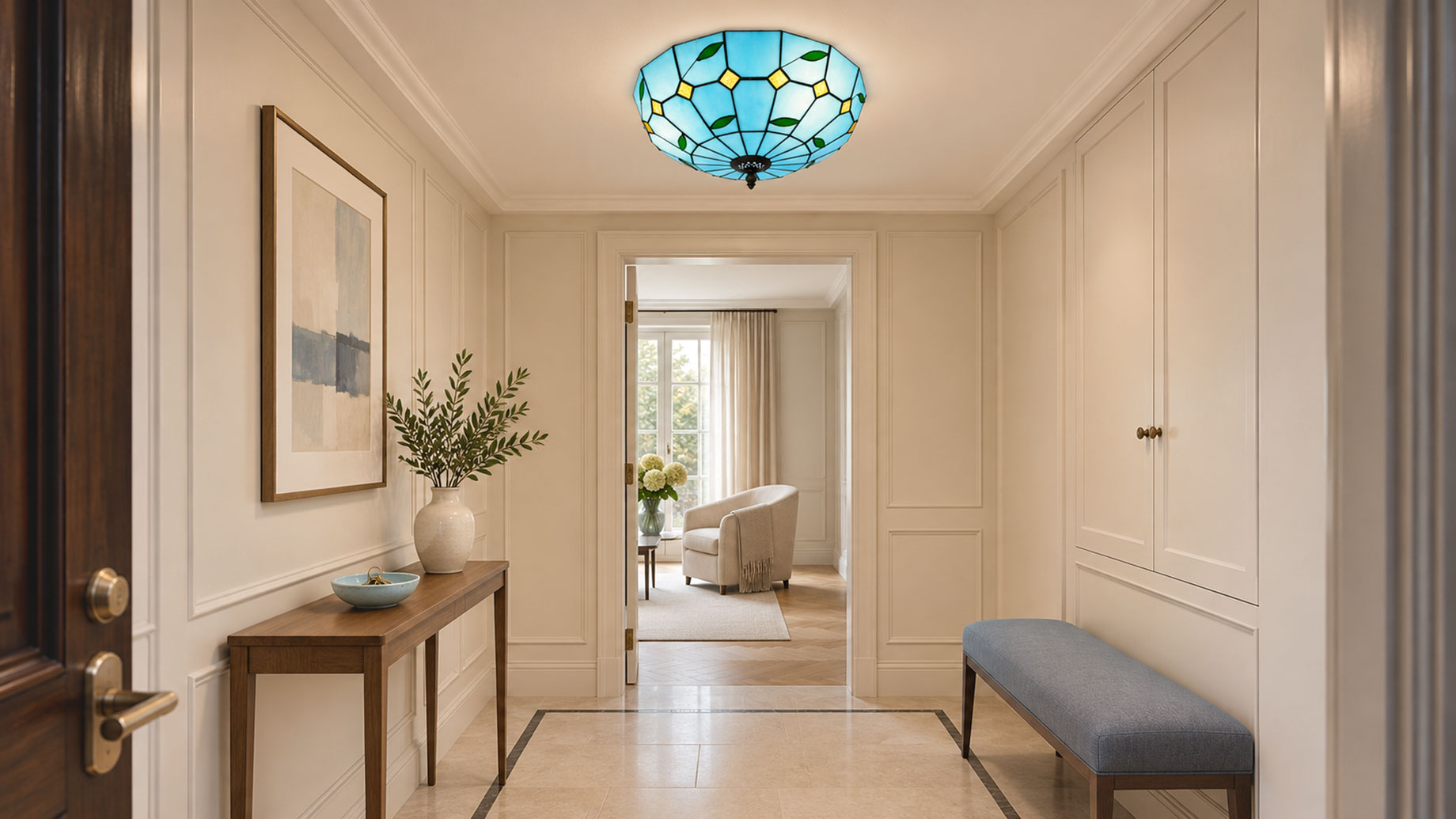
An entrance is experienced in motion. The front door opens, a bag is set down, and the eye travels toward the rooms beyond. In those few moments, the ceiling light becomes part of the first impression. Its position, proportions and colour can give a modest vestibule a distinct identity without filling the floor with furniture.
For an apartment or a home with limited ceiling height, stained glass offers an interesting way to introduce detail overhead. A shallow fixture can bring colour into an otherwise restrained interior while leaving the view through the house open. The design challenge is to make that decorative presence feel connected to the architecture and useful in everyday life.
Start with the Entrance as a Whole
Before choosing a fixture, stand just outside the open front door and consider what is visible. There may be a console against one wall, a coat cupboard opposite and a doorway leading directly into the living room. Each element affects where the eye settles.
In a compact entrance, one decorative ceiling light can provide enough visual interest. A patterned floor, elaborate mirror, heavily veined console and colourful shade may compete for attention when seen together. Keeping some surfaces simple gives the glass room to be noticed.
The same principle applies to the ceiling itself. Narrow cornices and a plain painted surface can frame a detailed light effectively. If the ceiling already contains ornate plasterwork, the fixture needs to work with its scale and geometry. Measure the available space inside any moulded border rather than treating the entire ceiling as an empty canvas.
Choose the Profile Before the Pattern
When comparing Tiffany flush mount lighting fixtures, begin with the side view and dimensions. A shade photographed from directly below may conceal a substantial drop. The important measurement is the complete installed projection, including the mounting assembly and any finial beneath the glass.
A flush mount sits close to the ceiling, whereas a semi-flush design has a more noticeable gap between the ceiling and the shade. Retail categories sometimes contain both arrangements, so the individual product drawing matters more than the collection name.
Check the proposed position against the movement of the entrance door and nearby cupboard doors. A fixture should also leave comfortable clearance for people carrying luggage or moving furniture. Where headroom is restricted, ask the installer to assess the location before committing to the fitting.
Width deserves equal attention. A shallow but broad shade can still dominate a small vestibule. Mark its diameter on a floor plan, then compare that footprint with the width of the room, the console and the doorway beyond. This helps establish whether the light will read as a considered accent or an oversized object.
Let the Glass Introduce a Controlled Accent
Blue glass can create a crisp focal point against warm ivory walls, pale stone and walnut. Amber can sit comfortably beside tobacco leather and muted earth tones. Green can connect with a view of planting through an adjoining room. These are starting points for a palette, rather than instructions to match every object.
Imagine a blue and green shade above a limestone entrance floor. A small blue ceramic dish on the console might be enough to relate the ceiling to the furnishings. The upholstered bench could remain a quiet grey, while artwork introduces a looser version of the same colours.
Look at the shade both illuminated and unlit. Glass that appears restrained in daylight may become much more prominent when lit from within. Product photographs can help explain that difference, but their exposure and surroundings will not reproduce the conditions in your own home.
Keep paint and fabric samples together while reviewing the light. The aim is to understand how the colours sit alongside one another, without expecting a photograph to provide an exact colour match.
Place the Light for the Architecture You Actually Have
A single Tiffany flush mount ceiling light can give a small vestibule a clear centre. That centre should relate to the usable space, however, rather than automatically following the midpoint of an old ceiling outlet.
Built-in storage may make one side of the room shallower. An open stair may draw the circulation to the other side. In a rectangular entrance, the main walking route and the sightline into the next room may be more useful references than the position of a movable console.
Consider these relationships before decorating or closing a renovated ceiling. Moving a light point is easier to coordinate while the electrical work and surface repairs are already being planned. A qualified installer can confirm the mounting requirements, ceiling support and suitability of the selected fixture for the property.
A long hallway needs a different approach from a small entrance room. One attractive light near the front door may leave the rest of the route inadequately lit. Treat the full route as a lighting problem, even if only its first section receives a decorative fitting.
Give Decorative Light a Supporting Cast
The entrance must still work when someone is searching for keys, fastening a coat or checking a delivery label. A coloured shade should therefore be assessed for the light it provides, as well as the pattern it displays.
A discreet console lamp or carefully positioned wall light can support these activities. If there is a mirror, check whether the arrangement lights the person standing in front of it comfortably. A ceiling fixture alone may leave unwanted shadows on the face.
Where dimming is desired, confirm compatibility between the fixture, lamps and control. A decorative shade does not itself make a fitting dimmable. Test the arrangement at the levels you expect to use, including the quieter setting intended for evening arrivals.
There is no need to repeat stained glass in every light source. Plain supporting fixtures allow the ceiling piece to remain distinctive while giving the entrance more flexible illumination.
Connect Adjoining Spaces Without Repeating Everything
When considering Tiffany flush mount ceiling lights for more than one area, decide where repetition will strengthen the design. Matching fittings can suit a sequence of similar enclosed spaces. In rooms with different proportions, sharing a colour or metal finish may create a more natural relationship.
An entrance shade might echo the blue in a sitting-room painting without requiring another blue glass fixture beyond the doorway. This creates continuity while allowing each room to retain its own purpose and atmosphere.
Finally, consider how the fitting will be maintained. Confirm how the shade is supported during lamp replacement and follow the manufacturer’s cleaning instructions. Leave space below for safe access; a heavy console positioned directly beneath the light can make an ordinary maintenance task unnecessarily awkward.
A successful entrance makes arrival easy. There is somewhere to place a bag, a clear path into the home and enough light to use the space comfortably. Above those practical details, a carefully proportioned stained-glass shade can add a memorable touch of colour—visible from the first step through the door.
