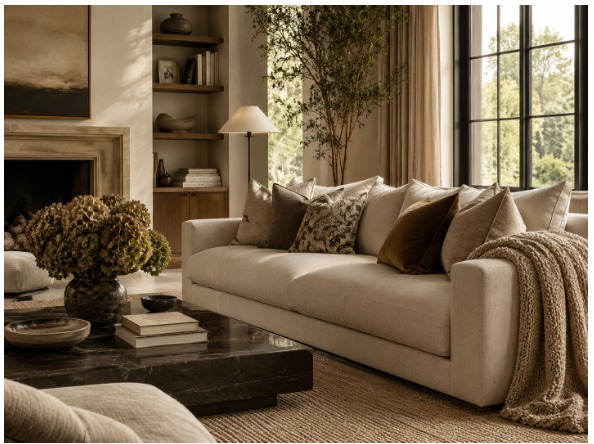
Learning how to layer textures in a room is less about collecting more materials than assigning each one a clear role. A space usually feels flat when its largest surfaces, soft furnishings, and decorative details carry the same visual weight—or compete without a hierarchy.
The foundation, fill, and finish framework below is designed for homeowners refining an existing room rather than replacing its furniture. It uses visual weight to show where contrast belongs, where repetition creates cohesion, and which layer should be edited before anything new is added.
Visual Weight Is the Variable Most Decorators Skip
Color gets most of the attention in interior design conversations, and for good reason — it’s the most immediate signal a room sends. But color without texture is a costume. Two rooms can share the same palette and read completely differently depending on how their surfaces interact with light.
Visual weight describes how strongly a surface attracts attention. A smooth painted wall registers differently from a linen or grasscloth wall covering in the same shade of sage. A polished concrete floor carries a different presence from the same area covered by a low-pile wool rug. The aim is not to rank one material above another, but to decide where each level of texture should sit within the room.
A balanced room distributes visual weight across both vertical planes—walls, drapery, and upholstery—and horizontal surfaces such as floors, tables, and beds. When one plane carries all the texture while the others remain visually uniform, the composition can feel unfinished even when every individual item is well chosen.
How to Layer Textures in a Room: Foundation, Fill, and Finish
The most efficient framework for texture layering works in three distinct stages. Each stage has a different function, and understanding where each material belongs prevents the two most common mistakes: over-layering at the detail level before the foundation is established, and treating everything as equally weighted decoration.
Foundation Layer
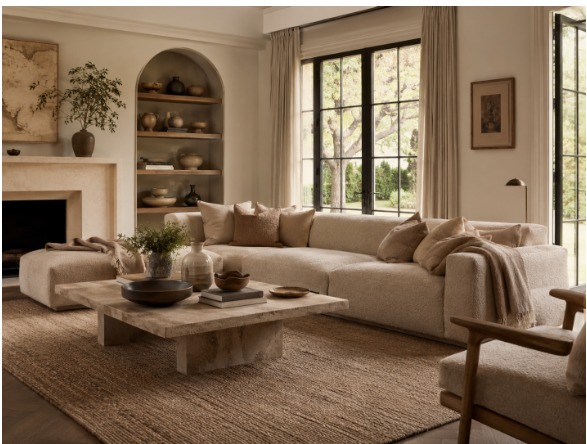
Start with the room’s largest textile surfaces: upholstery, window treatments, and rugs. Because they occupy the largest area, these materials should establish the dominant level of texture rather than compete with one another. A tightly woven sofa fabric can sit against a low-pile rug in the same tonal family, while differences in weave and sheen keep the combination from reading as flat.
If you are sourcing upholstery independently, compare swatches in the room before buying full yardage. When you buy fabric by the yard, view each option in daylight and evening light, then compare its weave, sheen, and scale alongside the rug and window treatments.
Fill Layer
Cushions, throws, secondary seating, and bedding introduce contrast at a smaller scale. If the foundation is smooth or matte, add one or two materials with visible tactile variation, such as bouclé, velvet, or knit. When a bold pattern is present, keep neighboring textures quieter so the eye can distinguish the pattern from the surface detail rather than processing both as equal focal points.
Finish Layer
Ceramic vessels, lacquered trays, woven baskets, books, and artwork complete the hierarchy, but they should not be asked to supply all of the room’s texture. A handmade pot on a plain painted shelf reads as an isolated accent; the same object beside a woven runner or stone bookend participates in a material sequence already established by the larger furnishings.
The Most Common Texture Mistakes — and Why They’re Hard to Diagnose
Because texture layering operates below the level of conscious analysis for most people, mistakes are felt rather than identified. Here are the patterns that appear most consistently in rooms that feel almost right.
Monotexture Rooms
When floors, cabinetry, upholstery, and walls all repeat smooth or reflective finishes, a space can feel sterile even when the individual materials are high quality. Introduce one substantial soft surface—such as drapery, an area rug, or upholstered seating—to bridge the hard finishes before adding small decorative accents.
Competing Texture Scale
Contrast in scale is useful, so a chunky knit can work well against finely woven linen. The problem begins when several high-relief textures compete at the same level or when every surface repeats the same fine grain. Give one material the dominant texture and let adjacent materials support it.
Layering without tonal anchoring
Texture becomes harder to read when every material also introduces a new color. For a controlled scheme, keep most soft furnishings within two or three related tonal values, then use a smaller accent to break the range deliberately.
How to Layer Textures in a Room When Starting from What You Already Have
Most rooms don’t need to be rebuilt — they need to be edited and supplemented at the right layer. The diagnosis is straightforward:
- Identify which layer is underdeveloped or overrepresented: foundation, fill, or finish.
- Choose one dominant texture in each viewing area, then reduce any neighboring material that competes at the same intensity.
- Check the palette in daylight and evening light. Consolidate unrelated colors before introducing another weave or finish.
For the foundation layer, upholstery in a structured woven twill can provide a restrained diagonal surface that contrasts with bouclé, velvet, or knit without becoming the room’s dominant pattern. Use it when the space needs a visible structure at the largest textile scale.
This is the core logic that separates rooms that feel designed from rooms that feel decorated. Every element is doing a specific job within a hierarchy, and the hierarchy was established before the shopping started.
Texture layering is not a trend, and it doesn’t require a design budget that scales with ambition. What it requires is a framework applied in the right sequence — foundation first, then fill, then finish — and the discipline to evaluate each layer before adding the next. That process turns a room from assembled to resolved.