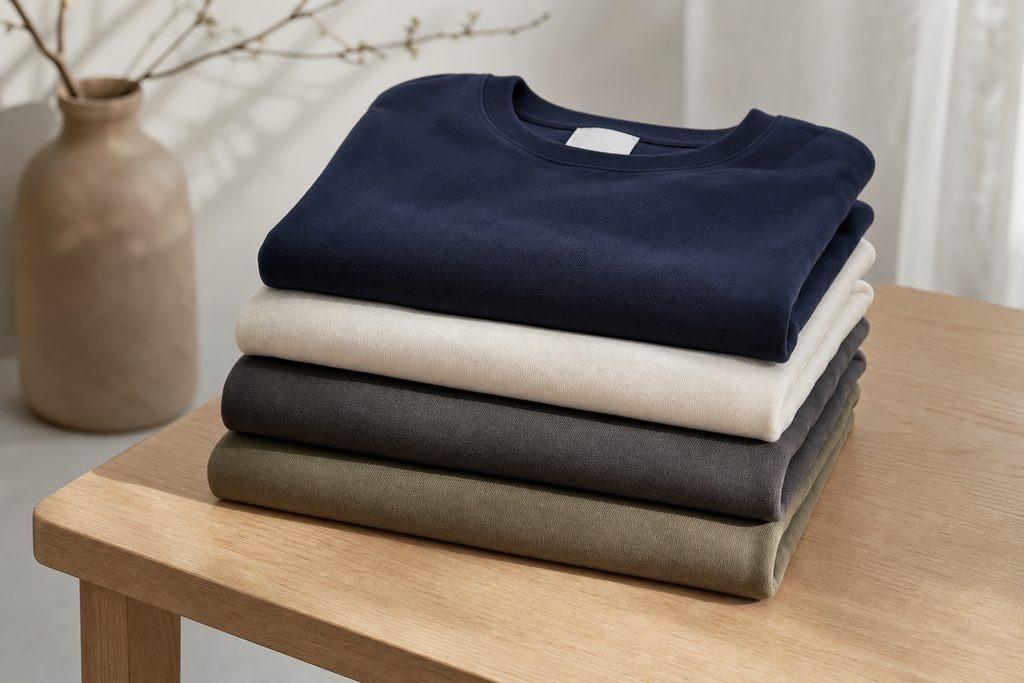
Choosing staff uniforms for an estate, a boutique hotel or a managed property looks like a procurement decision and behaves like a brand decision. The garments are worn by the only people most guests will speak to, they are laundered several times a week, and they carry two claims that almost every supplier now makes: organic cotton and tested-safe fabric. Both claims are real and both are regulated, but neither means what most buyers assume. Knowing where the thresholds actually sit is what separates a wardrobe that holds up over three seasons from one that is replaced after one.
Key takeaways
- The GOTS “Organic” label requires a minimum of 95% certified organic fibres. The “Made with Organic” grade sits between 70% and 95%.
- Both grades are legitimate. A supplier quoting “GOTS certified” without naming the grade has told you very little.
- OEKO-TEX STANDARD 100 tests every thread, button and accessory against a list of over 1,000 harmful substances.
- Its limit values are reviewed at least once a year, so a certificate’s date matters as much as its existence.
- Rental and outright purchase suit different staffing patterns. Turnover rate, not headcount, is the deciding variable.
Buy or rent: the decision that comes before the fabric
Most properties choose a supplier before deciding on the ownership model, which is the wrong order. The two models fail in different places, and the failure mode should be matched to how the property actually staffs itself.
| Consideration | Outright purchase | Rental |
| Best suited to | Stable core teams, long tenure | Seasonal properties, high turnover, event staffing |
| Sizing risk | Carried by the property, unused sizes become dead stock | Carried by the supplier, sizes exchanged as staff change |
| Laundering | Handled in-house, and it dictates fabric choice | Usually included, industrial process assumed from the start |
| Replacing a damaged item | New order, with a colour-match risk against older stock | Swapped from the managed pool |
| Cost profile | Capital outlay, then near zero | Recurring, predictable, scales with headcount |
Turnover is the variable that decides it. A property with a stable year-round team amortises a purchase easily. A seasonal estate that doubles its staff for four months will accumulate unused sizes within two cycles, and the dead stock quietly cancels the savings. Suppliers that offer both models on the same catalogue, such as workshops producing sweatshirts embroidered with a company logo for purchase or for rental, let a property split the decision by role: bought for the permanent front-of-house team, rented for seasonal and event staff.
One practical point is routinely missed. If laundering stays in-house, the washing temperature and cycle should be fixed before the fabric is chosen, not after. A garment specified for domestic laundering behaves very differently under an industrial cycle, and a wardrobe ordered before that decision was made is a wardrobe specified against unknown conditions.
“Organic cotton” is not one claim but several
The Global Organic Textile Standard defines distinct label grades, and the gap between them is substantial. Products carrying the “Organic” grade contain a minimum of 95% certified organic fibres. Products carrying “Made with Organic” contain between 70% and 95%. Two parallel grades exist for fibres from farms in the process of converting to organic certification: “Organic in-conversion” at a minimum of 95%, and “Made with organic in-conversion” at a minimum of 70%.
| GOTS label grade | Minimum organic fibre content |
| Organic | 95% |
| Organic in-conversion | 95% (in-conversion fibres) |
| Made with Organic | 70% to 95% |
| Made with organic in-conversion | 70% (in-conversion fibres) |
Neither grade is a lesser product by definition, and the lower one is frequently a deliberate construction choice rather than a compromise, since the remaining share is what allows a blend to be built for a given use. The problem is not the grade, it is the silence around it. A quotation that says “GOTS certified” without naming the grade has not answered the question, and the certification body’s scope certificate names it explicitly.
GOTS also applies beyond the fibre itself. Certification covers every stage from fibre processing and spinning through wet processing, manufacturing and trading, and every company in that chain has to be certified independently. That is why a supplier can legitimately use certified fabric and still not be entitled to sell the finished garment as GOTS-certified.
What a harmful-substances certification actually covers
OEKO-TEX STANDARD 100 answers a different question from GOTS. It is not about how the fibre was farmed but about what remains in the finished article. Every item carrying the label has been tested against a list of over 1,000 harmful substances, and the testing covers every thread, button and accessory rather than the main fabric alone. For workwear, where trims and fastenings are where cheap sourcing usually hides, that distinction is the useful part.
Two details are worth carrying into a supplier conversation. Requirements are tiered by skin contact, so the more intensively a garment touches the skin, the stricter the limits it must meet. And the limit values themselves are reviewed at least once a year, which means a certificate is a snapshot rather than a permanent status. Asking for the current certificate, not a screenshot of a logo, is a reasonable and easily met request.
Frequently asked questions
Does “GOTS certified” on its own guarantee 95% organic content?
No. It guarantees at least 70%, because the “Made with Organic” grade also qualifies as GOTS certified. Only the “Organic” grade requires a minimum of 95%. The grade is stated on the certificate, so it can be verified before ordering rather than assumed.
Is OEKO-TEX an alternative to GOTS?
They are complementary rather than interchangeable. GOTS governs organic fibre content and the conditions across the processing chain. OEKO-TEX STANDARD 100 tests the finished article for harmful substances, regardless of whether the fibre is organic. A garment can hold one, both or neither.
Should embroidery or printing be chosen for a logo on staff uniforms?
The laundering regime usually decides. Embroidery is stitched into the fabric rather than applied on top of it, so it is far less exposed to the surface abrasion of repeated industrial washing. Printing generally reproduces fine detail and colour gradients that stitching cannot, so complex logos sometimes force the choice.
How many sizes should be held for a seasonal team?
This is precisely the question that favours rental. Buying requires forecasting a size distribution for staff who have not been recruited yet, and the forecast error becomes dead stock. Renting transfers that forecasting risk to the supplier, which is the substance of what the recurring fee buys.
Sources
- Global Organic Textile Standard, label grades and minimum organic fibre content (global-standards.org).
- OEKO-TEX STANDARD 100, scope of testing and review of limit values (oeko-tex.com).