Anyone who has sold a house knows the awkward truth about empty rooms. A vacant living room photographs like a storage unit. Buyers cannot picture themselves in a space that has no scale, no warmth, and nothing to compare its size against. For decades the fix was physical staging, renting furniture, hiring a stylist, and spending days arranging a home before a single photo got taken.
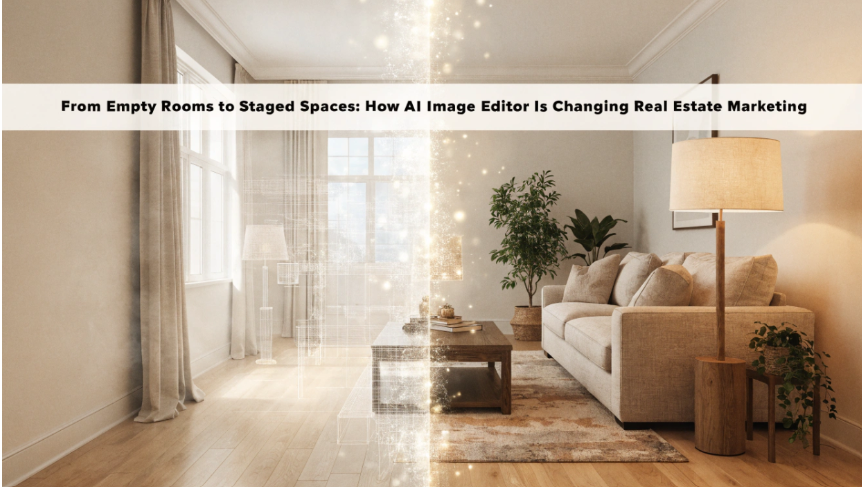
AI image editing tools are now offering agents and homeowners a much faster and cheaper path to the same result, turning bare rooms into styled, inviting spaces without moving a single piece of furniture into the building.
Why Empty Rooms Struggle to Sell Homes
Real estate photography has one job, which is to make a buyer stop scrolling and imagine living somewhere. Empty rooms make that job harder in ways that are easy to underestimate. Without furniture, a room loses its sense of proportion, so a spacious bedroom can look small and a small living room can look strangely cavernous. Buyers also struggle to see the intended use of a space. A flexible room meant as either a home office or a nursery just reads as an empty box with no clear identity. This is exactly why staged listings tend to sell faster and often at better prices than unstaged ones, and it is exactly the gap that virtual staging tools have stepped into.
What an AI Image Editor Actually Does With a Room Photo
Tools built around image to image AI, like the free AI Image Editor at image-to-image.ai, work by taking an uploaded photo and applying changes described in plain text, while keeping the structure of the original room intact. For real estate specifically, this tends to cover a handful of very practical edits.
Furniture and decor can be added into an empty room, giving buyers a sense of scale and function without a single physical item being delivered or arranged. Backgrounds and lighting can be adjusted so a room shot on a gray afternoon looks bright and warm instead. Distracting objects such as cords, clutter, or an unfortunate piece of furniture left behind by the previous owner can be removed from a photo entirely. And a single room can be restyled in more than one way, letting an agent show a bedroom as both a nursery and a home office from the exact same base photo, side by side, so buyers can imagine either possibility.
A Practical Workflow for Agents and Homeowners
Getting started with this kind of tool follows a fairly simple sequence, whether you are an agent trying to move a listing faster or a homeowner preparing your own house for sale.
The first step is capturing a clean, well lit photo of the empty room, since a clear, evenly lit starting image gives any AI editor much more to work with than a dim or awkwardly angled shot. Once that photo exists, the next step is deciding what the room needs to become. An empty bedroom might need a bed, a nightstand, and soft lighting described in a simple text prompt, while a bare living room might just need a sofa, a rug, and some warmth added to the color tone.
From there, the actual editing takes seconds rather than days. A prompt describing the desired furniture or mood is entered, and the tool generates a staged version of the room while preserving its actual layout, windows, and architectural features. Most of these tools also allow further refinement, so if the first result feels too sparse or too busy, another prompt can adjust it without starting over from scratch.

The final step is reviewing the result carefully before it goes anywhere near a listing. AI generated staging occasionally introduces small oddities, like a rug that does not quite sit flat or a piece of furniture that looks slightly out of proportion, and these are worth catching before the photo becomes part of a public listing.
Why This Matters So Much for Smaller Agents and Sellers
Traditional staging is expensive, often running into thousands of dollars for a single property, and it requires physical furniture to actually be delivered, arranged, and later removed. That cost puts real staging out of reach for a lot of sellers, especially in smaller markets where listing budgets are tighter and margins matter more. Virtual staging through a free AI Image Editor removes almost all of that overhead. There is no truck to schedule, no furniture rental fees, and no waiting for a stylist’s availability. An agent can stage an entire empty house in an afternoon, testing different furniture styles for different buyer profiles, at a fraction of the traditional cost.
There is also a speed advantage that matters more than it might first seem. Listings lose momentum the longer they sit without strong photos, and virtual staging lets a property go live with compelling images almost immediately after the space is emptied out, rather than waiting for a staging crew to be available.
Where Caution Still Matters
Virtual staging is powerful, but it comes with responsibilities that are worth taking seriously. Most real estate boards and listing platforms require that virtually staged photos be clearly labeled as such, since presenting an AI generated room as an accurate depiction of the property’s actual furnishings can mislead buyers and create real legal exposure for an agent. Being upfront about which photos are virtually staged protects everyone involved and keeps expectations honest once a buyer actually walks through the door.
It is also worth remembering that virtual staging works on photos, not on the physical experience of walking through a home. A buyer who tours the property in person will still encounter the empty room as it actually is, so the staged photos work best as a way to get attention and interest online, not as a substitute for what a buyer will feel standing in the space itself.
Quality control matters here as well. Because these tools generate results quickly, it is tempting to accept the first output without a close look. A quick review for odd proportions, strange shadows, or furniture that clips through a wall or window saves a lot of embarrassment later.
The Bigger Shift in Real Estate Marketing
What virtual staging through AI image editing really represents is a shift in who gets access to strong marketing. Staging used to be a tool mostly available to higher end listings, where the cost made sense relative to the sale price. Now a modest starter home in a smaller market can get the same visual treatment as a luxury listing, at a cost that barely registers against the price of the sale. That levels the playing field in a meaningful way, giving every listing a fair shot at looking its best online, regardless of budget.
Bringing Empty Rooms to Life Without the Overhead
AI image editors are not replacing real staging entirely, since some buyers and some listings will always benefit from physically staged walkthroughs. What these tools are doing is closing the gap for everyone else, turning empty, hard to sell rooms into inviting, easy to imagine spaces without the cost and logistics that used to make staging out of reach. For agents and homeowners working with a tighter budget or a tighter timeline, that difference can be the thing that gets a listing noticed instead of scrolled past.