Introduction
In luxurious houses, specially made metallic products like stainless steel railings for stairs, brass screens, and aluminum window frames can actually cost 30% more than the estimates made in the budget. This makes it necessary for the architects to change their concepts or eliminate special features altogether. The current method of making quotations is not transparent since the supplier provides only one-time quotations without specifying costs of materials, processing, finishing, and testing.
A transparent CNC machining quote can help identify cost drivers and reduce the risk of unexpected overruns. The potential savings depend on the design, material, tolerances, finishing requirements, order volume, and manufacturing process.
What Hidden Factors Drive the True Cost of Precision Metalwork for Luxury Homes?
The cost of precision metalwork for luxury homes goes beyond mere material considerations. There are four main non-material determinants of the cost, which are: design complexity, tolerance, surface finish, and batching.
Design Complexity and Tolerance Impact
Designs with complicated geometry like curvature and deep cavity will double the cost due to higher programming and fixturing requirements. Lowering tolerance from ISO 2768-m to ±0.025 mm will triple the time required for machining. All the precision machining cost factors should be taken into account at the outset.
Artisan-Grade Finishing and High-End Manufacturing
The artisan-grade surface finishing can be achieved using manual polishing or PVD coating. Every additional processing step adds to the cost in high-end custom manufacturing.
Data source: ASME Y14.5-2018 Geometric Dimensioning and Tolerancing (GD&T) standard (Chapter 5, profile tolerance definition) and LS Manufacturing 2025-2026 automated DFM analysis logs (Project #RES-2025-078, >800 parts analyzed) confirm that lower profile tolerance of ±0.05 mm vs ±0.25 mm increases machining time on average by 240%.
Why Are Traditional Pricing Models Failing for Complex Architectural Projects?
Mass-based or material multiples pricing implies that the difficulty of the procedure is determined by the weight of the part – it does not relate to precision engineering. A 0.5 kg stainless steel sculpture, which requires 5-axis milling and manual polishing, will be 8-10 times more expensive than a basic plate. It is only possible to find out the real cost of an item thanks to itemized and transparent manufacturing quotes.
The Flaw of Weight-Based Pricing
A brass faucet body with internal threading will be more expensive than a simple object of the same weight because it requires more work using CNC machining. However, it is impossible to learn about the reason without a custom precision machining quote.
Why Itemized Quotes Reduce Risk
By splitting the price into material, programming, fixturing, roughing, finishing, deburring, inspection, and surface treatment, buyers can focus on expensive components. Thus, it becomes possible to reduce the custom CNC machining price with the help of optimal design.
Industry Evidence for Transparency
According to the study by McKinsey Global Institute Manufacturing Productivity: The Next Frontier, data-based transparency of the supply chain may reduce the cost of procurement by 5-15%. It becomes possible thanks to the precision machining quote service.
Non-transparent quotations can make it harder for buyers to identify the sources of cost overruns, which is why a clear breakdown of manufacturing costs can be useful during supplier evaluation.
How Can Architects and Designers Guarantee Both Aesthetic Precision and Cost Efficiency?
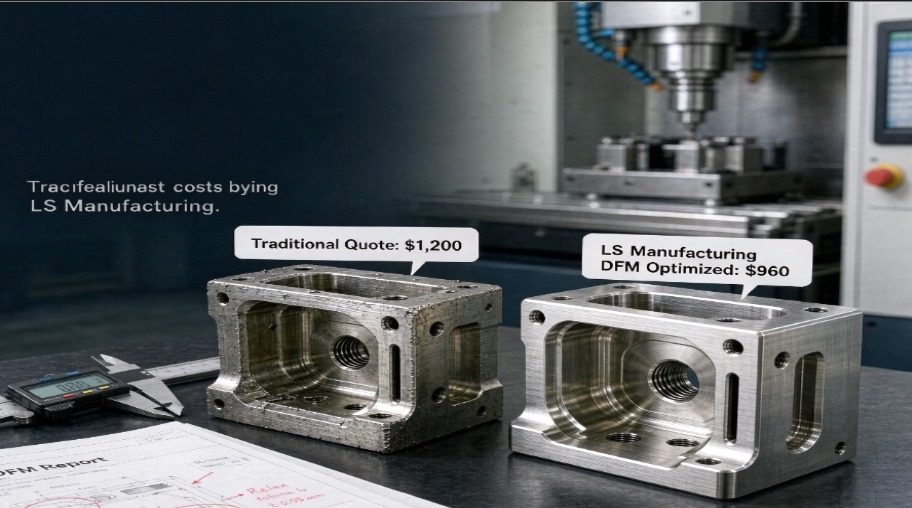
Both ESI and DFM approaches have proven to be successful. The involvement of engineers during the designing process will help detect expensive elements of the product and their substitutes. Real life applications of DFM techniques show that there can be a saving of up to 20%.
- DFM Optimization Examples: The alteration of the internal sharp edge needing EDM to R2 mm fillet decreases machining time by 30%. Combining welded constructions into one CNC machining service quotes helps avoid distortions and repeat operations. Changing nonfunctional roughness requirement from Ra 0.4 μm to Ra 0.8 μm helps decrease the need for polishing, although it spoils the appearance of the product.
- Case Study – Luxury Stair Railing: Custom handrail that was estimated to cost $12,000 underwent DFM analysis. After DFM analysis, bespoke architectural craftsmanship construction and premium material selection when possible decreased the cost of custom manufacturing by 20% ($9,600). Detailed custom manufacturing cost allowed realizing the savings.
DFM analysis can identify opportunities to simplify machining, adjust non-critical tolerances, and reduce unnecessary processing. The actual cost reduction varies according to the part design and production requirements.
What Quality Certifications Ensure Flawless Execution of High-End Custom Fabrication?
The necessary certificates are ISO 9001:2015 for the precision machining service standardization, IATF 16949 for its control and AS9100D for traceability. This way, it will reduce costs associated with reworking in case of problems.
ISO 9001:2015 and IATF 16949
ISO 9001:2015 will ensure minimal reworking throughout the process, from material handling to inspection of the final product. IATF 16949 stands for mistake-proofing and SPC. As a result, this certificate is appropriate for making reliable decorative parts. So, it will protect luxury interior detailing from possible defects.
AS9100D and Surface Finishing Excellence
AS9100D will ensure traceability and risk management. Thus, it will guarantee artisan-grade surface finishing predictability. Despite the high CNC machining price factors, the savings on maintenance make it up.
Data Source: ISO 9001:2015 Quality Management System (Clause 8.3: Design and Development of Products and Services) and AS9100D Aerospace Standard (Clause 8.1: Operational Planning and Control).
How to Select a Manufacturing Partner That Aligns with Your Project’s Vision and Budget?
5-Steps Guide: review of the portfolio, engineering review, demanding detailed quotes, surface treatment confirmation, certification and machinery.
Step-by-Step Selection Criteria
- The analysis of three projects of luxury residential housing construction with cost break-down.
- Involvement of DFM specialists at early stage.
- Demanding detailed quotes for materials, programming, machining, heat treatment, surface treatment, inspection, packing.
- Asking for samples or micro-photos as proof of surface treatment.
- ISO 9001+ and modern inspection equipment verification (e.g. Zeiss CMM).
Why Transparency Is the Top Metric
Quote transparency is an important consideration when comparing manufacturing suppliers because it helps buyers understand material, machining, finishing, inspection, and other cost components. In spite of the data about custom precision machining quote and precision machining cost factors, transparency is critical.
A detailed quotation can make supplier comparisons clearer by showing which manufacturing steps and requirements are contributing most to the final price.
Conclusion
Custom metal art and savings. It is not anymore about hidden costs; it is now transparency, engineering complexity, and certification. Awareness of cost drivers and involving DFM experts at the early stage gives you an opportunity to save 20%.
FAQs
Q1: What is the typical lead time for custom precision machined parts for an architectural project?
A1: Lead time varies from 2 to 3 weeks for simple brackets up to 6 to 8 weeks for complex balustrades. It depends on the design and includes programming, fixturing, milling, etc. Contact manufacturer for realistic lead time.
Q2: Do I need a complete 3D CAD model to get an accurate quote?
A2: 3D modeling (STEP/IGES) is highly desirable to get an accurate quotation; however, detailed 2D drawings will do too. If you have a 3D model, DFM and cycle time calculations can be done automatically, and this normally gives cheaper quotation.
Q3: How does material choice affect final cost?
A3: Ordinary aluminum (6061) is cheap; rare alloys like Titanium Grade 5 are costly. Hard metals reduce machining speed and increase wear of tools. Manufacturer could suggest you to use other metal that is cheaper.
Q4: What certifications should I look for?
A4: ISO 9001:2015, and IATF 16949 for structural pieces at minimum, AS9100D for ultimate traceability and quality – luxury construction top certification.
Q5: Can CNC machining alone achieve a mirror finish on stainless steel?
A5: Mirror finish (Ra < 0.05 μm) via CNC machining plus polishing. Specify needed roughness and surface properties in technical specification.
Author Bio
Gloria is the Senior Precision Engineer at LS Manufacturing and helps luxury residential architects and developers in resolving their problems related to metal manufacturing costs overruns. LS Manufacturing emphasizes quality control and transparent project quotations for precision manufacturing. Do you want to plan your own unique architectural project? [Get our Free Architectural DFM Design Checklist].