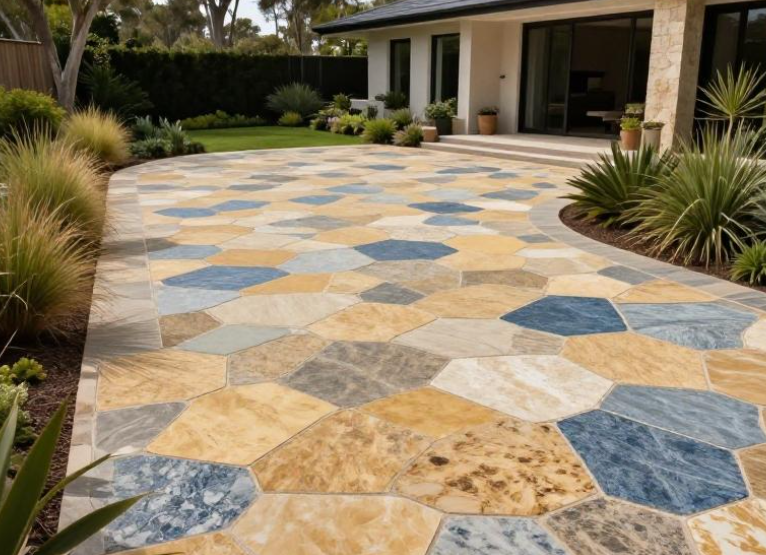
Short answer: crazy paving uses irregular pieces of natural stone fitted together like a puzzle. The most popular stones in Australia are bluestone, sandstone, travertine, quartzite and granite. What it costs depends on the stone, how thick it is, how complex the area is and whether it’s laid on a compacted base or on a concrete slab. Get itemised quotes rather than relying on a single price per square metre.
Once associated with 1970s backyards, crazy paving is back in high-end landscape design. Architects and landscape designers are using it to soften modern homes, frame pools and create paths that look as though they’ve always been there. Here’s what to know before choosing it for your own home.
Why crazy paving is popular again
- It looks organic. The irregular shapes blend with planting and suit relaxed coastal, Mediterranean and native gardens.
- It’s flexible. Irregular pieces wrap around curves, trees and pool edges more easily than square pavers, with fewer awkward cuts.
- It uses natural material. Each piece is unique, which gives a crafted, bespoke look that manufactured pavers can’t match.
- It suits luxury homes. Large, carefully fitted pieces with tight joints look refined rather than rustic.
- It ages well. Natural stone develops character over time, and a well-laid surface can last for decades.
Choosing the stone
| Stone | Character | Things to know |
|---|---|---|
| Bluestone | Blue-grey to charcoal, very hard | Classic in Melbourne; can get hot in full sun |
| Sandstone | Warm golds and creams | Softer and porous; seal it |
| Travertine | Soft creams and silvers | Cool underfoot; popular around pools |
| Quartzite | Shimmering, layered colours | Hard and dense, so it’s durable |
| Granite | Speckled, many colours | Very hard; good for high-traffic areas |
The right choice depends on the look of the house, the amount of sun and how the area will be used. Dark stones absorb heat. Light stones show dirt more easily but stay cooler. Harder stones such as quartzite and granite handle heavy use with less wear, while softer stones such as sandstone and travertine give a gentler, warmer look but need more care.
It also helps to think about the architecture. A contemporary home with clean lines and pale render often looks best with a light travertine or quartzite in large pieces. A period home with a heritage garden suits bluestone. A beach house or a garden full of natives tends to sit comfortably with sandstone.
What affects the cost
No two crazy paving jobs cost the same, which is why a single “per square metre” figure is rarely useful. These are the main factors:
- The stone. Prices vary widely between stone types and grades. Imported stones and premium colours generally cost more.
- Thickness. Thicker pieces suit driveways and dry-laid paths. Thinner pieces are usually laid on concrete.
- The base. Laying on a new concrete slab costs more than laying on a compacted crushed rock base, but gives a firmer result.
- Complexity. Curves, steps, pool edges and tight joints take longer to lay. Crazy paving is labour intensive because every piece has to be selected and fitted by hand.
- Access. If materials have to be carried by hand through a narrow side path, labour goes up.
- Grouting and sealing. Grouted joints and sealing add materials and time.
- Site preparation. Removing old paving, levelling the ground or improving drainage all add to the total.
The best approach is to measure the area, pick a stone, and ask several installers for itemised quotes that separate materials, base preparation, laying and sealing. That makes it far easier to compare like with like and to see where the money is going.
Laying methods
Dry-laid crazy paving sits on a compacted base of crushed rock and sand, with gaps filled with sand or gravel, or planted with ground cover. It drains naturally and suits garden paths and informal areas. It’s also easier to lift and relay if tree roots or services ever need attention.
Wet-laid crazy paving is bedded in mortar on a concrete slab, with grouted joints. It’s firmer and easier to clean, which suits alfresco areas, entertaining terraces and pool surrounds.
Think about water
Hard surfaces send more rainwater into drains. Dry-laid paving with permeable joints lets some water soak into the ground, which helps garden beds nearby. Some homeowners pair new paving with a raingarden to capture runoff from paths and roofs. Melbourne Water’s raingarden guide explains how they work and how to build one.
Whichever method you choose, make sure the paving falls away from the house so water doesn’t pool against walls or doors.
Design tips from the professionals
- Go big. Larger pieces with tighter joints look more refined and more contemporary.
- Mix sizes carefully. Avoid lots of small pieces clustered together, which can look busy.
- Lay it out first. Good installers dry-fit sections before fixing them, so the pattern looks balanced.
- Plan the edges. A straight border in matching stone frames the paving neatly, especially next to lawn or garden beds.
- Consider planted joints. Creeping thyme or dichondra between dry-laid stones softens the look and adds a little fragrance underfoot.
- Test colour when wet. Many stones darken considerably when wet, which changes the look around pools.
- Carry it through. Using the same stone on paths, steps and walls ties a garden together.
Safety when cutting stone
Natural stone contains crystalline silica, and cutting it produces dust that is harmful to breathe. Experienced installers use wet cutting and dust controls. If you’re planning a DIY project, it’s worth leaving the cutting to a professional.
Maintenance
Crazy paving is low-maintenance once it’s laid well. Sweep regularly, clean with a pH-neutral cleaner, and reseal porous stones such as sandstone and travertine as the sealer manufacturer recommends. On dry-laid paths, top up the joint material occasionally and pull out any weeds before they take hold. A gentle pressure clean once a year keeps the surface looking fresh, but avoid harsh chemicals that can mark the stone.
Where to see the stone
Natural stone varies so much that seeing it in person makes a real difference. In Victoria, RMS Traders stocks natural stone crazy paving in several stone types, which you can see at its showrooms in Hoppers Crossing, Richmond and Geelong. Trade accounts are available for landscapers and builders.
With the right stone, a solid base and a skilled installer, crazy paving can be one of the most beautiful and long-lasting surfaces in a luxury garden.