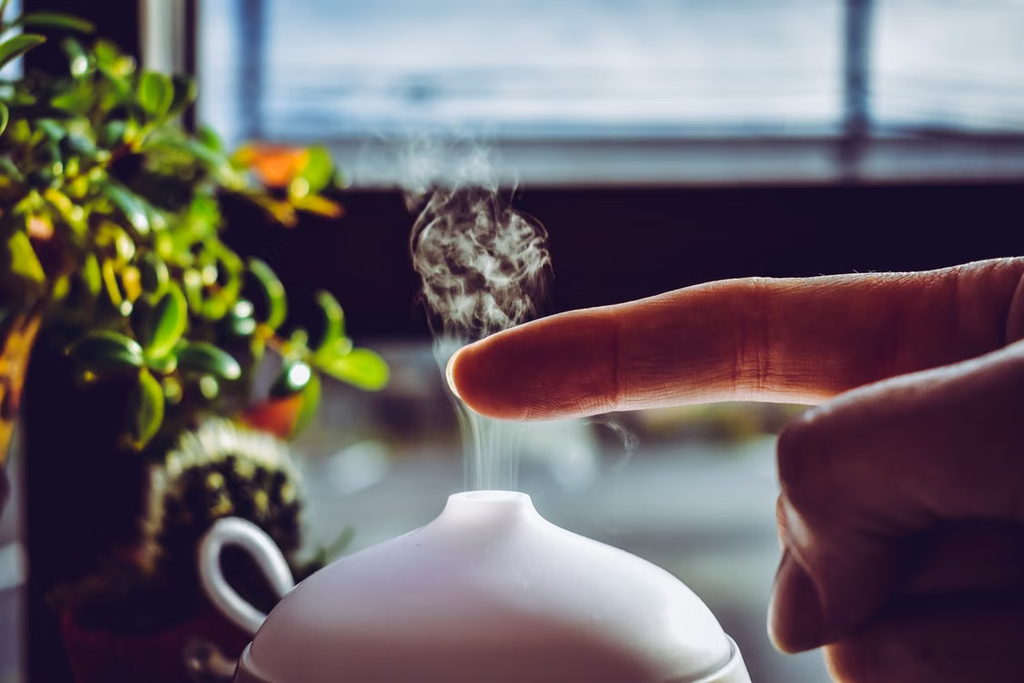
Furniture, lighting, soft furnishings, etc., all go into creating an attractive home environment – but as soon as there’s a scent in the air, it can immediately impact a person’s perception of a home.
Smart home fragrance diffusers allow the user to specify timing, intensity, and location of the fragrance in their home. This allows greater control over the experience compared to simply having an ever-burning candle or diffuser in situ.
What this article will cover:
- Smart fragrance & luxury home interiors
- Understanding smart fragrance diffuser technology
- Assigning fragrances to individual rooms
- Creating a schedule using an app-controlled smart diffuser
- Selecting your smart fragrance system
- Considering others’ wellbeing when using smart home fragrance
- Conclusion
Smart fragrance & luxury home interiors
Lighting, materials, acoustics, and more all come into play when creating a luxurious home interior. Fragrance is another subtle element that can add to that, despite being imperceptible to sight. Simply having a discreetly placed smart diffuser by your front door can alter how the home feels as you enter it.
More generally, consumers are keen to enhance their homes with fragrance – a report by Grand View Research estimated the global home fragrance market to be worth ~$24.2bn in 2025. However, this spans all types of products (e.g., candles, aerosols, diffusers), so it does not specifically quantify smart fragrance.
For interior designers and homeowners alike, there is scope to add complementary fragrance to various rooms of a property and tailor it to the décor and ambiance of each room. Ideally, this can be done in a seamless way, so the home is perfumed throughout without it being overpowering.
Understanding smart fragrance diffuser technology
Passive reed diffusers have no built-in switch to control when fragrance is emitted, and similarly many lower-tech electrical diffusers offer minimal user control. By connecting a diffuser to a smartphone, you can unlock further functionality to adjust your fragrance experience.
This can take the form of altering fragrance strength, setting timings/schedules and/or controlling a number of diffusers across your property – for instance, with Pura smart diffusers you can schedule usage via their app and increase/decrease the strength of the scent in one or multiple rooms.
However, app control doesn’t tell you where a diffuser sits or how scent reaches the room. Devices can plug into wall sockets, stand on furniture, or deliver fragrance through HVAC systems across a larger area. Each has its merits but are not directly comparable – it is therefore advisable to ascertain what you require before looking into different products and features.
Assigning fragrances to individual rooms
Although it could be possible to apply the same fragrance to the whole home, you may want to vary it to reflect the purpose of each room:
- Front door/hallway: Fresh/light scents such as citrus would work well here, but avoid anything too potent
- Lounge/living room: Relaxed aromas (woody, tea, light floral…) can complement the relaxing ambience
- Office/study: Consider something herbal/sharp to designate the space as “work”
- Bedroom: Minimal/no fragrance if the aim is to promote rest
This is only a rough starting point of course, and people will have varying likes/dislikes of certain fragrance notes. However, it can aid selection of refills if you plan on having multiple in your home.
It’s also worth considering how the fragrance will diffuse between rooms, depending on whether your home has open-plan or enclosed areas, and how your chosen fragrances will interact if adjacent rooms are each emitting. You may find that you can get away with just one smart diffuser in certain instances to cover 2 rooms.
Creating a schedule using an app-controlled smart diffuser
Using a smart diffuser’s scheduling function allows you to customise when fragrance is released, to coincide with usage of the relevant room(s). Depending on your day-to-day lifestyle this may include:
- Early morning – emit fragrance in your hallway/entrance prior to beginning your daily routine
- Mid-day – have the smart diffuser in the lounge/other living room off
- Prior to expecting guests – program a period of fragrance release and assess its effect once the timer is complete
- Night-time – conclude any remaining timed periods of operation
You can obviously refine this further to suit you, but it can be useful to know how your typical day plays out and align the device schedule accordingly.
As with any scent, it is advisable not to continue increasing the strength, as you may gradually become less aware of a particular fragrance over time – although this won’t be as marked for guests/newcomers to the space. Should you feel that it’s fading, simply step away and re-evaluate after a break before turning the strength up. Aim to use the schedule to enhance your experience, not create a constantly fragranced environment.
Selecting your smart fragrance system
As mentioned above, you need to ensure that the smart diffuser is suited to your space, and not just aesthetically pleasing! Look at the maximum square footage that the manufacturer recommends per diffuser, and then consider variables in your room such as number of openings, height, etc.
Once you have narrowed down potential products, think about practical considerations: does it require a mains supply, or will it be freestanding on furniture? Do you need/want a fixed installation? These will all dictate where it can go, and in turn how prominent the fragrance source will be in the room and its proximity to users. Take care to adhere to guidance around placement of the diffuser relative to dining areas, seating, etc., and factor in refill logistics/pricing into your decision-making.
Also test out the app functionality that will be most relevant to you (quick on/off? Easy identification of each diffuser? Etc.), to ensure ease of use by any users. If fitting out a larger property, it may be beneficial to start with a single room and scale up once you are familiar with the required settings/operation.
Considering others’ wellbeing when using smart home fragrance
Of course, you want to ensure the home smells pleasant, but fragrance shouldn’t be used to mask poor-quality indoor air (dampness, cooking, etc.). The US EPA highlights that certain air freshening products can exacerbate particulate matter levels indoors. Likewise, the American Lung Association cautions that these can induce adverse reactions in some individuals (asthma, hay fever, chemical sensitivities…), and so it’s equally important to be able to turn off your smart fragrance diffuser(s).
You can mitigate some of the risks by:
- identifying and treating the source of any odor you wish to mask
- ensuring adequate ventilation of your home, and following the guidance from your chosen product
- speaking with other occupants/regular visitors of your home to ascertain if there are any fragrance considerations/preferences
- ensuring that there is a simple method of switching the smart diffuser off for sensitive guests
Again, children’s bedrooms/areas of occupancy and those who may be susceptible to fragrance-related health effects should be prioritized, and perhaps left free of any artificial scent altogether.
Smart home fragrance controls can enable a more bespoke experience in the home, but are not a panacea for poor air quality or disregard of other residents.
Conclusion
When deployed appropriately, smart fragrance diffusers can elevate the sensory appeal of a home. Curated scents in each room (that pair well with neighboring areas), a considered schedule, suitable hardware for the space, and an off-switch are good practices when implementing this in your property.
This leaves you with a more refined interior where scent is another aspect of the overall design scheme.