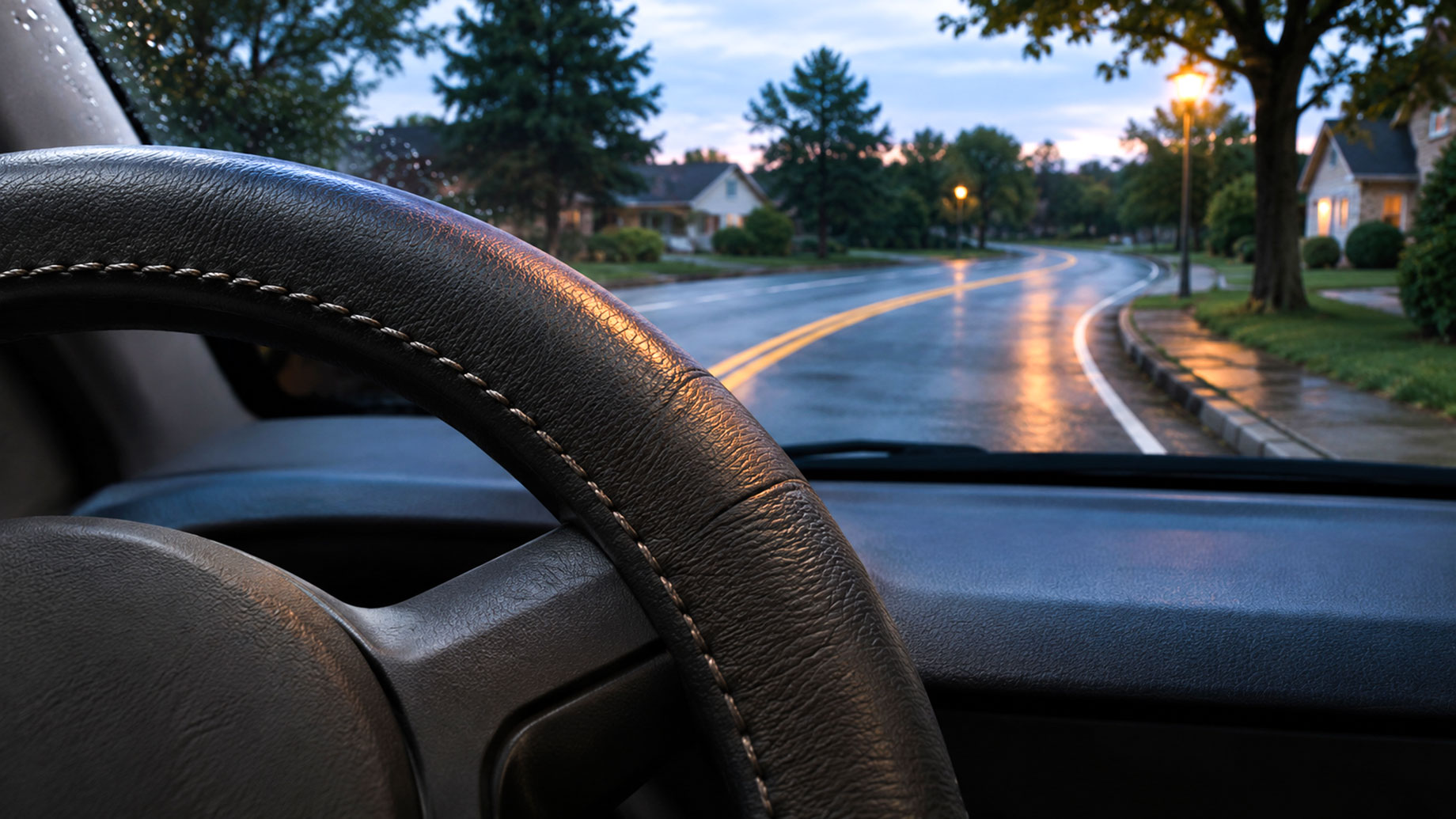
A National Institutes of Health study that instrumented cars with cameras and sensors found teenage drivers were eight times more likely to be involved in a crash or near miss in the first three months after licensure than in the previous three months on a learner’s permit. The permit period wasn’t the danger zone. The independence that followed it was.
This is worth understanding before a new driver in your family, or one you teach, gets on the road alone. The first two years behind the wheel don’t look like a smooth ramp from cautious to competent. They look like a cliff, and then a long, uneven climb back up.
The Learning Curve Is Shaped Like a Cliff
New drivers don’t gradually get better at avoiding crashes. They start with a crash rate that is dramatically higher than it will ever be again, and it drops fast in the first few hundred miles of solo driving. Research summarized by the National Academies traced this shape in detail and found the highest crash rates in the earliest miles of independent driving, falling sharply over the first several thousand miles before flattening out.
The crashes themselves also look different from what experienced drivers have. New drivers are more likely to run off the road on a curve, misjudge a gap at an intersection, or fail to slow for stopped traffic ahead. They’re less likely to be drunk, and more likely to be overwhelmed by information they haven’t yet learned to filter.
- Failure to reduce speed. The driver enters a curve or a slowdown carrying more speed than the situation allows, and can’t scrub it off in time.
- Inattention. Eyes leave the road for a phone, a passenger, or the radio, and the vehicle drifts before the driver looks back up.
- Failure to yield. The driver misreads who has the right of way and pulls into a gap that isn’t there.
More Practice Hours Won’t Close the Gap on Their Own
The intuitive answer is to log more supervised hours before licensure. Practice more, crash less. Most graduated licensing programs already require a set number of supervised hours for exactly this reason, and those hours do help.
The trouble is that supervised practice and solo driving are different tasks. With a parent in the passenger seat, someone else is scanning for hazards, calling out mistakes, and absorbing part of the cognitive load. The teen is steering the car, but they aren’t carrying the whole job.
The moment the license arrives and the supervisor gets out, that shared workload lands on one person who has rarely carried it alone. Hours don’t transfer cleanly. Passengers show up, night trips show up, and routes get longer and less familiar.
Video analysis of teen crashes has repeatedly shown that peer passengers are a major source of driver distraction, and the risk multiplies at night. More daylight hours behind the wheel with a parent don’t prepare a driver for a car full of friends at 10 p.m.
Structure the First Two Years, Don’t Just Fill Them
The interventions with the strongest track records don’t try to make new drivers experienced faster. They accept that inexperience is the underlying condition and reduce exposure to the situations where inexperience gets people killed. That’s the logic behind graduated driver licensing, and the state-by-state GDL provisions tracked by the Insurance Institute for Highway Safety show how widely the specifics vary.
- Passenger limits. Restricting non-family passengers during the first year of solo driving takes one of the largest distraction risks off the table.
- Night restrictions. Late-night driving carries higher crash risk for every age group, and disproportionately so for newly licensed drivers.
- A phone that can’t reach the driver. Do-not-disturb settings, or putting the phone in the trunk, remove the decision during the months when it’s hardest to make well.
- Gradual route expansion. Start with familiar routes in daylight on dry roads, and add unfamiliar routes, dusk driving, and rain one variable at a time.
None of this replaces practice. It’s a way to make sure the practice happens under conditions where a mistake is more likely to be a scare than a hospital stay. A family rule about passengers or curfews carries weight that a statute doesn’t.
A Crash Is Its Own Problem, With Its Own Rules
Even with every guardrail in place, some crashes will happen. Document the scene, get medical evaluation even for injuries that seem minor, keep records of everything, and don’t give a recorded statement to the other driver’s insurer before you understand what you’re agreeing to.
For serious injuries, talking to an experienced car accident attorney early is often the difference between a claim that reflects what happened and one that gets shaped by the other side’s version first. The first two years behind the wheel set the pattern for the next fifty. Handling them as their own phase, with their own rules, is what closes the gap between a new license and a safe driver.
