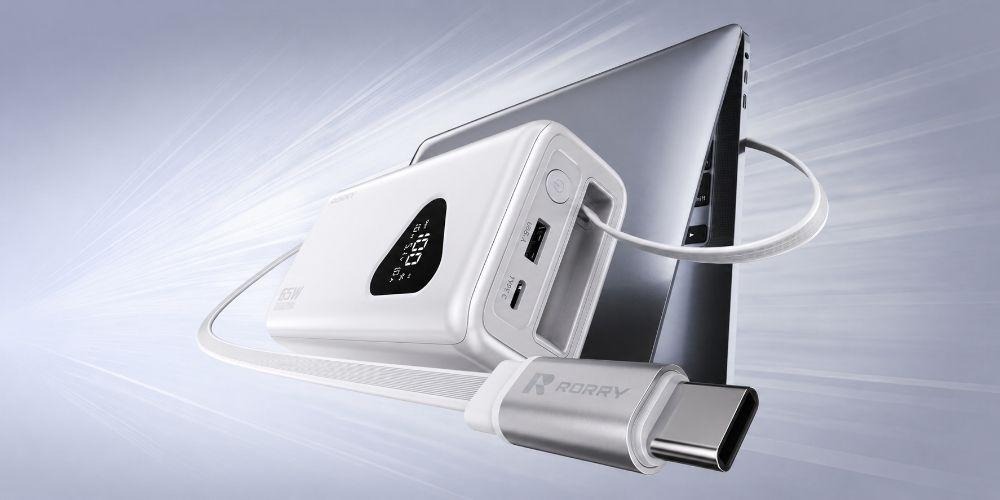
Choose 10,000mAh for lighter everyday carry and one main device. Choose 20,000mAh for longer trips, several devices, or more time away from an outlet. Capacity matters, but output wattage, ports, recharge speed, and weight decide which power bank will work better in daily use.
What Do mAh and Wh Mean on a Power Bank?
Milliamp-hours, or mAh, describe the battery’s charge capacity. When two power banks use cells with a similar nominal voltage, a 20,000mAh model stores roughly twice as much charge as a 10,000mAh model. That does not mean it charges twice as fast, because speed is measured in watts rather than mAh.
Watt-hours, or Wh, describe stored energy and are especially useful for air travel. A typical 10,000mAh battery is around 37Wh, while a 20,000mAh battery is commonly around 74Wh to 77Wh. When comparing a USB-C power bank, check the printed Wh rating as well as capacity, output, and supported charging standards.
The number printed on the case is rated cell capacity, not the exact amount that reaches your phone. Voltage conversion, the cable, heat, background phone use, and the device’s charging circuit all consume some energy. Wireless charging usually loses more energy than a direct wired connection, so exact charge counts should always be treated as estimates.
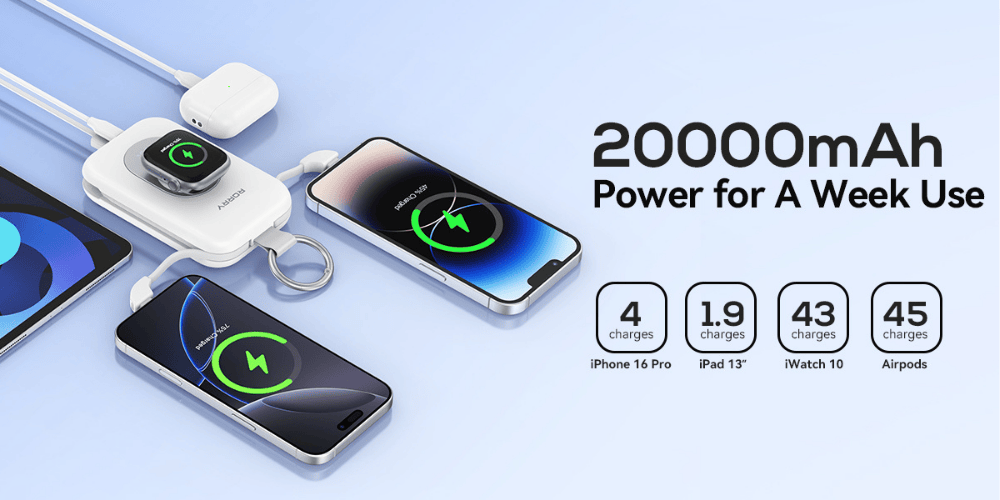
How Do 10,000mAh and 20,000mAh Power Banks Compare?
The practical difference is not simply twice the battery. A larger pack gives you a wider safety margin, but it also takes up more space and usually needs longer to recharge when both models use the same input power.
| Factor | 10,000mAh | 20,000mAh |
| Best for | Daily carry and short trips | Travel, multiple devices, and heavier use |
| Typical phone use | About 1-2 full charges | About 3-4 full charges |
| Portability | Usually pocket-friendly | Better suited to a bag or backpack |
| Power-bank recharge | Usually faster at equal input wattage | Usually longer at equal input wattage |
| Laptop use | Possible when output meets the laptop’s needs | More reserve energy, but sufficient USB-C PD output is still required |
| Air-travel category | Normally below 100Wh | Normally below 100Wh |
| Main tradeoff | Less reserve capacity | More weight and bulk |
Capacity and Portability
A 10,000mAh model is usually easier to keep in a pocket, handbag, or small everyday bag. It works well when you can recharge the power bank at night and mainly need to rescue a phone before the end of the day.
A 20,000mAh model is heavier, but it reduces how often you need to find an outlet. It makes more sense for a weekend trip, a long workday with several devices, mobile gaming, photography, or a household emergency kit.
Recharge Time and Cost
With the same input wattage, the 20,000mAh pack generally takes longer to refill because it stores more energy. A high-capacity model with 30W or 45W input may still recharge faster than an older 10,000mAh model limited to a weak input, so compare input specifications instead of capacity alone.
The larger battery often costs more, but value depends on whether you use the extra capacity. Paying for 20,000mAh makes sense if it prevents repeated recharging or replaces a second battery pack. If it stays at home because it feels too heavy, a smaller model offers better practical value.
How Many Charges Can You Expect?
A 10,000mAh power bank commonly provides around one to two full charges for a modern smartphone. A 20,000mAh model commonly provides around three to four. Phones with smaller batteries may receive more, while large-screen phones, intensive background use, and wireless charging reduce the result.
For tablets and handheld consoles, 10,000mAh is better viewed as a substantial top-up rather than several complete charges. A 20,000mAh pack provides a more useful reserve for these devices, but a laptop also needs the correct USB-C Power Delivery wattage and cable. Capacity alone cannot make an incompatible or underpowered port charge a computer properly.
Does Higher Capacity Mean Faster Charging?
No. A 20,000mAh power bank is not automatically faster than a 10,000mAh model. Charging speed depends on output wattage, the USB-C PD or other protocol supported by both devices, the cable rating, and the maximum input your phone, tablet, or laptop will accept.
For phones, 20W to 30W covers many common fast-charging needs. Tablets and handheld consoles often benefit from 30W to 45W, while many USB-C laptops need 45W, 65W, or more. A high-output power bank can safely serve a lower-power device when both follow compatible charging standards because the device requests the power it can accept.
Also check total output when several ports are active. A model advertised at 45W may provide that maximum through one USB-C connection but divide power when a phone, watch, and earbuds charge together. If speed matters, read the single-port and multi-port ratings separately.
Which Capacity Fits Your Routine?
Everyday Carry
Choose 10,000mAh if you commute, spend a day away from an outlet, or mainly charge one phone and a few small accessories. It gives most people enough reserve without turning a pocket-size backup into an item they leave behind.
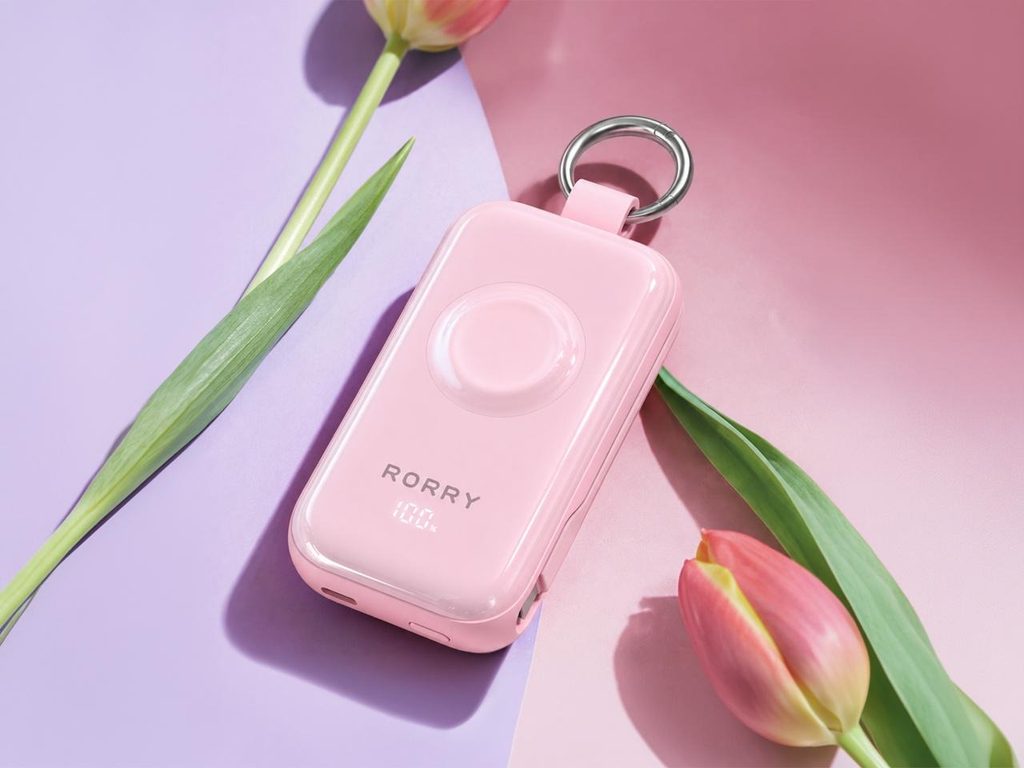
For Apple users who also carry a Watch, the RORRY CharmGo D4 10000mAh Power Bank 45W combines 45W USB-C output, a 5W Apple Watch charging surface, and a digital battery display in a 222g body. It is a useful example of why built-in functions can matter as much as capacity: one device can replace a separate watch charger.
Travel and Multiple Devices
Choose 20,000mAh if you expect two or more days between outlets, charge several devices, share power, or need more reserve for a tablet or compatible laptop. It is also the safer choice for navigation-heavy travel, mobile work, gaming, or events where the phone stays active all day.
The RORRY T2 20000mAh Power Bank 45W stores 77Wh, supports 45W bidirectional USB-C charging, and can charge up to three devices through its built-in USB-C cable, USB-C port, and USB-A port. Its 334.5g weight is noticeably higher than the D4’s, but the extra capacity is better suited to multi-day travel and larger devices.
Can You Take Both Sizes on a Plane?
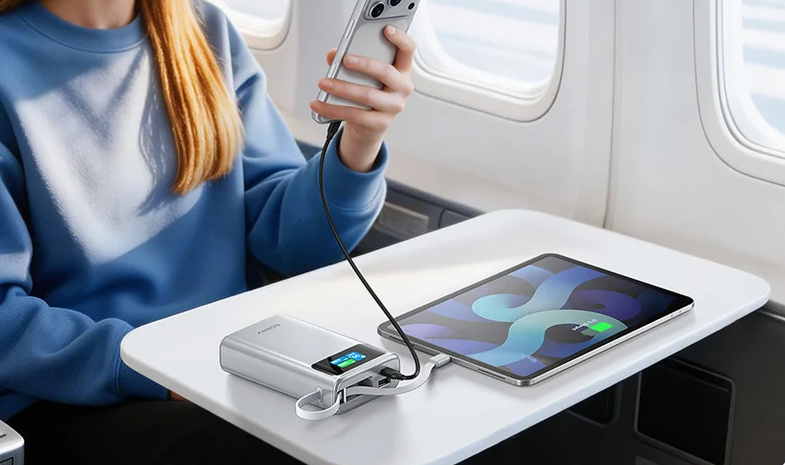
In the United States, FAA rules allow rechargeable batteries rated from 0Wh to 100Wh on passenger aircraft without airline approval. Power banks count as spare lithium batteries, so they must stay in carry-on baggage and cannot go in checked luggage. A typical 10,000mAh or 20,000mAh power bank falls below 100Wh, but always read the Wh label instead of relying only on mAh.
Airlines and other countries may apply stricter limits on quantity, use during the flight, or how a power bank must be stored. Protect the ports from short circuits, do not travel with a swollen or damaged battery, and check the operating airline’s current policy before departure.
Frequently Asked Questions
Should I Buy a 10,000mAh or 20,000mAh Power Bank?
Buy 10,000mAh if you want a lighter charger for daily phone use and short trips. Choose 20,000mAh if you spend longer away from outlets, charge several devices, or need more reserve for a tablet or compatible USB-C laptop.
Is a 20,000mAh Power Bank Overkill?
It can be overkill if you only need one emergency phone charge and prefer a charger that fits easily in a pocket. It is worthwhile for multi-day travel, heavy phone use, several devices, or situations where outlets are difficult to find.
How Long Will a 10,000mAh Power Bank Last?
For many users, it provides one to two full smartphone charges and can cover a normal day or short trip. The actual result depends on phone battery size, charging efficiency, connection type, temperature, and whether the phone is used while charging.
How Many Times Can a 20,000mAh Power Bank Charge My Phone?
A 20,000mAh power bank commonly provides about three to four full charges for a modern smartphone. Phones with smaller batteries may receive more, while large batteries, wireless charging, heat, and energy conversion losses reduce the total.
What Power Banks Are Not Allowed by TSA?
Power banks above 160Wh are not allowed on passenger aircraft, and units rated from 101Wh to 160Wh require airline approval under U.S. rules. Damaged, swollen, or recalled batteries should not be carried, and every permitted power bank must remain in carry-on baggage rather than checked luggage.
Conclusion
For most daily routines, 10,000mAh offers the better balance of useful capacity and portability. Move up to 20,000mAh when you travel longer, charge several devices, or need a larger reserve for a tablet or compatible laptop. Whichever size you choose, check output wattage, input speed, ports, cable requirements, and the printed Wh rating instead of judging the power bank by capacity alone.