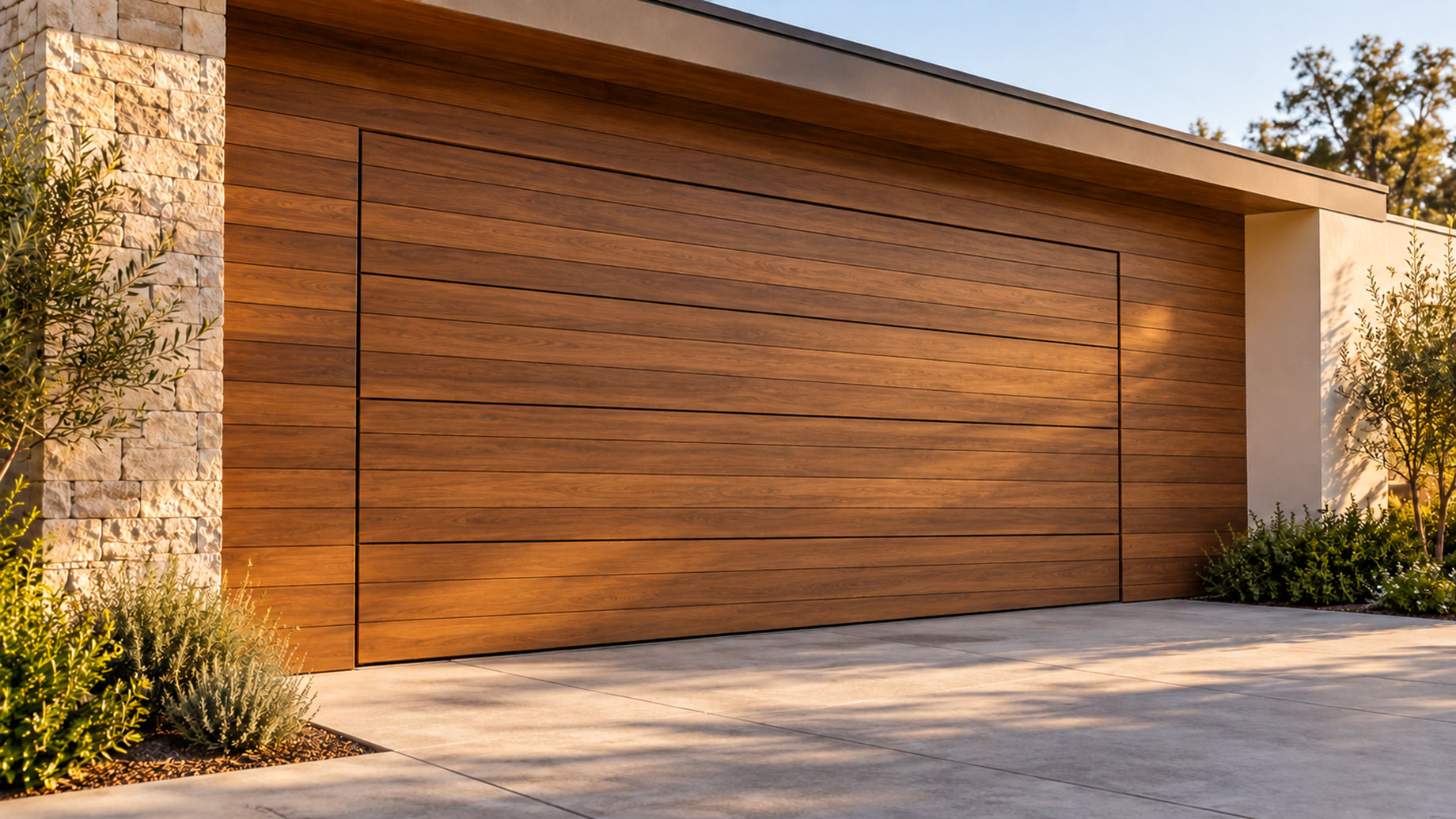
Walk through a well-made house and notice what you don’t notice. No visible fixings on the cabinetry. Hinges tucked into the joinery. Lighting that seems to come from nowhere. The best interiors tend to hide their machinery, and the same instinct is now working its way outdoors, to the largest moving part of the house: the garage door.
Here is the rule worth knowing before you start. The more a piece of hardware is meant to disappear, the earlier it has to be planned. Nothing on a garage door actually vanishes. The track, the springs, the cables and the motor are all still there. What changes is where they sit, how they are detailed, and whether anyone thought about them before the walls were clad.
What “concealed” really means
A sectional garage door needs a few basic things to work. It needs a track to guide it, a counterbalance system to carry its weight, and an operator to move it. The industry body DASMA describes the counterbalance as a force roughly equal to the weight of the door, which is why a well-balanced door can be lifted by hand without much effort.
Concealing that hardware is therefore a design question, not a removal one. Where do the springs go? Does the operator hang from the ceiling or sit on the wall? Are the tracks left visible or set into the framing? Each answer changes how the garage looks from the street and how it feels from inside.
Getting the motor off the ceiling
The most common way to clear the ceiling is a wall-mounted, or jackshaft, operator. Rather than pulling the door along a rail, it sits on the wall beside the door and turns the torsion shaft, letting the spring system raise and lower the door. Installers and retailers point to the same benefits: with no rail and no hanging motor, the ceiling stays free for lighting, storage, a vehicle lift or a finished surface, and many owners find the setup quieter. One retailer is careful to add that noise also depends on the condition of the door, the rollers, the springs and the quality of the installation, which is a fair reminder that a quiet motor cannot make up for a poorly set-up door.
There are limits. These operators generally need a torsion spring system and enough clear wall beside the door for installation and servicing, and not every garage can offer both. Where the ceiling isn’t a concern, a conventional ceiling-mounted opener can be the simpler and cheaper choice. Hiding hardware is worth doing when the space gives you a reason to.
Weight changes everything
Here is where high-end homes differ from the standard catalogue. A door that carries real cladding is a heavy door, and heavy doors are less forgiving.
Installers note that heavy wood doors can strain smaller wall-mounted motors, so the operator has to be chosen for the door, not the other way around. DASMA’s technical guidance goes further. It says the operator is there as a convenience and to absorb minor imperfections in balance, but it should never be doing the heavy lifting. Weight differences between sections, from glazing for example, and larger door sizes make an imbalance more noticeable. The association’s own rule of thumb is blunt: if it takes two people to lift an 18-by-10-foot door by hand, something is seriously, and perhaps dangerously, wrong.
For a design-led home the lesson is useful. A concealed operator on a badly balanced door doesn’t solve a problem. It hides one.
Taking the idea all the way
The fullest version of this thinking is luxury flush-mount garage doors. In these systems, as specialist suppliers describe them, the door is built to accept the same siding as the rest of the house, whether wood, composite or metal, and the track is recessed into the framing, so nothing mechanical shows from outside. Closed, the elevation can read as one continuous wall, with the door no longer standing apart from the architecture around it.
It is worth being clear about what makes that possible. The door is heavier, since it carries the cladding. The framing has to be set up for it. The springs, track and operator have to be matched to the finished weight, and the cladding team and the door supplier need to be talking before anything is ordered. Suppliers in this field describe reviewing structural drawings and coordinating with siding teams before procurement for exactly this reason. Concealment of this kind is a decision made in the drawings, not a finish applied at the end.
Hidden is not the same as maintenance-free
There is a quieter point that tends to get lost in the pursuit of a clean facade. Springs and cables are under tension, and DASMA recommends annual inspection and maintenance by a trained door systems technician. A flush, seamless design is only a good idea if a technician can still reach what they need to reach.
So the planning question has two halves. How will this be hidden, and how will it be serviced? Clear wall beside the door, an accessible operator position and a note in the handover file are small things on a drawing. They are much harder to add later.
The rule, in practice
If you take one thing from all this, take the order of operations. Decide the door type, its approximate weight, the spring system, the operator position and the service access while the elevation is still being drawn, and certainly before the cladding is specified. Do that and the hardware can disappear without any drama. Leave it until the end and you are likely to be choosing between a visible compromise and an expensive rework.
The best-hidden hardware in a house is almost always the hardware that was thought about first.
